

Scientists Discovered These Fish May Communicate By Farting
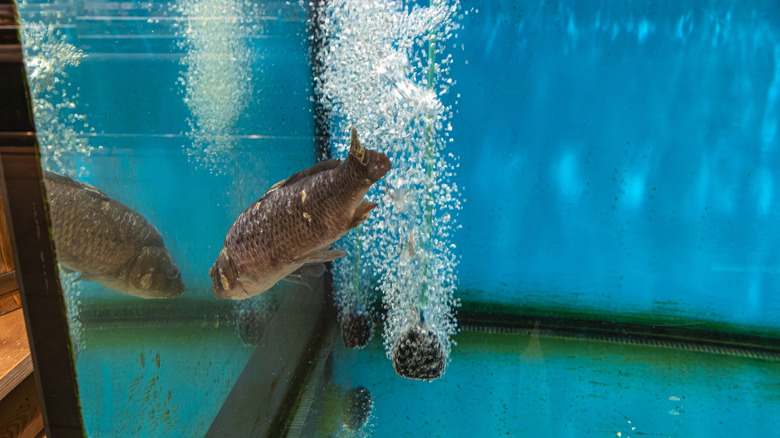
Many sea creatures are known for their distinctive sounds that scientists believe to be forms of communication between the animals. Dolphins click and whistle, whales "sing," and it seems herring also have a slightly unorthodox way of communicating — farting. While it may be undignified in humans, research suggests that herring may use the bodily function to chat to each other, especially when the lights are out.
The discovery came about when scientists noticed that bubbles were escaping the rear ends of herring that were in captivity, particularly after dark. They decided to monitor the fish's farting behavior more closely (as you do), kitting the room out with infrared lighting and microphones to pick up sounds traveling through the water. "We heard these rasping noises, which sound like high pitched raspberries, only ever at night, whenever we saw tiny gas bubbles coming from the herrings' bottoms," said Bob Batty, one of the three researchers involved.
In a 2004 study published in Proceedings of the Royal Society B: Biological Sciences, the noises created by the herring are referred to as Fast Repetitive Tick sounds. The resulting acronym, FRT, looks suspiciously like fart with a vowel missing. Their findings won them an Ig Nobel Prize, an award given out each year to "achievements so surprising that they make people LAUGH, then THINK." There is serious science behind the study, however, because while it was previously known that herring could produce bubbles of gas as a defense mechanism, these episodes of farting occurred when there was no apparent threat.
Where the herring's fart actually comes from
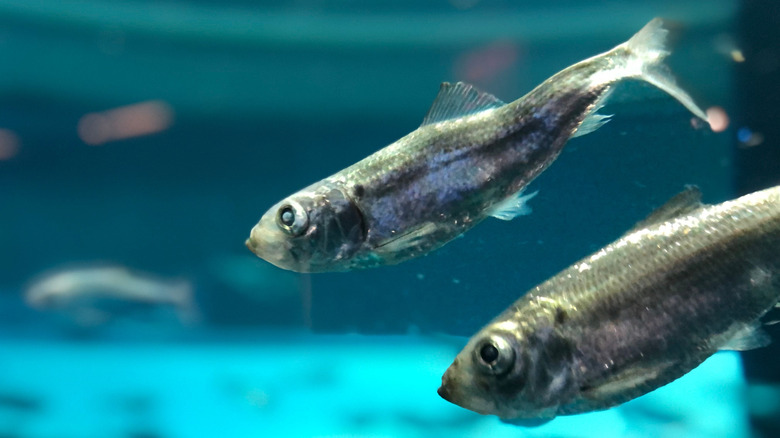
One important distinction from the study is that the herring are not actually farting in the way that humans do. Rather than their raspberry-like sounds being the results of a meal eaten too quickly, researchers concluded that the sounds were unconnected to food, since fish that hadn't eaten also produced FRTs. Instead, the sounds are likely coming from the swim bladder, through the rear waste duct. The swim bladder is not a characteristic shared by all fish, but is used by most bony fish to aid with buoyancy, and in herring, it is connected to the anus.
To determine whether the gas was coming from air gulped from the surface and expelled directly, the researchers set up two tanks. In one, a screen was placed below the surface of the water, to prevent the herring from accessing surface air. In the other, the screen was above the water, allowing them to gulp air freely. The results from the first evening showed similar results from both tanks, suggesting that recent access to surface air is not required for gas to be released from the swim bladder.
However, the results from the subsequent two evenings gave greater insight into the role that surface air plays. In the tanks without access to air, the number of FRTs recorded dropped dramatically, while in the other tank they remained consistent. The results supported the idea that the FRTs are created by air that has been previously gulped from the surface then stored in the swim bladder, rather than needing immediate access to it.
Herring seem to enjoy farting in company
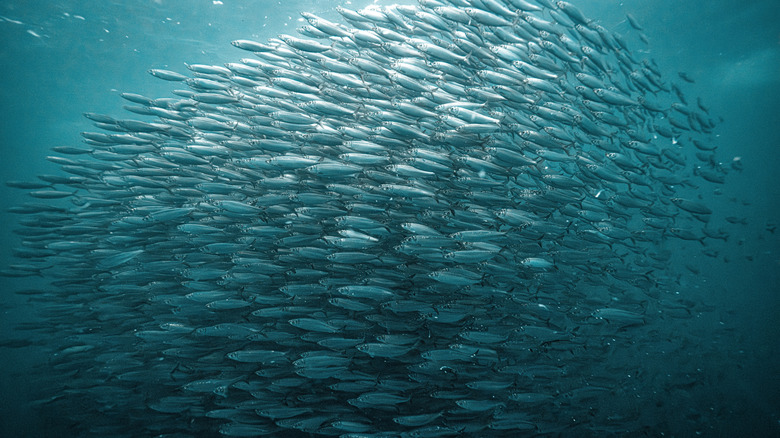
To ascertain whether the herring were using their farting as communication, the researchers compared a lone herring in a tank with groups of 5, 10, and 30. The solitary fish produced no FRTs, while the fish in the larger sets created increasingly more noise as the group size increased. Interestingly, the increase was not proportional, meaning that the greater number of FRTs was not only down to the higher number of fish in the tank, but the number of sounds per fish increased too.
This suggests that the more fish there are in the tank, the more inclined each individual herring was to release gas, leading the researchers to propose that the bubbles could be a form of communication. The sonic frequency of the farts was of interest too, falling above the range of hearing of most of their fishy predators. Their high-pitched flatulence could be a clever way to communicate with the rest of the school without alerting predators.
The timing of the farting was also crucial, with the vast majority of the flatulence taking place in the dark. This is likely because in the light of day, herring can communicate to other fish in the shoal using visual cues to keep everyone tightly organized and as safe as possible. After dark, that ability becomes less useful, so chatting through farts is clearly a better option. It seems that while we humans consider farting in company to be socially unacceptable, herring seem to use it to keep in contact with their friends after dark.