

In The '60s, A Woman Lived In A Flooded House With A Dolphin. Here's Why
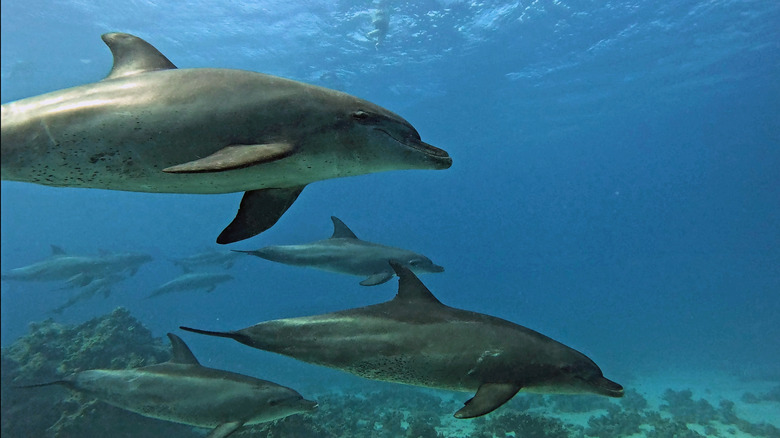
Ask someone to list the top five most intelligent animals on Earth, and chances are dolphins will almost always make the cut. However, our modern appreciation of the intelligence of these marine mammals wasn't always the case. Until the 1950s, many people considered dolphins to be a pest and weren't interested in whether they could be intelligent or communicate with each other or with humans. But during the 1960s, one researcher carried out unorthodox experiments with dolphins. One of these involved a woman living in a flooded house with a dolphin to try teaching it to speak English.
Margaret Howe Lovatt was living on St. Thomas in the U.S. Virgin Islands when in 1963 she heard about a laboratory doing research with dolphins on the island. A lifelong animal lover, Lovatt was immediately interested despite not having any scientific training. However, she did have enthusiasm and the ability to closely observe animal behavior. In early 1964, she began working at Dolphin House, a research facility on St. Thomas opened by American neuroscientist named John Lilly with the help of funding from NASA and other government agencies. Astronomers at the time were becoming interested in how humans and extraterrestrial life might be able to communicate, and with their intelligence and potential for complex communication dolphins were a natural choice for study.
Teaching a dolphin how to talk
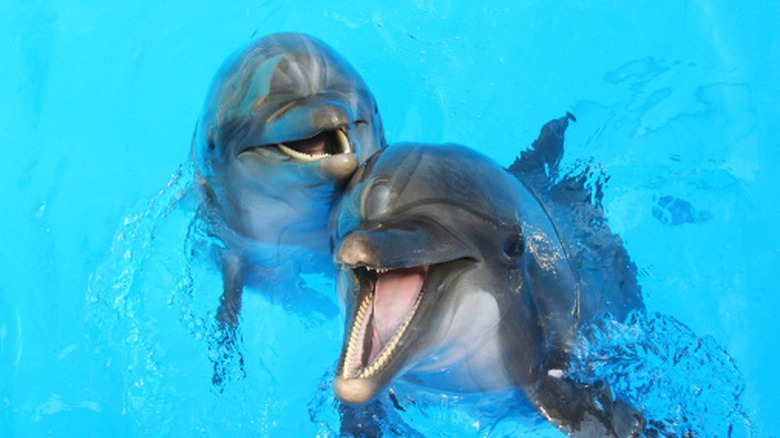
Lilly first became interested in dolphins and whales after encountering a beached pilot whale in 1949 and spent years learning about dolphin intelligence and communication. Lilly even thought that it might be possible for humans and dolphins to communicate with one another. Dolphins communicate using different clicks and whistles. They can accurately mimic a variety of sounds and frequently learn the calls of other dolphins. They have sounds they use during social situations, when happy or frightened, or when trying to find fellow dolphins.
It was this ability to accurately mimic sounds that Lilly initially found most interesting. His thought was that if dolphins could accurately reproduce the calls of other dolphins, maybe they could mimic human speech. Dolphin House had a pool that was home to three dolphins. Lilly studied dolphins by mapping their brains with electrodes and worked with two older female dolphins, exposing them to sounds of human speech.
However, the real breakthrough came when Lovatt arrived and soon after came up with the idea of flooding the building with a couple of feet of ocean water. This allowed Lovatt to live full-time at Dolphin House with a single male dolphin named Peter. After weeks of daily lessons, like teaching children a new language, Peter was able to mimic human speech to some degree
The fall of the house of dolphins

Lovatt became closely connected to Peter, who could eventually mimic human sounds; however, the research at Dolphin House did not achieve the lofty goal of interspecies communication. Soon after Lovatt moved into Dolphin House Lilly also started testing drugs like LSD on dolphins. The drugs had no notable effect on the dolphins but Lovatt was insistent that Peter not be given them.
At the same time living full-time with a dolphin proved to be challenging. Young male dolphins have a strong urge to mate since dolphins are one of only a handful of species that mate for more than just reproduction. These urges disrupted lessons and ultimately were one of the factors contributing to the end of the research and a loss of funding for the project. Additionally, Lilly had largely lost interest in dolphin speech research. Dolphin House closed soon after Lovatt's project and the three dolphins were shipped to another lab in Miami. Conditions at that lab were poor and Peter died a few weeks after being moved.
Lovatt stayed on St. Thomas after the project ended. She later bought the house known as Dolphin House and raised her family there. The work she did with Peter also helped inspire researchers like those with the Dolphin Communication Project, who are studying dolphin communication today. Despite having no formal scientific training, Lovatt made a big impact on research.