

The Difference Between Innie And Outie Bellybuttons Is Easily Explained By Science

Chances are, with the exception of occasional belly button lint, the most details you've thought about belly buttons involve their shape. In fact, while some people have what's largely considered as an "outie" belly button (navel), most have the ubiquitous "innie." The precise shape of your own belly button is highly individual, but you might rightly wonder why these variations exist to begin with. There is, in fact, a pretty straightforward scientific explanation behind why most people get innies versus outies. While the majority of these variations are attributed to umbilical cord detachment after birth, there are also certain medical conditions that can create outies, too.
Formally known as the umbilicus, this round entity is the spot where the umbilical cord was originally attached while in the womb. During fetal development, the umbilical cord provides essential functions, such as delivering nutrients and oxygen to an unborn baby from the placenta. Immediately after birth, the cord is cut, though a small piece called an umbilical stump is still attached to the lower abdomen. According to the National Institute of Child Health and Human Development, this cord remnant falls off within an average of 10 days, leaving behind a newly formed belly button.
Once the cord stump does fall off, your permanent belly button emerges. The result might be a more concave shape, or an "innie." On the flipside, an "outie" has a slight protrusion. These aren't the only anatomical differences, though. Some belly buttons might have hoods, while others do not. Others still might have wider or narrower shapes, and some may even be more oval than round. All of these belly button differences are created by chance, and are attributed to the precise indentation that the umbilical cord left on your stomach.
Medical issues that can impact belly button shape

Before the umbilical stump naturally falls off, it is the role of the caregiver to keep the area dry and clean to prevent complications such as infection. Other types of complications can arise shortly after birth, though, including an umbilical hernia or granuloma. These can both lead to an outie belly button shape.
First, an umbilical hernia occurs when parts of the small intestine creates a sac that pushes through your belly button area due to weakened abdominal muscles. This condition mostly affects newborns, but it occasionally affects adults, too, and umbilical hernias are thought to be about three times more common in females. Possible causes and other risk factors in adults include those that can weaken the abdominal wall, such as a history of abdominal surgery, multiple births, fluid around the abdomen, or obesity. An umbilical granuloma, on the other hand, refers to a small lump of excess tissue that forms around the belly button once the umbilical stump falls off. A granuloma requires treatment to help prevent infection, but it heals quicker than an umbilical hernia in newborns.
During adulthood, it's possible for some people to develop outies after being born with innies. Aside from umbilical hernias, other conditions can impact the abdominal area and push against the belly button to change its appearance. These include fluid buildup (ascites), an enlargement of both the liver and spleen (hepatosplenomegaly), or pregnancy. However, it's important to note that these changes are only temporary. After pregnancy or treatment for the underlying medical issue, your belly button should return to an innie like it was before.
Common misconceptions about belly button formation
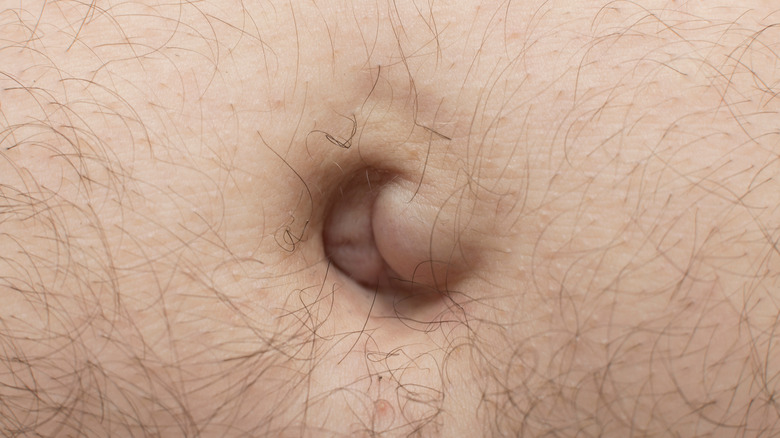
Despite the straightforward nature of belly button formation, there are unfortunately some myths and misconceptions surrounding this process. First, there is nothing wrong with any of the belly button variations you're born with. However, some people choose to undergo surgery to change the shapes and sizes of their own belly buttons (or even remove them altogether). Also known as an umbilocoplasty, it's important to know this is largely a cosmetic procedure, and not usually a medically necessary one outside of treating umbilical hernias during infancy or frequent naval infections in adults. (To the latter point, the belly button is an unexpected body part that can "leak").
It's also a misconception that a doctor or midwife creates the shape of your belly button upon delivery. While a medical professional does cut the umbilical cord, it is the section that's attached to your abdomen that in fact creates your navel. The belly button is not technically a scar from the cutting process, but is instead a scar tissue-containing indentation from the former umbilical cord. Also, it's even possible for some people to not develop a belly button altogether. While rare, this can happen when there are medical issues at birth that prevent the characteristic indentation in the abdomen. Finally, the area doesn't just sit there and exist, as scientists have even identified several types of bacteria that live in your belly button.