

Not Strength, Not Stamina: Scientists Say This Skill Is A Quiet Indicator Of Healthy Aging
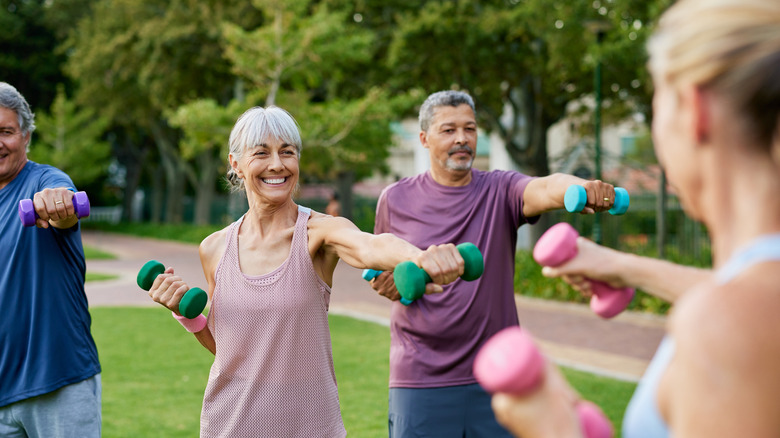
Health at any age involves a number of important aspects ranging from diet to sleep regularity to stave off premature death. Strength and stamina have undoubtedly garnered a lot of attention in recent years, as these are two common features that decline with age, says Harvard Health. What's more, age-related muscle mass loss (sarcopenia) can increase the risk of falls and make daily tasks more challenging. Yet there may be one quiet indicator of healthy aging you don't want to neglect: the ability to stand on one leg. This ability to stand on one leg not only indicates good balance that can improve quality of life as you age, but research also suggests a broader connection with longevity, too.
Balancing on one leg is a form of static balance, which indicates your ability to remain upright while in a standing position. This is the opposite of dynamic balance, which is the body's ability to move while still staying upright. The ability to stand on one leg is highly individual, but you might not want to shrug off your own lack of balance skills. Research has in fact revealed the benefits of this overlooked skill. In 2022, for example, a study published in the British Journal of Sports Medicine revealed interesting findings based on participants ages 51 to 75. Here, researchers concluded that the inability to stand on one leg at a time for at least 10 seconds was directly linked with all-cause mortality. Aside from improved balance, a separate 2022 study in Frontiers in Physiology even found a possible connection between standing with one leg with closed eyes and improved transient arterial stiffness in older females.
How researchers suggest you stand on one leg for better aging
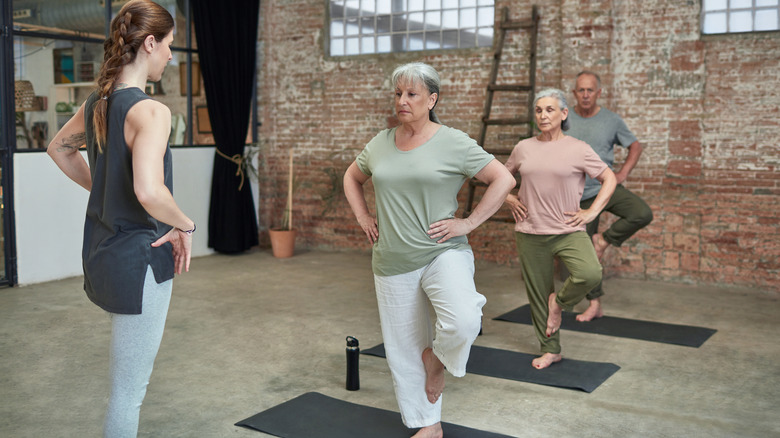
More research is certainly needed on the effects of one-leg standing on health aside from balance and reduced fall risk. Yet even these established benefits are enough to support individual one-leg standing practices. To work on your own balance, the HSS recommends working your way up to standing on one leg for 30 seconds at a time on each side for 2 to 3 sets, raising your leg directly off the ground. Alternatively, you can place one foot on the inside of the opposite calf for 10 seconds at time. You can practice these exercises daily at any age to help maintain long-term balance. A one-leg standing test can also help accurately determine neuromuscular aging.
Before you test out your own ability to balance on one leg, it's important to keep your expectations in check. It's unreasonable to expect to stand on one leg for long periods of time if you're not used to doing so, but you might gradually work your way up to better balance and coordination. You can also keep a sturdy chair nearby as you test out your own balance. Other balancing activities worth trying are walking backwards or side to side, or heel-toe walking. You might also consider joining a yoga or Tai Chi class, which will also help support dynamic balance at any age. (Tai Chi also happens to be one of the healthiest activities for people over the age of 60). In general, aside from balancing exercises, the National Institute on Aging recommends that older adults engage in a combination of aerobic and strengthening exercises every week.