

Not Weight, Not BMI: Scientists Say This Simple Test May Help Predict Longevity

When you think of factors that may impact longevity, Body Mass Index (BMI) and day-to-day energy levels can be signs of overall good health. Another surprising element can also be a good indication of how well you are aging — your ability to get up off the floor without any help. The sitting-rising test (SRT) is a quick assessment of physical health, and it has been shown to have a close relationship with living a long, healthy life.
The SRT sounds like a simple enough exercise, until you actually try it. The challenge is to sit on the floor without using anything to help you, including putting your hands down first — your rear has to be the first thing to touch the floor. Then stand back up again the same way, with no assistance.
In 2026, more than 4,000 participants took part in a research project, which scored each person between 0 and 5 depending on how much assistance they needed to complete the SRT. A score of 5 was given to those who managed the challenge without any other body part touching the floor, and one point was subtracted for each support required to complete the exercise. An extra 0.5 points were removed if any loss of balance was observed. The scores for sitting and standing were awarded separately, then combined for an overall maximum possible SRT score of 10.
What does getting off the floor measure?
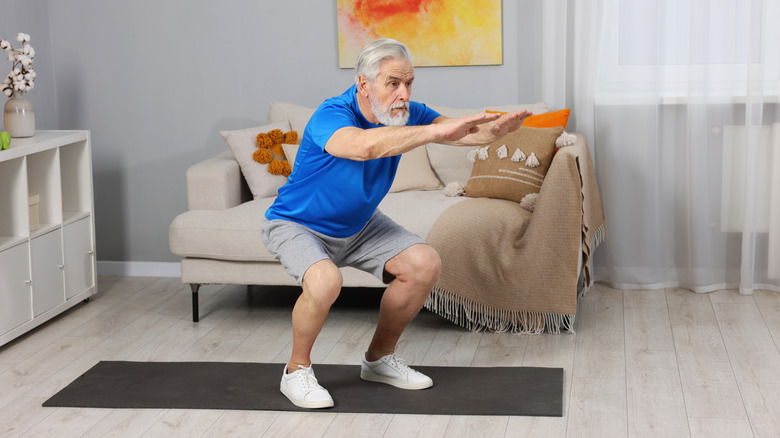
In the study by Araujo et al., published in the European Journal of Preventive Cardiology, it was found that in the group who struggled the most to get up and down to the floor, deaths were 11.4 times more frequent compared to those who could sit and stand unassisted. Of the 4,282 adults involved in the study, only three people (all men) with a maximum SRT score of 10 died within 4 years of the initial study. After 10 years, 97% of those with a score of 10 were still alive.
While one may logically presume that there would be a significant difference between those who can complete the test with no assistance and those who scored zero, there was also a steady shift as the numbers gradually decreased. With the adjusted results, an SRT score of just one point less was associated with a 33% increased risk of natural death, and a 31% higher chance of cardiovascular death.
You may assume that standing up from the floor requires strength in the legs — and it does — but the reason this test is so valuable for measuring overall health is that it requires many parts of an individual's body to work together in lifting their entire weight from the floor. In an interview with AARP, the first author of the study, Dr. Claudio Gil Araújo, said, "Sometimes people run a good marathon time, but they are unable to lace their shoes." Gaining a perfect 10 score in the SRT means muscle strength, balance, and flexibility must all work together — something that correlates with remaining healthy as you age.
A low SRT score can be improved upon
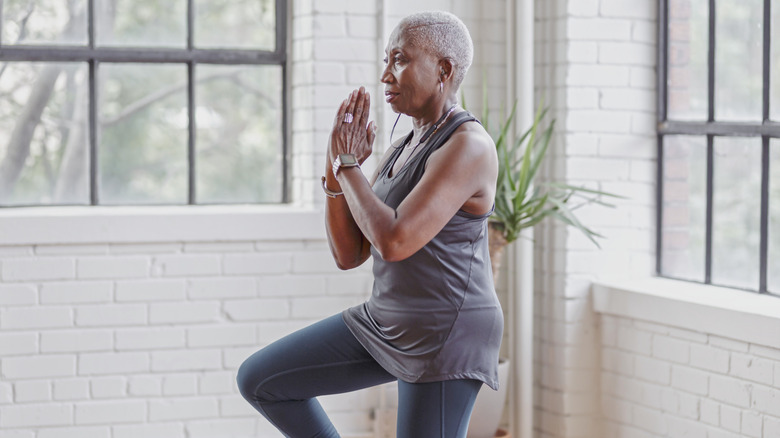
If you've already cleared space in the living room and found you needed a hand to get up from the floor, that doesn't mean that you are destined to struggle with your health as you age. The sliding scale of the test means that you can get a snapshot of your health based on how many supports you need to complete the full exercise, and Dr. Araújo recommends that a score of above 8 should be the target. And of course, no matter your age, your score may still be improved.
AARP also spoke to Dr. Anje'le Zhantil Alston, an internal medicine and sports medicine physician at Southern California Permanente Medical Group. Rather than assess the fitness of her patients using the SRT, she uses a chair-based variation of the test. She suggests taking the opportunity to work on your balance as you carry out everyday tasks around the home, such as brushing your teeth or while the kettle is boiling. Tai chi is also an excellent option to help those over 60 improve their balance.
Alston also recommends being sedentary as little as possible, and when you do need to sit, choose the floor rather than a chair, to keep your hips flexible and practice the range of movement needed for getting back up again. Increasing your longevity involves lots of daily, healthy habits, and regular efforts to increase balance, strength, and flexibility could mean that the next time you try to get up from the floor it will be a little easier — and you may not need that extra hand to help you get there.