

Physics Has A Cool Rule About Sound. Once You Know It, You'll Hear It Everywhere
Imagine you're standing at a bus stop when you hear the siren of an incoming ambulance. Concentrate on the pitch of the note, not the rise and fall of its volume. As the ambulance approaches you, the sound of its siren is high-pitched, like the highest note on a piano. Then, after the ambulance passes you, the pitch of its siren note drops lower as it moves away from you, like the lowest note on a piano. This shift in pitch is the Doppler effect, and it plays a bigger part in our daily lives than you might assume.
The Doppler effect is produced when a wave source moves in relation to the observer. This movement compresses the waves in front of the source's direction of movement and expands the waves behind it. For example, a swimming duck has short, close-together ripples in front of it, while the ripples behind it are spaced widely apart. Even though the ripples emanate from the duck's body at a steady pulse, they end up getting pushed together or pulled farther apart by the duck's movement. By the time the waves reach the opposing shores, the ripples produced in front of the moving duck have a higher frequency and shorter wavelength, while those behind have a lower frequency and longer wavelength.
The same is true of the ambulance example, which occurs with sound waves traveling through the air instead of ripples on a lake. For the ambulance drivers, the pitch of the siren remains the same, regardless of their direction or speed, since they're moving with the siren. But when you're standing ahead of an incoming ambulance, the sound waves arrive closer together and compressed into a higher frequency. This produces the higher pitch of an approaching ambulance and the lower pitch of its departure.
Common examples of the Doppler effect in real life

Passing ambulances, trains, motorcycles, planes, and other vehicles are the clearest examples of the Doppler effect — their loud motors and sirens sound higher in pitch on approach and lower in pitch when moving away from us, as the sound waves produced by their motors are compressed and then stretched by their movement through the air. (This is why we often imitate the sound of a passing motorcycle as "Nyoooom!" with a high-to-low shift in pitch).
You can even experience the Doppler effect in your home, too. Flying insects produce it all the time, such as when bees, house flies, or mosquitoes buzz past your ear to produce a distinctive pitch shift. You might even hear it when little kids run screaming through the house, as their voices sound higher pitched when running towards you and lower pitched when moving away.
The Doppler effect is used for a variety of useful applications, using acoustic waves, such as sound, and electromagnetic waves, such as microwaves. Police radar guns use the effect to calculate the speed of a moving car, while automatic doors use it to sense your movement. The Doppler effect is also used by devices that measure the wind and weather. Ultrasound machines use the Doppler effect by emitting sound waves into a patient's body to measure circulation.
However, police radar guns or automatic door sensors don't use sound waves — they use electromagnetic waves. This includes all the visible and invisible light waves that we use to see, microwave our food, generate x-rays of broken bones, connect to the internet, and heat our homes. We can't hear them, but electromagnetic waves affected by the Doppler effect play a big role in practical physics.
How the Doppler effect is used to measure the universe
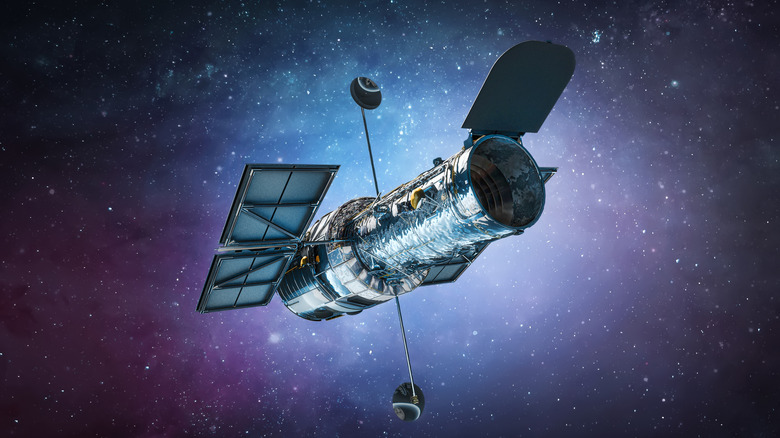
When the Doppler effect occurs in sound waves, the shift in frequency and wavelength changes the pitch that we hear. When it occurs in the electromagnetic spectrum, the shift in frequency and wavelength changes the colors that we see. Theoretically, a neutral light source moving towards you will shift to the higher-frequency colors, like blue and violet, while a light source moving away from you will shift to the lower-frequency colors, like red. Astronomers refer to these as blueshifts and redshifts, respectively.
Astronomers can use these color shifts to determine the speeds and directions of celestial objects, and the phenomenon was the key in Edwin Hubble's discovery of the universe's expansion. After surveying vast stretches of the night sky through telescopes, Hubble observed that the farther a galaxy was, the greater its redshift. This direct relationship between distance and speed of retreat suggests that spacetime itself is expanding at an average rate.
Our perception of the electromagnetic spectrum is confined to a small band of light called the visible spectrum. And because light travels at about 186,000 miles per second, no light sources in our daily lives move fast enough for the Doppler effect to be noticeable to the naked eye. Sound, on the other hand, moves through acoustic vibrations through a fluid. Its speed through the air is typically around 767 mph, which is far slower and easier to notice by those with sharp ears. Once you start listening for the Doppler effect, you start hearing it everywhere.