

Scientists Say Biology Textbooks Have Been Getting This Body Part Wrong For Over A Century
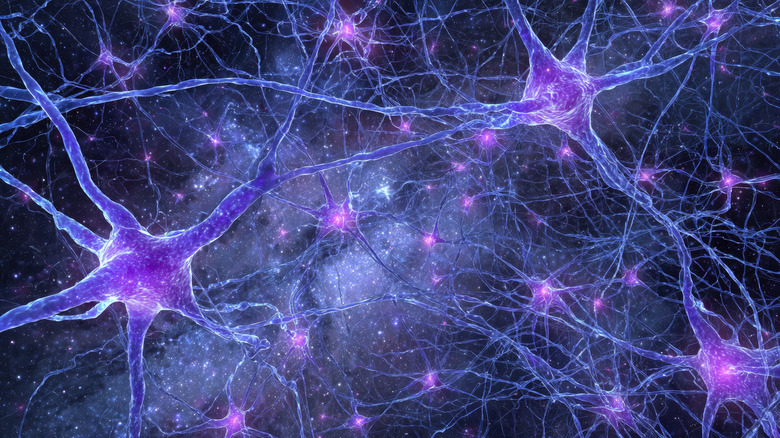
It's hard to believe that scientists are still making discoveries inside the human body while also visualizing what a manned mission to Mars might look like, but that's exactly what's happening. For years, biology textbooks have drawn brain cell axons as smooth, but recent research suggests that the natural shape of axons may more closely resemble a string of pearls. These pearl structures may help control how quickly neurons can communicate with other brain cells.
Researchers from Johns Hopkins Medicine brought this discovery into focus in their 2024 study published in Nature Neuroscience. The research team noted the same pearled appearance in tens of thousands of their cellular images from adult mice, mouse embryos, and neurons grown in a lab. According to the senior author, Shigeki Watanabe, "These findings challenge a century of understanding about axon structure."
In order to observe extremely small neuron axons which are around 100 times smaller than a human hair, researchers typically dry and dehydrate the tissues to observe them under a microscope. This dehydration can cause the cells to lose their original shape — think of a grape that shrinks after being dehydrated into a raisin. To get around this, they froze the samples to help preserve their original form. The researchers then used beams of electrons on the cells to provide a precise outline of their shape and structure.
Why might brain axons have a pearled appearance?

Some axons are myelinated, meaning they're surrounded by a fatty layer that speeds up conduction, while others are unmyelinated. Myelinated axons resemble a string of sausages separated by nodes, and the traditionally held belief has been that unmyelinated axons appear as tubes with a mostly consistent diameter. The pearling that researchers noted in unmyelinated axons may help control how quickly electrical impulses travel through the brain.
Pearling, or periodic "non-synaptic varicosities," has been previously observed in axons damaged by neurodegenerative diseases such as Parkinson's disease. In people with these diseases, pearling often develops from loss of membrane and the axon's skeletal integrity. The conventional thinking has been that pearls can develop as a natural barrier to prevent neurological damage from spreading. This study provides evidence that pearling may develop in healthy cells even without signs of injury. According to Watanabe, a wider space allows more chemical particles to pass through without causing "traffic jams."
Using mathematical modelling, the research team found that wider spaces between the pearls led to faster conduction speed. The researchers also applied high-frequency electrical stimulation to neurons, which caused the axons to swell to an average of 8% longer and 17% wider for at least 30 minutes.
Future research on neuron pearling and skepticism
While the findings of this study may make scientists rethink how neurons function in the brain, more research is needed to understand if the pearling is typical or an unusual variation. Some researchers remain skeptical of the results, claiming that the freezing needed to prepare the samples may play a role in giving the cells their pearling pattern.
Watanabe had previously noted pearling in the nervous system of worms, and took further interest after conversation with Swiss researcher Graham Knott. In a 2026 study, the same research team went one step further by examining the structure and properties of human neurons. Human brain tissue is difficult for researchers to access, but they were able to source it from epilepsy surgeries. The researchers also noted pearling in these human samples.
The brain is arguably the most complex structure in the human body and still provides us with many mysteries. Researchers are continuing to try to map human neurons and improve their understanding of what each part of the brain controls. It may be too early to start redrawing biology textbooks, but this study serves as a reminder that our understanding of the human brain is a long way from complete.