

Scientists Explain The Mystery Behind The Brain's Spontaneous 'Aha!' Moments

One of the most famous alleged "Aha!" moments in history occurred in ancient Greece when Archimedes figured out how to determine whether King Hiero of Syracuse's crown was made of pure gold. As the story goes, he jumped out of a bathtub when the solution suddenly came to him and ran naked into the streets yelling, "Eureka!" While the science behind these moments of discovery has long been a mystery, researchers are getting closer to understanding what parts of your brain may be involved. Modern imaging techniques suggest areas such as the hippocampus and amygdala play a critical role.
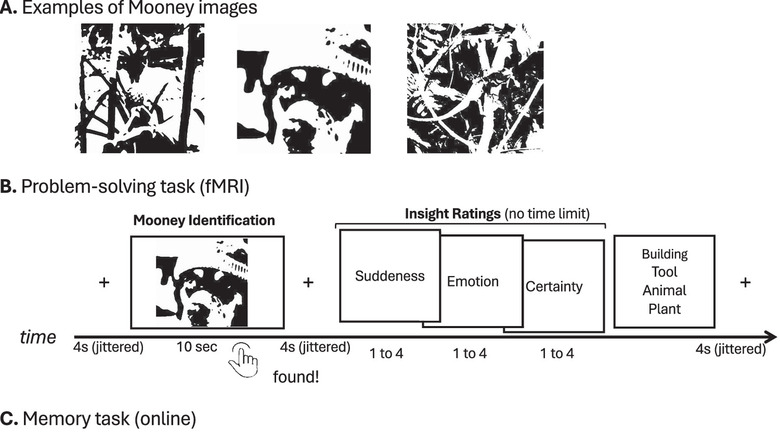
In a study published in Nature Communications, researchers identified new insights into the "Aha!" moment by measuring brain activity while participants completed visual puzzles. Each puzzle showed a two-toned black-and-white image with a hidden object. The researchers measured the participants' brain activity with functional magnetic resonance imaging (fMRI), which allowed them to see which parts of the brain were active at the moment of discovery.
They found high levels of activity in parts of the brain responsible for positive emotions, visual pattern processing, and memory. Additionally, the research team found that participants who recognized images in a flash tended to remember them better than people who remembered them without a sense of epiphany. According to the senior researcher, Roberto Cabezo, having an "Aha!" moment while learning seems to almost double your memory of it.
Parts of the brain responsible for the 'Aha!' moment
An "Aha!" or "Eureka!" moment relies on the power of insight, or applying pre-existing knowledge in a new way to make a discovery. Like many creative processes, it isn't fully understood since the anatomy of the brain is complex and many parts are activated nearly instantaneously. However, modern brain monitoring techniques have greatly improved our understanding of when certain brain regions are activated. Electroencephalography allows researchers to measure brain electrical activity, and fMRI allows them to examine areas activated during specific tasks.
Sudden moments of discovery are associated with positive emotions and a feeling of certainty that the answer is correct. Feelings of positive and negative emotion have been associated with activation of the amygdala. The amygdala is a deep cluster of neurons inside your brain that plays a role in processing emotions. Feelings of surprise are associated with increased activation in the hippocampus. The hippocampus is another deep structure in your brain that plays a role in learning and memory.
In the study where participants were shown visual puzzles, the researchers noticed increased activation in the ventral occipito-temporal cortex (VOTC) when the participants recognized the hidden object in the image. The VOTC is thought to help your brain recognize visual patterns. The VOTC was likely activated due to the puzzle being primarily visual and may not be activated in non-visual situations.
How 'Aha!' moments may influence memory
Research consistently shows that sudden moments of insight lead to better memory retention than more analytical methods of problem solving. In the Nature Communications study, researchers noted that participants were better able to remember images they had seen prior if they had higher insight scores. These insight scores were a way to quantify the abstract concept of the "Aha!" moment.
These findings may have applications for education since providing environments that foster discovery may help with memory retention more than more traditional memorization methods. For example, giving students the chance to work hands-on to observe scientific principles may help them retain the concepts better than simply learning them from a book. Improving our memory might be more important than ever since common bad habits like spending too much time on our phones may damage our memory.
Researchers still don't have a full understanding of what each part of the brain controls, but techniques like fMRI are improving our understanding. Although we haven't cracked the code on how to have "Aha!" moments on demand, many people find it helps to step away from the problem and revisit it later. More research is needed to understand the phenomenon fully, but some researchers think that giving your mind time to wander may help your brain make unconscious associations.