

NASA Crashed A Spacecraft Into An Asteroid. Scientists Didn't Expect What Happened Next
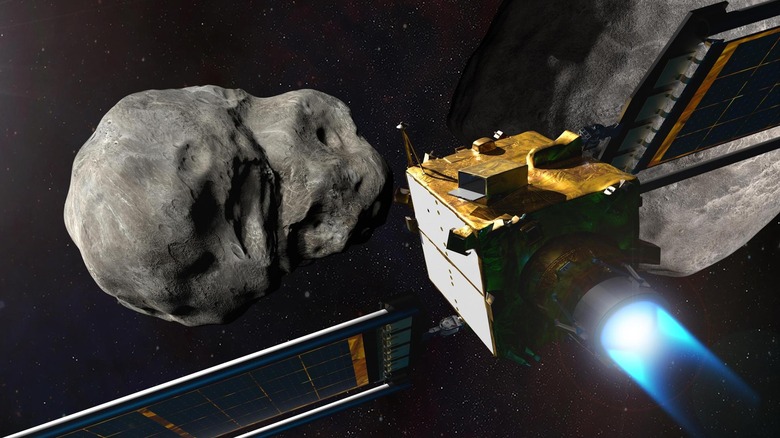
In late 2021, NASA launched the Double Asteroid Redirection Test, or DART, spacecraft. The mission's goal was to crash an impactor into a asteroid to see how feasible it would be to change its path. Being able to do so could be vital for protecting Earth from an asteroid impact that would cause widespread devastation. Scientists anticipated that the impact would change the asteroid's path slightly, but they did not expect the change to be as large as it was and were surprised by changes to the asteroid's shape.
On September 26, 2022, the DART spacecraft collided with the surface of Dimorphos, the smaller body of a binary near-Earth asteroid system. Before the impact, Dimorphos orbited a larger asteroid named Didymos every 11 hours and 55 minutes. Scientists calculated that if the DART spacecraft transferred all of its momentum to Dimorphos that its orbital period, that is, how long it takes to orbit Didymos, would decrease by about seven minutes. But after taking careful measurements, the researchers found that Dimorphos' orbital period had decreased by around 33 minutes. This notable difference is known as momentum transfer enhancement and was likely due to the physical properties of the asteroid itself.
A fountain of debris
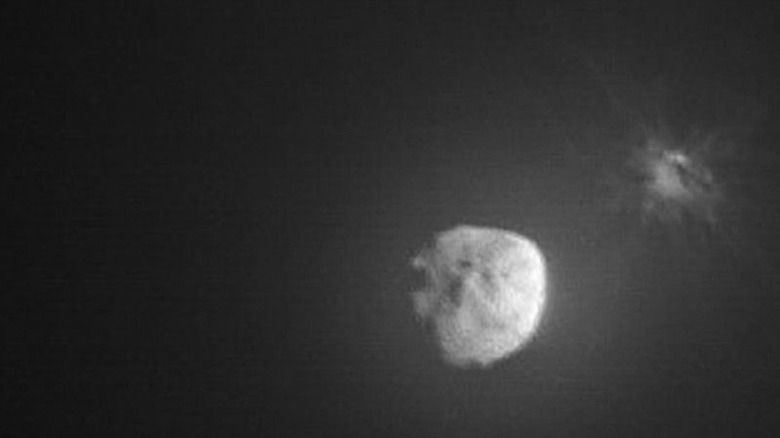
When the spacecraft collided with Dimorphos at around 14,000 miles per hour it kicked up a fountain of debris from the asteroid. The recoil from this ejection of rock from Dimorphos is likely what enhanced the momentum transfer and caused the larger decrease in orbital period. The ejected material also meant it took several days to get good measurements of Dimorphos' orbital period after the impact.
Scientists spent years carefully measuring the asteroid's orbital period, studying changes in reflected sunlight. As Dimorphos orbits Didymos, the amount of light reflected from the binary asteroid system changes. After the impact, scientists continued studying changes in light from the asteroids to measure how the orbital period had changed and verified it with radar observations.
With continued observations and close comparisons between images of Dimorphos before and after impact, scientists also noticed that the asteroid had changed shape. After the impact the asteroid was more stretched out than before, suggesting that the smaller asteroid was less rigid than its larger companion that stayed the same shape. The composition and structure of Dimorphos could explain why the ejected material had such a large effect on its orbital period; however, scientists need more detail on the asteroid to gain a clearer understanding.
Taking a closer look at Dimorphos
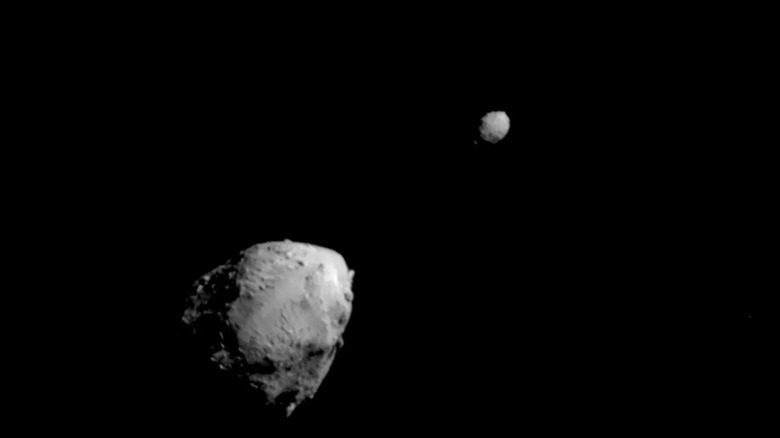
Next, a European Space Agency mission called Hera will study the asteroid system in more detail to improve understanding of what happened when the DART spacecraft impacted. Launched in October 2024, Hera will reach Dimorphos and Didymos in late 2026. Once there, the spacecraft will collect data for six months. Hera will also collect detailed images of the asteroids and measure Dimorphos' shape in detail with a precision laser instrument. In addition to the main Hera spacecraft, two CubeSats, including one that will attempt landing on Dimorphos, will measure gravity fields and the rotation of the asteroids to better understand their mass and composition.
These measurements will help scientists understand whether Dimorphos is a collection of boulders held together by gravity, or a larger solid core surrounded by a layer of smaller rocks. Having a better understanding of Dimorphos' mass and composition will help clarify how much momentum transfer can be enhanced by different kinds of asteroids. DART marked the first time that humans altered the movement of an asteroid and showed how we can redirect it. Having a better understanding of how DART changed Dimorphos' orbital period could be helpful if humanity needs to protect Earth from asteroids in the future.