

Scientists Are Disputing This 'WEIRD' Optical Illusion Theory From The '60s
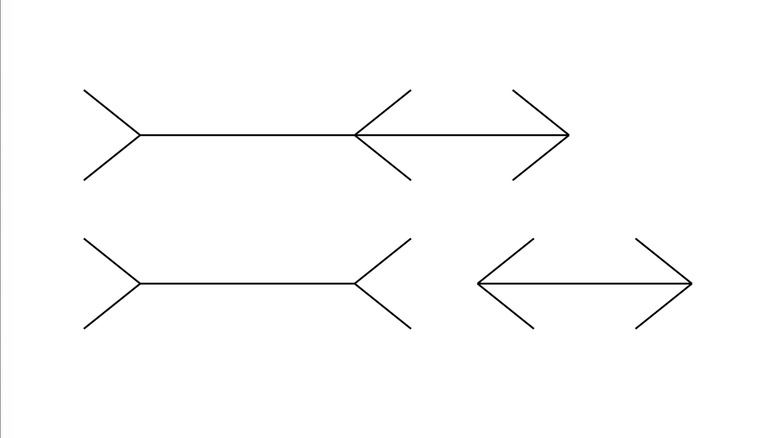
The Müller-Lyer illusion, named after its creator, Franz Carl Müller-Lyer, is one of the most famous optical illusions in the world. Two lines, one with arrows pointing out from the ends and one with arrows pointing in from the ends. Most people who see the image for the first time perceive the line with arrows pointing in as being longer than the line with the arrows pointing out, but in fact, they are the same length. Strangely, researchers in the 1960s found that test subjects in African and Southeast Asian countries didn't seem to fall for the trick. It only worked on people who were Western, Educated, Industrialized, Rich, and from a Democracy... a.k.a. WEIRD.
There is no exact consensus as to why the Müller-Lyer illusion works, but scientists thought there might be an answer in the fact that only WEIRD people see it. They theorized that people who grow up in industrialized societies — worlds defined by lines and angles — are susceptible, while those who grew up in less industrial, less angular environments were not. Somehow, the prominence of angles and straight lines in our lives was molding our brains in a certain way. That's fascinating ... if it were true. Only recently, a review of scientific literature has thrown this whole theory into question.
The WEIRD theory might be bogus
In 2025, anthropologists Dorsa Amir and Chaz Firestone of Duke and Johns Hopkins Universities, respectively, published a compilation of evidence against the old 1960s theory in the journal Psychological Review. Their research refutes the idea that the illusion only works because of childhood conditioning to lines and angles.
Consider the fact that the illusion works even with curved lines. There are also numerous other illusions with a similar premise, like the Ebbinghaus illusion, which features one dot surrounded by either six large dots or eight small dots — the center dots are the same size, but the one surrounded by smaller dots looks bigger. These illusions do not feature straight lines, but have the exact same effect as the Müller-Lyer illusion.
Amir and Firestone also reviewed the original case studies on which the theory was based and found substantial flaws. In many cases, later reports had entirely misconstrued the original findings, and there is actually very little evidence to suggest that Africans and Asians don't fall for the Müller-Lyer illusion.
But the most fascinating piece of evidence against the WEIRD theory is something truly amazing. Scientists have tested it on people who were born completely blind and later have lens replacement surgery. The illusion appears to work as soon as sight is gained, even though those people never had the visual concept of lines and angles before that point. So, if being WEIRD can't explain it, the Müller-Lyer illusion is still a mystery.