

The Common Nosebleed Myth That's Been Debunked By Science

If blood suddenly starts pouring from your nose, common sense suggests that tipping your head back to stop the flow would be a good idea. However, this is a misconception, and while it may seem like the blood flow has slowed, it may actually just be headed somewhere that you can't see it.
Nosebleeds, known by the medical term epistaxis, tend to originate at the Kiesselbach plexus, which is a network of small blood vessels near the front of the nose. These arteries lie close beneath the skin, meaning they are easily ruptured, causing a nosebleed. Common triggers include physical trauma to the nose or elsewhere in the face, allergies that affect the nasal passages, and even blowing your nose too hard.
When epistaxis occurs, the immediate aim should be to stop the bleeding quickly by allowing a clot to form over the damaged blood vessel, so that your body can begin repairing the damage. While tilting your head back may cause less blood to come out through the nose, it does not encourage it to clot, meaning that when you return your head to its natural position, the bleeding will likely continue. Instead, it could send the blood down your throat and esophagus, which can cause stomach upsets. If there is significant blood flow, it could even cause gagging or become a choking hazard. While your instinct may be to prevent the mess caused by a pouring nose, focusing on stopping the blood should be the priority, and a different head position is recommended for that.
The best head position to stop the bleeding
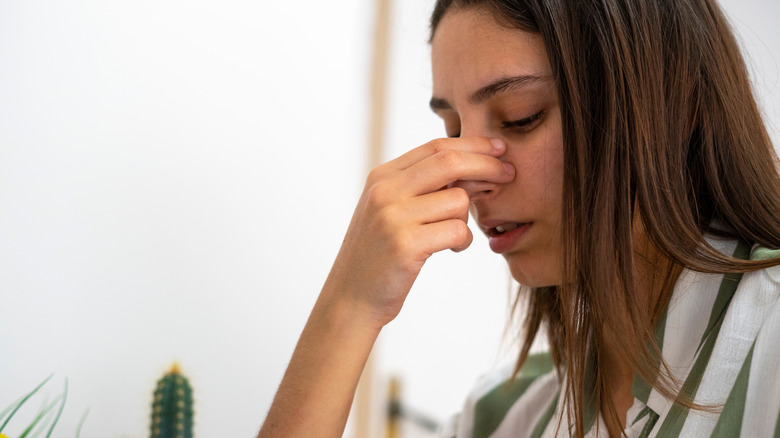
As awareness of tipping your head back being a myth has grown, many people assume that leaning forward instead is the best course of action. While a slight forward incline is fine, bending all the way forward is not a great idea either, since this can actually increase the level of bleeding. Instead, where possible, sit upright and keep your head in a fairly neutral position. Pinch your nostrils together just below the bridge, underneath the bony section at the top.
Pinching your nose encourages the blood to clot in the area where the bleeding originated. Keeping the blood vessels compressed until they clot is crucial, so keep your nose pinched for as long as possible, up to 20 minutes. Try not to let go of your nose every few minutes to see if it has stopped. If the bleeding doesn't stop from pinching your nose, you may need to move your fingers slightly to find the right spot.
Once the bleeding stops, try not to touch your nose, though it can be difficult to resist the temptation to check it out. Blowing your nose or sticking your fingers in your nostril could disturb the newly-clotted blood vessels and restart the bleeding, so try to keep your hands away from it for as long as possible.
When to seek medical attention

Most nosebleeds correct themselves within 15–20 minutes, with no need for medical attention. However, if you employ the techniques above for more than 20 minutes and you still have blood pouring from your nose, you should seek further advice. Medline Plus advises to seek emergency care if your nose continuously bleeds for more than 20 minutes, or if you suffered a head injury shortly before the nosebleed. They may need to rule out fractures that could be causing the bleed, either to the nose or the skull. If you take blood thinners such as aspirin or warfarin, it may be more difficult to stop the bleeding, so emergency care must be sought.
If your nosebleed stops using the methods described above, but you have repeated nosebleeds that were uncommon before, you should make an appointment with your doctor to discuss. While the vast majority of nasal bleeding is harmless, in very rare cases, they could signal an underlying condition, so it is best to get them checked out if you feel they are happening regularly.
Most nosebleeds can be easily treated at home, but you should resist the urge to halt the blood flow by leaning back. It may make a bit more of a mess, but the blood vessels should be able to heal reasonably quickly, confirming that the old-school advice of tilting your head back is indeed a medical myth.