

8 People Were Sealed In An Everest Simulation For 40 Days. They Didn't Expect What Happened Next
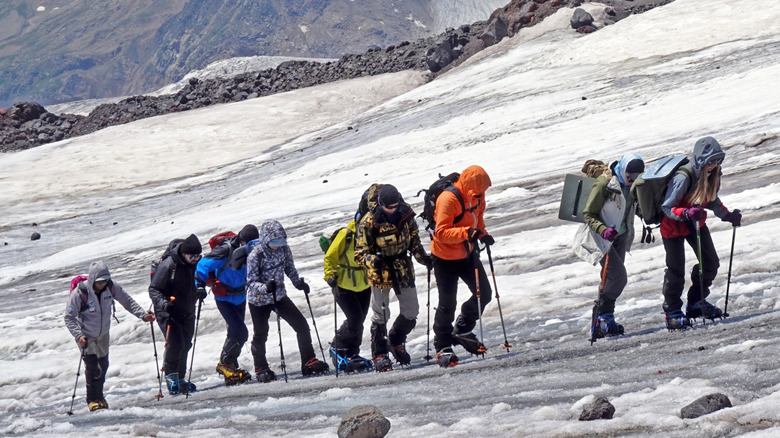
In 1953, Sir Edmund Hillary and Tenzing Norgay completed the first successful ascent of Mount Everest. Each man carried 22-pound oxygen tanks during the final climb, since the air at Everest's 29,000-foot peak is only a third as dense as it is at sea level. That means not only does less oxygen enter your lungs with each breath, but your cardiovascular system needs time to acclimate to the low pressure. For Hillary and Norgay, that acclimation involved several weeks of up-and-down climbing to build up extra red blood cells in their bodies (As a sherpa, Norgay had a genetic advantage). Over 30 years later, scientists decided to simulate the acclimation process in a controlled study called Operation Everest II. The result was just short of brain damage.
The Operation Everest II study was conducted in 1985 by North American researchers given access to hypobaric altitude chambers at the U.S. Army Research Institute of Environmental Medicine. The team sealed eight athletic, healthy male participants into a decompression chamber for 40 days, and then slowly lowered the internal pressure to simulate what it would be like to acclimate to an ascent.
Hillary and Norgay acclimated by climbing a little higher each day, and then descending at night to sleep. But in the case of Everest II, the participants woke and slept in a continuously decreasing atmosphere. Unlike the "climb high, sleep low" practice used among Everest climbers, the participants' bodies had no respite. Even as their cardiovascular systems struggled to adapt to the lack of oxygen, the participants were made to exercise. By the time the chamber reached the atmospheric pressure of Everest on Day 37, the participants were already suffering from serious hypoxia-related conditions.
The atmospheric limits of the human body
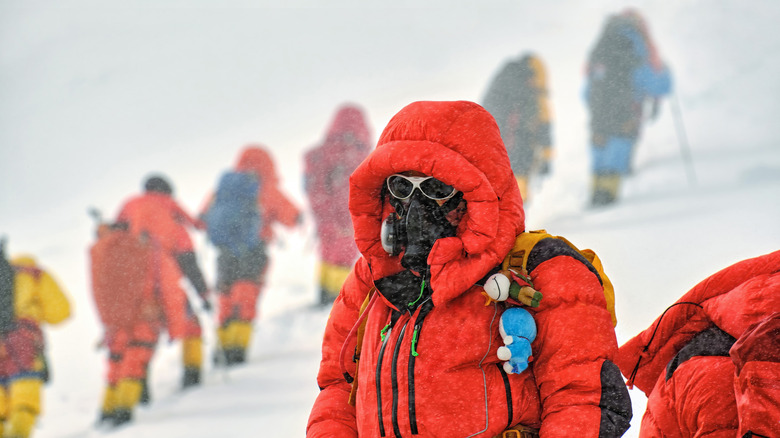
Today, climbing Mount Everest is a science, and the limiting factor is more about money than it is fitness and skill. Yet, even with all our modern technology, yearly death tolls still remain high. An average of five to six people die every year due to accidents. Plus, emergency support is limited, if not impossible. The thin air and unpredictable weather make access by aircraft dangerous — the only successful helicopter landing on Mt. Everest was in 2005.
In the decompression chambers of the 1985 Operation Everest II simulation, however, the environment was heavily controlled to rule out accidents. The implicit goal of Operation Everest II was to explore the limits of the body's adaptability in the face of increasingly low-oxygen and low-pressure. And they were successful. The study found unexpected results, especially the resiliency of the cardiovascular system while it's essentially suffocating.
In the last few days of the simulation, in which the air was equivalent to that of Mount Everest, the participants' pulse and blood pressure remained stable. Yet, although their hearts were able to pump effectively, their blood oxygen content reached lows of 28–30 mmHg, which is equivalent to an oxygen saturation percentage of around 50%. In diagnostic terms, the participants left the chamber with "severe hypoxia," as well as clear cognitive deficits. Later studies suggest that extended severe hypoxia can damage the hippocampus, the learning and language center of the brain. Consequently, they all experienced drops in memory and language skills. It took several weeks to recover, but they eventually returned to normal. Not only is the heart resilient — so is the brain.