

Archaeologists Have Physical Evidence This Ancient Roman Technology Was Way Ahead Of Its Time
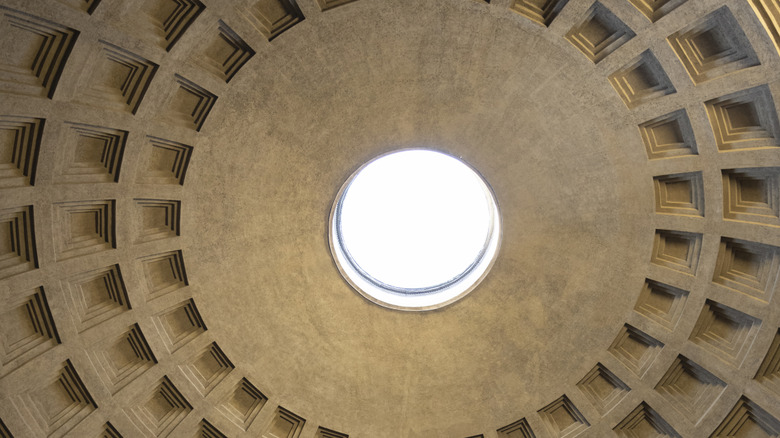
In many parts of the world, summer inevitably becomes road-construction season. You have probably marveled at the irony that ancient Roman concrete structures like the Pantheon have stood for millennia, but modern humans can't make concrete last more than 30 to 40 years. It turns out that the ancient Romans knew something about making concrete that made their technology way ahead of its time. Archaeologists are now finding physical evidence, at Pompeii, for how they did it.
The eruption of Mt. Vesuvius in A.D. 79 famously buried the town of Pompeii in the middle of a typical day. The citizens were cooking, tending to horses, training for sports, and renovating buildings with concrete. The process of mixing the concrete was preserved along with the rest of the day's activities.
The relatively simple components of modern concrete become something very different when mixed with water. It contains sand, an aggregate, and Portland cement (crushed limestone mixed with clay, shale, or other material rich in calcium, aluminum, and silica). Adding water hydrates the mixture, changing its chemical composition by an exothermic (heat-releasing) reaction. As the concrete dries and cures, it also hardens. However, precipitation, chemicals, or structural stress will break down modern concrete over time.
What made Roman concrete so special?
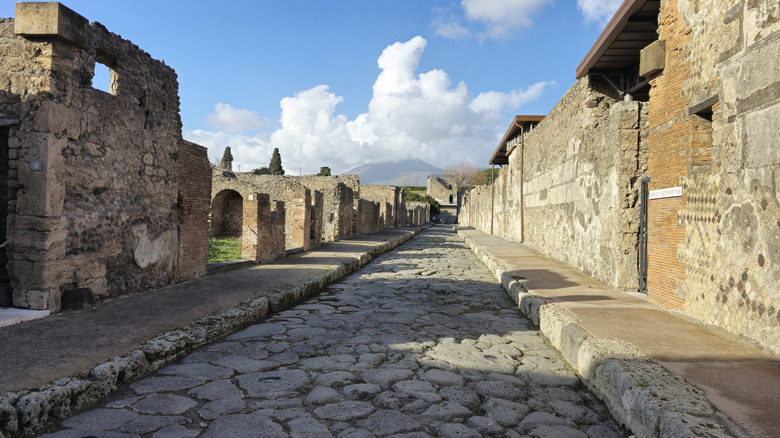
In 2024, archaeologists working at Pompeii discovered a building site where the ingredients for Roman concrete were assembled next to a rebuilt wall. Although finished Roman concrete is abundant, its component materials have not been found assembled and ready for use in any other archaeological site. In contrast to modern concrete, Roman concrete contained volcanic ash in addition to a calcium source (lime), aggregate, and sand.
This preserved building site provided evidence for the concrete preparation process. Prior to the discovery of the segregated concrete materials, researchers had assumed that Roman concrete was made with slaked lime (calcium hydroxide). However, the dry material at Pompeii was quicklime (calcium oxide).
Researchers at the Massachusetts Institute of Technology realized that the Romans must have premixed the quicklime and volcanic ash before adding water, in a process called hot mixing. Adding water caused the mix to release heat as the lime hydrates. The heat also turns some of the lime into brittle, calcium rich chunks, called lime clasts, that are distributed throughout the concrete. These lime clasts are the key to the durability of Roman concrete because they enable its self-healing behavior.
Self-healing concrete: An engineering marvel

Self-healing concrete is so named because when cracks form, the concrete can repair itself. The calcium in Roman concrete dissolves when exposed to water. The dissolved calcium then crystallizes as calcium carbonate in the crack, preventing further damage. Modern versions of self-healing concrete contain polymers, bacteria, or fibers that don't need to be exposed to water to activate. But it wasn't until the late 2010s that modern self-healing concrete became commercially available.
More than 2,000 years ago, the Romans were making durable, self-healing concrete from abundant local materials. They took advantage of the pozzolanic reaction between the quicklime and the reactive silica and alumina in the volcanic ash. This reaction produces a calcium silicate hydrate, the binder that literally cements the concrete together. The lime clasts in the Roman concrete functioned as reservoirs of calcium to quickly fill in any cracks that did appear.
The ongoing archaeological excavations at Pompeii will continue to provide insights about ancient Roman culture and technology. In this case, they helped to solve the mystery of why Roman concrete lasts for thousands of years. The physical evidence found at one preserved building site proves that Roman concrete was a technology way ahead of its time.