

Why Death By Shark Attack Is One Of The Worst Ways To Die
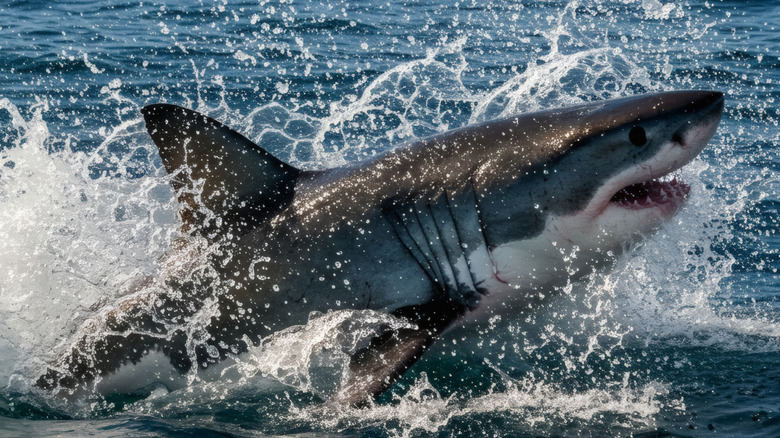
The sight of a shark fills most of us with terror, and while they don't top the list of animals that see humans as food, staying out of their way is probably the safest option. Although shark attacks are rare, they can be devastating, and even though the scenes we all remember from "Jaws" are not entirely accurate, getting caught between the teeth of one of these apex predators, such as a great white or tiger shark would be a pretty horrific way to die.
First, the good news — shark attacks are genuinely a rare occurrence. In 2025, there were only 28 shark attacks across the U.S., and only one proved fatal. The chances of surviving a shark attack are massively increased by the presence of a watercraft that allows the victim to float and can act as protection against the animal. In 2010, researchers at the University of Florida created a scale to measure the severity of shark attacks, named the Shark Induced Trauma scale, or SIT scale. A Level I injury is a little nibble that is unlikely to cause serious damage, whereas a Level V attack is highly likely to result in death. Just 22.9% of the 4,000 shark attacks examined while creating this scale were a Level IV or Level V attack.
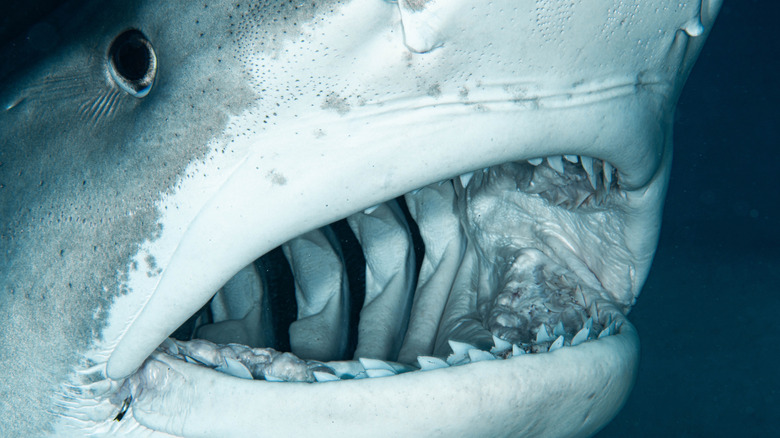
The shark's dozens or even hundreds of sharp teeth, coupled with their incredibly powerful jaws, are responsible for life-threatening and fatal attacks. Dr. Ashley Lentz, a plastic and reconstructive surgeon at the University of Florida College of Medicine explained "If a shark comes up and takes a big bite out of a thigh and takes out the femoral artery, then that's a life-ending bite — pretty quickly."
The devastating injuries that can make a shark attack so dangerous
Evidence suggests that humans have been the unfortunate victims of fatal shark attacks for thousands of years. In a study published in 2021 in The Journal of Archaeological Science: Reports, researchers tell of a skeleton excavated in 1969. It was found with both legs missing and almost 800 injuries, and the paper stated that "if alive at the time of attack, as argued here, the victim undoubtedly would have expired from exsanguination and shock."
The extreme danger from a shark attack is the damage that can be done by the combination of lots of teeth and phenomenal bite force, which has been estimated to be around 4,000 pounds of force. If the shark damages a crucial artery or vein, blood loss can be severe. If the victim is alone at sea or unable to get medical help quickly, they could bleed out from a severed limb in less than 5 minutes. In January 2026, a woman snorkeling in the Virgin Islands lost an arm during a suspected shark attack, and later died despite receiving medical attention.
Maria Korcsmaros, a shark-bite survivor, described "deep, unimaginable pain from my upper arm to my waist," when remembering the feeling after being bitten. Shock will set in with some people, but others remain conscious and experience excruciating pain as they struggle to escape the shark and find help. The location in the water of course adds even more danger, as shock or disorientation can increase the chances of drowning, compared to a similar injury on land. Even if you make it safely to land, the danger isn't over yet.
The risk of infection is significant
Escaping the shark's teeth would obviously be an enormous relief, but the threat hasn't necessarily passed yet. Even if the bleeding can be slowed or stopped, which requires a tourniquet to be applied until medical treatment can be administered, there could be lasting damage from a less visible threat.
An article titled "Shark Trauma" published in StatPearls and updated in 2026 stated "Wounds sustained in marine environments are exposed to multiple bacterial species," with Streptococcus, Aeromonas, Clostridium, and Vibrio among some of the most dangerous. The CDC singles out Vibrio as a bacteria that can cause serious infection, with 20% of people with Vibrio vulnificus dying, potentially within a few days of infection. The infection can lead to vibriosis, which in turn can cause sepsis, shock, and painful blisters. The same article also explains that pieces of the shark's enormous teeth can be left behind in the wound, acting as the perfect breeding spot for dangerous bacteria to multiply.
The paper also shows that a serious shark bite often requires major medical intervention, with half of patients requiring intensive care, and half needing immediate surgery, with almost all of the patients in the period from 2015–2018 needing surgery of some kind. Even for survivors of a shark attack, there is often a painful recovery journey. Tissue necrosis, nerve damage, and sepsis can all be complications that occur during recovery, and limb amputation may be required as a result of a severe wound. While fatal shark attacks are rare, dying as a result of an attack would be a horrifying experience to endure.