

You Should Think Twice Before Walking Barefoot In Hotel Rooms
After a full day of travel, you might be looking forward to kicking off your shoes and relaxing barefoot in your hotel room. However, an October 2026 report by NBC News suggests that you may want to consider keeping your socks or slippers on rather than cavorting around barefoot. The investigation found potentially harmful bacteria on floors of two New York City hotels: the five-star Ritz-Carlton near Central Park and the three-star Hilton Garden Inn Midtown East.
The investigators found Pseudomonas bacteria on the carpets of both hotels. The Ritz-Carlton bathroom tile was the cleanest surface tested while the Hilton bathroom floor showed the highest levels of germs. Pseudomonas bacteria can cause lung infections but rarely cause infections in people with normal immune function. They fall into a group of microorganisms called opportunistic pathogens, meaning they primarily affect people with conditions that weaken immune function, such as cancer, uncontrolled diabetes, or those who have had a recent organ transplant.
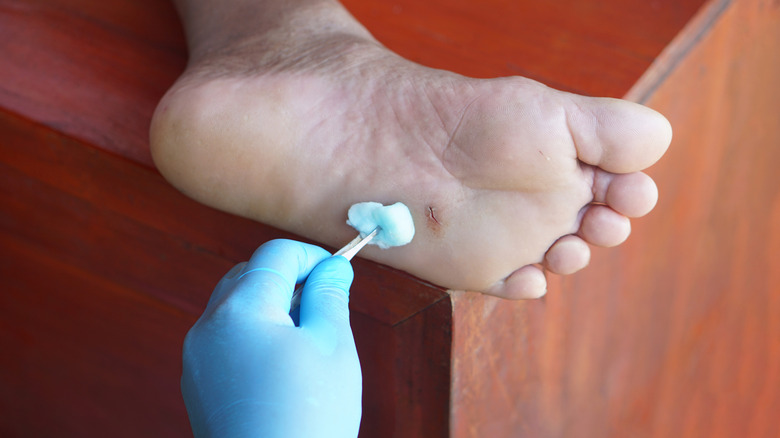
As a doctor featured in the investigation noted, the overall risk of Pseudomonas infection is likely relatively low, and most travelers don't need to be overly concerned by the findings. Still, it's a good reminder about some of the microorganisms that might be lurking underfoot. You may want to be extra cautious in hotels if you have cuts on your feet, since cuts can be a potential route of entry for bacteria.
Can bacteria live on floors and hard surfaces?
It's well known that hotel rooms are a hotbed for parasites like bed bugs, but they can also harbor bacteria that can make humans sick. While many bacteria thrive in warm, moist environments, some types can survive on dry surfaces like carpets for hours, days, or even longer. For example, Staphylococcus aureus can live on dry surfaces for months. It's also among previous strands of bacteria identified in hotel rooms.
There hasn't been a ton of research examining the risk of disease transmission inside of hotel rooms, but there's some evidence that even rooms that appear clean may not be free of contamination. In a 2015 study, researchers found that visual assessment of hotel rooms poorly predicted microbial levels. In the study, researchers reported the highest concentration of bacteria on sponges, mops, toilet basins, and bathroom floors.
There's no single federal agency in the United States that enforces hotel room cleanliness standards. It's enforced through a mix of local health departments and state laws. The Occupational Safety and Health Administration sets federal rules for worker protection, including the use of cleaning chemicals by the hotel staff. Many chains like Marriott and Hilton set their own standard operating procedures that their hotels have to follow, and the American Hotel & Lodging Association creates industry-wide guidelines, although following them is optional.
What other diseases have been linked to hotel rooms?
Hotel rooms have also been linked to some other types of bacteria infection. For example, Legionnaires' disease was discovered in 1976 after an outbreak leading to 11 deaths at the Bellevue-Stratford Hotel in Philadelphia. Legionnaires' disease is a potentially serious lung infection with a death rate as high as 1 in 10. It's primarily passed through inhaling microscopic water particles containing the bacteria.
In a Canadian investigation by CBC Marketplace (a watchdog series funded by the Canadian Broadcasting Corporation), researchers found evidence of Clostridioides difficile and S. aureus in 54 hotel rooms across six major chains. Every hotel that they tested included some forms of "superbugs" resistant to antibiotics, although levels of dirt and contamination varied. In this report, the researchers found that high-touch surfaces were the biggest bacterial hot spots.
It's not possible to avoid bacteria and other microorganisms entirely. They're everywhere from the surface of your skin to every surface you touch. However, to minimize your risk of illness, you may want to reconsider staying at hotel chains or locations with many negative reviews related to their cleanliness. For extra peace of mind, you should also leave on your socks or slippers on while walking around your room, especially if you have cuts on your feet or immunosuppression. And of course, never follow the 5-second rule and eat food off the floor.