

Scientists Still Can't Fully Explain This Bizarre Lightning Phenomenon
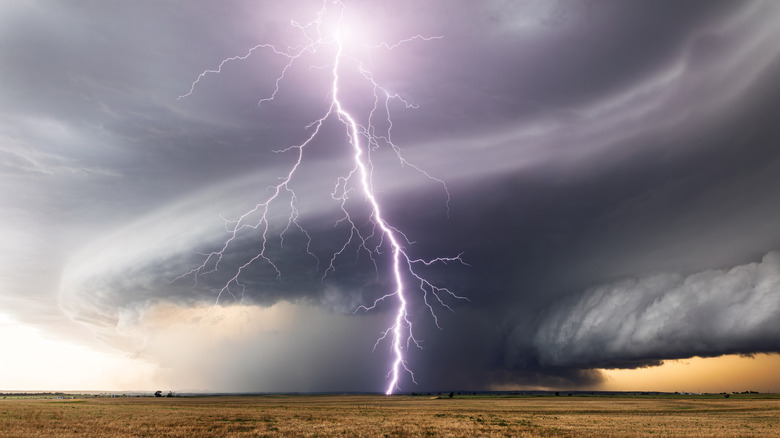
Few things are as awe-inspiring, or in some cases fear-inducing, as a thunderstorm. Once a mysterious force sometimes attributed to the supernatural (and still the subject of myths), we now understand that lightning is the result of positive and negative electrical charges within storm clouds and the ground below. However, there is a bizarre and relatively rare phenomenon known as ball lightning that continues to evade explanation.
Unlike regular lightning, which has been photographed countless times, there are only a handful of visual records of ball lightning. Much of what we know about ball lightning comes from eyewitness accounts going back as far as the 17th century. People have reported seeing similar phenomena like light-emitting spherical objects around 8 inches in diameter that slowly move along the ground, mostly near thunderstorms. In some cases the spheres have been said to pass through small openings like chimneys or through glass windows. These objects are typically about as bright as a standard light bulb and disappear after a few seconds, sometimes silently and sometimes in a noisy explosion. Some accounts even report buzzing sounds or acrid odors with ball lightning sightings.
The causes of ball lightning remain unclear
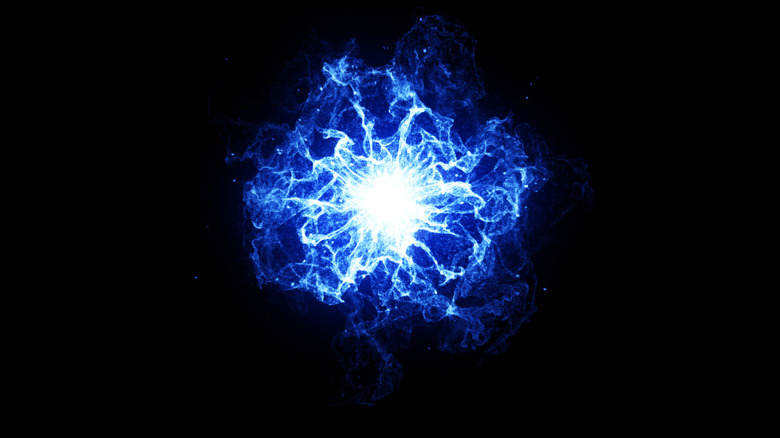
Eyewitness accounts of ball lightning are similar enough that it's fairly clear people are describing the same phenomenon. However, what ball lightning actually is remains unclear. There are a few competing notions of what ball lightning is. Some scientists suspect that the phenomenon is the result of oscillating ions or electrons, others posit that the objects are the result of electromagnetic waves that are strong enough to break down air and cause it to glow or plasma released when lightning strikes the ground, while still others hypothesize that ball lightning is plasma flowing along interlinked magnetic field lines.
These hypotheses all seem plausible and researchers have been able to produce phenomena that are similar to ball lightning in some respects in laboratory settings. For example, scientists have used a microwave beam to create something resembling ball lightning and produced intersecting magnetic fields that could explain the phenomenon. However, these attempts don't always capture all of the characteristics of ball lightning and have been difficult to reproduce. Similarly, reproducing the atmospheric conditions that lead to lightning in thunderstorms would be incredibly challenging.
Despite these challenges, there is a slowly growing body of quantitative evidence of ball lightning to go with eyewitness accounts. And one of the tools that could help with this is the phone most of us carry around daily.
Getting more eyes on the ball

Quantitative data on ball lightning has been limited largely because of its short duration. But with more cameras out in the world, the odds of someone capturing ball lightning have increased. In 2012, scientists in China were conducting lightning research using video cameras and captured an object that looked and behaved like ball lightning. Further analysis showed that the object's light spectrum showed traces of silicon, iron, and calcium, all of which were present in that region's soil. In 2015, multiple observers recorded video of a glowing object around 2.5 feet across moving above buildings in Moscow.
Having footage from multiple cameras at different locations can provide better data on brightness and motion. Similarly, researchers could correlate images and video of ball lightning with data from lightning detectors. Scientists could also use drones flying at low altitude near thunderstorms to capture images and video of ball lightning. At the same time, the increase in the number of people with high-quality video recording capabilities thanks to smartphones could enable citizen science efforts to study ball lightning.
Scientists in multiple fields are working to understand this strange lightning. While its no longer in the realm of the supernatural, a lot remains to be discovered when it comes to ball lightning. With more quantitative data, researchers could one day explain what causes this strange phenomenon. But for now, ball lightning is still a mystery.