

Scientists Launched The Fastest Manned Rocket Sled Ever. Many Experts Didn't Expect What Happened Next
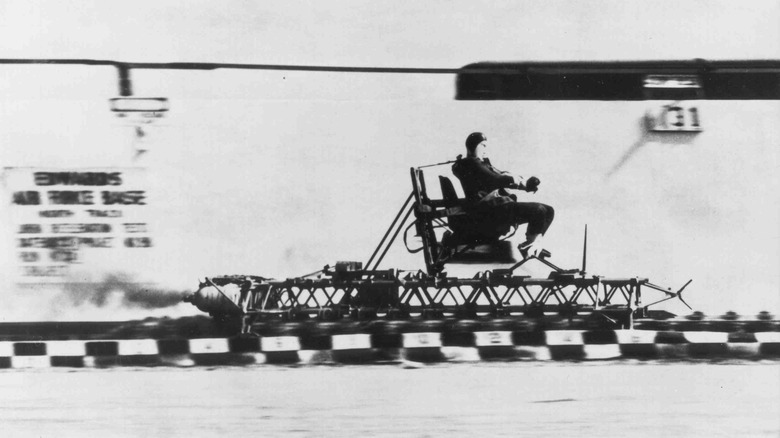
The years after World War II saw amazing breakthroughs in aviation. Jets allowed people to fly faster and higher than ever before. But the rapid acceleration and deceleration, especially in military jets, was taking a toll on bodies. Around this time, medical researchers led by Air Force Col. John Stapp tested how rapid deceleration affected human physiology using rocket-powered sleds. They found that humans could withstand far greater forces than what many experts considered the limit of human endurance.
For years conventional wisdom was that any acceleration or deceleration that exceeded 18 times the force of gravity (commonly referred to as Gs) would be lethal to humans. Stapp, a medical doctor and biophysics researcher who served in the Air Force as a flight surgeon, would prove that assumption wrong using himself as a test subject. From 1947 to 1954, project MX981 ran repeated tests of deceleration on the human body using a rocket-powered sled on rails called Sonic Wind I. These tests were run at Muroc Dry Lake in the California desert until 1953, after which the project moved to Holloman Air Force Base near Alamogordo, New Mexico.
Strapping in for science
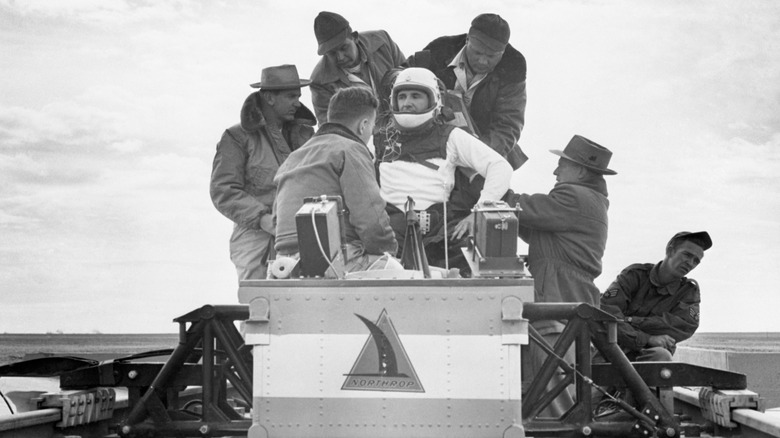
The Sonic Wind I was powered by nine solid fuel rockets that provided a total of 40,000 pounds of thrust. The rocket motors fired for five seconds and then the sled braked to a stop in less than one second. During the first tests, researchers tried using a crash test dummy equipped with sensors as a test subject. However, the dummy kept slipping out of its harness. Stapp responded by designing an improved harness and then decided to use himself as a test subject instead of a dummy. His first test run reached a speed of 90 mph without incident. After this the team slowly dialed up the speed, first to 150 mph and then to 200. After these successes Stapp continued increasing the sled's speed, completing nearly 30 runs over the course of seven years.
During acceleration Stapp experienced up to 22 Gs over a few seconds and then a greater force load when stopping. During his fastest run on December 10, 1954, Sonic Wind I propelled Stapp to 632 mph. After that, the sled slammed to a stop, subjecting Stapp to more than 46 Gs for an instant. Stapp survived, but during his time as a test subject he experienced several broken bones, had fillings fly out of his teeth, and even lost his vision for a short time because of broken blood vessels in his eyes.
Speeding toward improved safety

Although subjecting oneself to such forces sounds like an unusual choice, project MX981 was in pursuit of a worthwhile goal. Faster jets mean more acceleration and deceleration forces on pilots during normal flight. But escaping from a damaged plane at high speeds subjects pilots to previously unimaginable forces. In some cases this could be as much as 40 or 50 Gs. Stapp's experiences on Sonic Wind I demonstrated that people could survive forces far greater than the 18 Gs once thought to be the limit.
The lessons learned from project MX981 informed the development of safety procedures and equipment like ejection seats needed for pilots to escape from high-speed aircraft. This has saved the lives of many pilots and made air travel safer. In addition, finding that people can survive high-energy crash forces with the right restraints transferred into automobile safety. Stapp advocated for including safety belts in all cars, which was mandated by law in 1966. It might seem strange that someone would volunteer to ride on a rocket-powered sled, but what researchers learned from that kind of very hands-on science has improved safety both in the air and on the road.