

The 5 Strangest Photos In Human Medical History
Modern medicine has come a long way from its roots in administering heroin after surgery or lobotomizing people with almost any form of mental illness. Many practices that were normal for their time seem incomprehensible today. Whether it's archaic medical practices or extremely rare diseases, many bizarre moments have been captured over the years. Here are some of the strangest photos ever taken in human medical history.
A boy in an iron lung during the polio epidemic
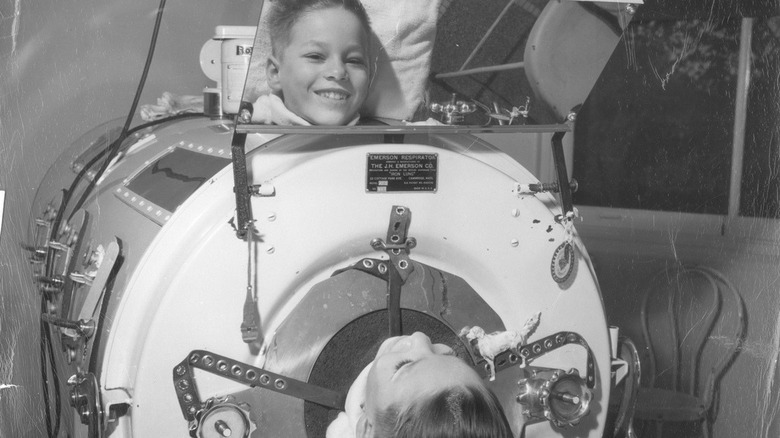
The smiling boy in the picture may look like he's on his way to outer space, but he's fitted inside an iron lung during the polio epidemic. The device, also called an Emerson respirator, allowed people to breathe when they weren't able to on their own. It worked by creating negative pressure that pushed and pulled air out of the lungs without the person inside needing to use their respiratory muscles.
The iron lung is effectively extinct today and has been replaced with positive pressure ventilation. Positive pressure ventilation works on the same principle of allowing a machine to take load off the respiratory muscles, but is usually delivered with a mask or intubation tube.
Hyperdontia: Having an extra row of teeth
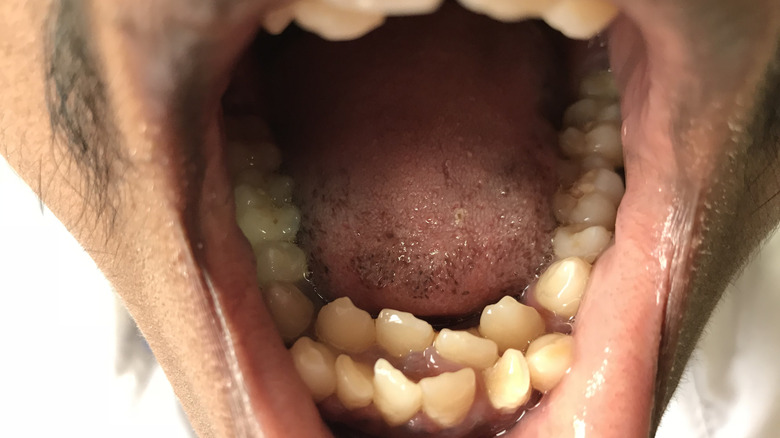
Some animals with extremely high bite forces, like sharks, have an extra row of teeth and famously regrow them throughout their lives. Most adult humans have just one row of 32 teeth (including the wisdom teeth that are often removed). About 1–3% of people have a condition called hyperdontia, which is the presence of extra teeth.
Most people with this condition only have one or two extra teeth, but the number can vary depending on the severity. The picture above shows an extreme case of somebody with an entire extra row of teeth. Hyperdontia is often an isolated trait, but it has been linked to Gardner syndrome and Down syndrome.
Doctors performing a lobotomy in the 1940s
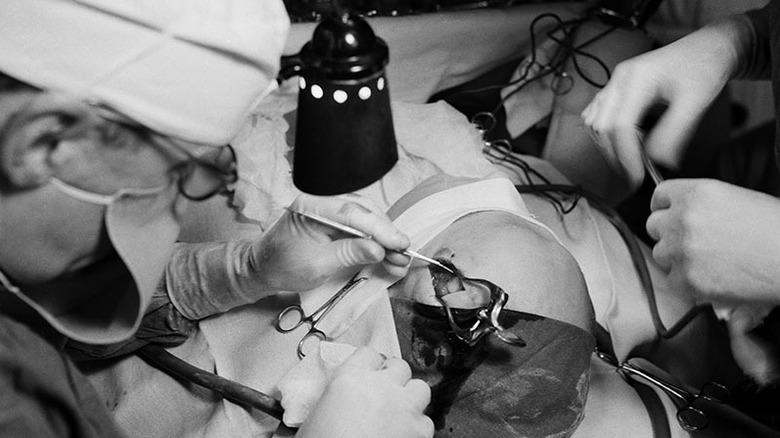
The lobotomy is a dark spot in the annals of human history. Through the 1930s and 1970s, doctors in the United States performed about 50,000 lobotomies to treat a myriad of mental illnesses. The procedure involved severing the connection between the prefrontal lobe and the rest of the brain. Although it would sometimes lead to improvements in severe mental illness, it also commonly led to emotional blunting, seizures, and even death.
The most common technique doctors used was called the transorbital lobotomy where an instrument resembling an ice pick was drilled through the eye socket to reach the brain. The picture above is showing a different technique where surgeons would drill a hole into each side of the head.
The extremely rare skin condition epidermodysplasia verruciformis

Epidermodysplasia verruciformis is a rare condition that causes wart-like growths. It's caused by a compromised immune system that increases susceptibility to human papillomavirus (HPV). HPV is the same group of viruses that cause regular warts most commonly found on your hands or feet. Epidermodysplasia verruciformis is considered extremely rare. As of 2017, there had only been about 500 cases reported worldwide.
By surface area, the skin is the largest organ in the human body. People with epidermodysplasia verruciformis may develop warty growths over large parts of their skin. They also have a drastically increased risk of skin cancer. The lifetime risk of skin cancer may be as high as 70%.
The man with a brain for a scalp
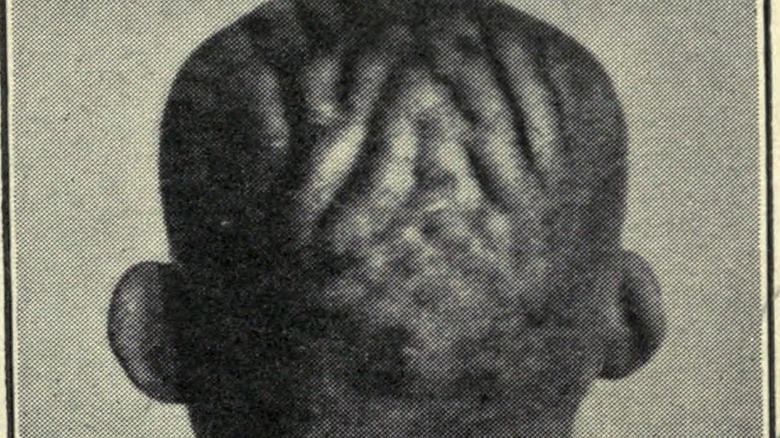
Cutis verticis gyrata (CVG) is an extremely rare condition also called "bulldog scalp." It's characterized by a folding of the scalp that gives it an appearance like the human brain. It's more common in males, affecting roughly 1 in 100,000. Its cause remains unknown, but it's thought that hormonal factors may play a role.
Two primary forms of CVG have been identified (primary means it isn't caused by another underlying medical condition). Primary essential CVG is not associated with any cognitive changes. On the other hand, primary non-essential CVG has been associated with intellectual disability or seizures.