

Scientists Can't Quite Believe This Bizarre Cosmic 'Cow' Phenomenon
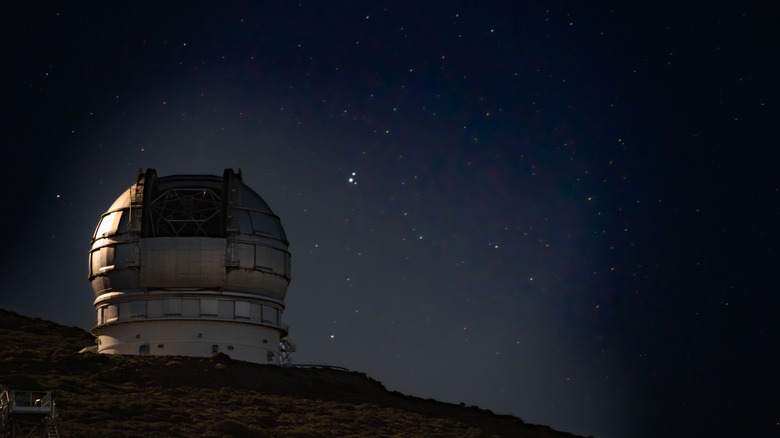
In 2018 scientists observed something in the night sky that nobody had ever seen before, an unusual cosmic blast roughly the same size as our solar system. The Asteroid Terrestrial-impact Last Alert System, or ATLAS, a network of telescopes meant to watch the sky for asteroids that pass near Earth captured the event and gave it a unique name: AT2018cow. ATLAS names objects based on the year and a sequential set of letters, meaning the cow part was a coincidence. Astronomers quickly started referring to the bizarre phenomenon as The Cow and have spent the past several years attempting to unravel its mysterious origins.
In some ways AT2018cow looked like the bright flash of a supernova, but scientists quickly noticed a few key differences. The flash was around 20 times brighter than the average supernova. It also went from not being visible to full brightness more quickly than supernovas usually do. Some researchers suspected it was a flaring white dwarf in our own galaxy, but careful observation showed it was in another galaxy about 200 million light years away. Astronomers soon determined that they were seeing something new, a hot, bright burst they classified as luminous fast blue optical transients, or LFBots.
Cosmic cows and their bizarre behavior
In the past few years since AT2018cow, scientists have been able to capture other LFBots using ATLAS and similar sky-monitoring systems like the Zwicky Transient Facility. These sensitive telescopes can detect objects thousands of times dimmer than the faintest stars humans can see with the unaided eye. This is important because even though LFBots are incredibly bright, they are also very far away. For example, one LFBot observed in 2024 was 100 times brighter than the average supernova, but was around 2 billion light years away. That leaves the question, if these events aren't ordinary supernovas, what are they?
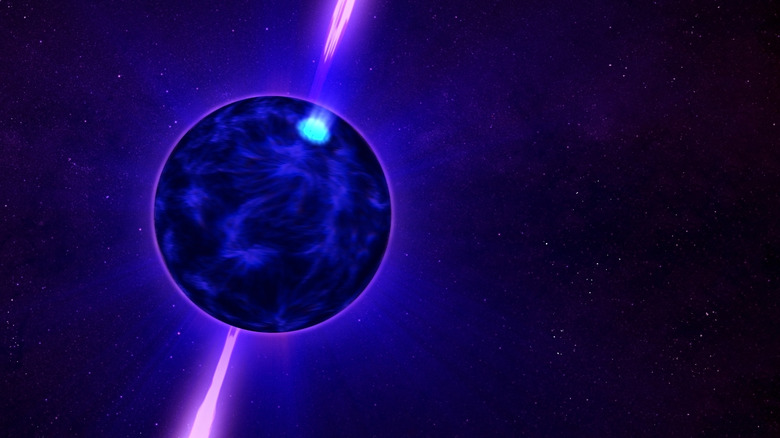
Scientists ruled out ordinary supernovas because of their brightness, how quickly they brighten, and how long they stay luminous, which left a few possibilities. One possible explanation was that it was a failed supernova, with a star collapsing in on itself to form a neutron star or black hole that sends jets of radiation through the remaining stellar matter. However, further analysis of The Cow and other LFBots pointed at a second mechanism: It could be a star that was being gobbled up by an as-yet unknown type of black hole known as an intermediate-mass black hole.
A theoretical class of black hole
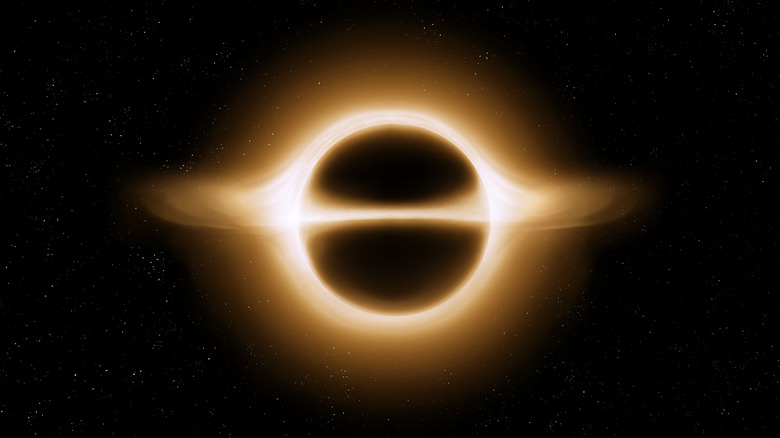
Intermediate-mass black holes are a new class of black hole more massive than stellar-mass black holes but far smaller than supermassive black holes like the one at the center of our galaxy. Scientists have theorized that intermediate-mass black holes can form when stellar mass black holes collide, but until recently these objects have eluded confirmation. Researchers analyzing light and X-ray emissions from AT2018cow determined that the event was possibly the result of a star interacting with a black hole somewhere between 100 and 1 million times the mass of the sun. This helps build the case that LFBots are caused by intermediate-mass black holes and provides more information on this class of black hole.
However, these findings are still far from conclusive. Better understanding of what LFBots are and how they form will take more observation. Fortunately, ATLAS and other sky-monitoring telescopes are up to the task, with ATLAS now able to monitor the skies in both hemispheres. After detecting a suspected LFBot scientists can immediately inform other astronomers around the world so they can collect as much data as possible as quickly as possible. With more observations, scientists could one day better understand this bizarre cosmic cow.