

Scientists Reconstructed A Tiny, 56 Million-Year-Old Fossil. They Didn't Expect What Happened Next.

Many different animals have an internal GPS-like system that allows them to migrate hundreds (sometimes thousands) of miles between consistently precise locations. In North America, the classic example is how Canadian geese migrate south for the winter. In fact, long-distance migration can be found all over the world and within every major taxonomic animal group, including birds, mammals, insects, fish, and reptiles. Yet, as common as migration may be, scientists are still unsure how migratory animals get their bearings so accurately. The popular theory is that they must possess some kind of magnetically receptive organ, like a compass. In 2025, the early origins of that compass may have been found in the fossil record.
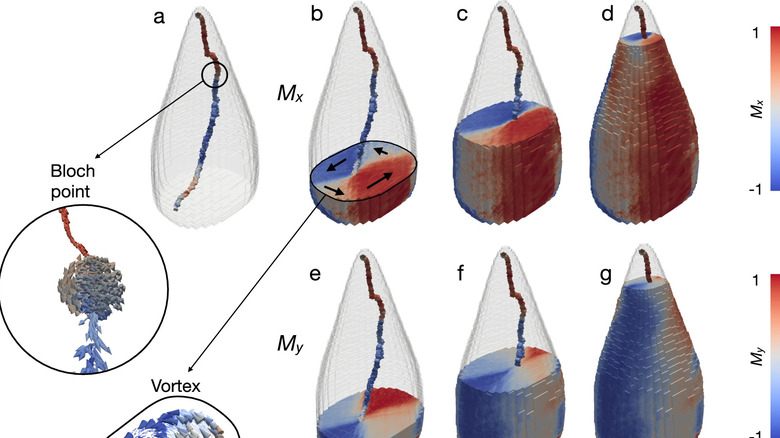
The study was published in Communications Earth & Environment in 2025, and its findings contain the earliest-known evidence of an internal animal GPS. To find ancient organic compasses in fossils, the researchers analyzed the magnetic structures of a sample of marine sediment that was fossilized around 56 to 97 million years ago. Using a technology called "magnetic vector tomography," the researchers were able to scan and map a 3D structure of the ancient sample's magnetic field and composition.
The researchers discovered tiny metal shards in the sediment, most of which are about the size of a single bacterium and thinner than a strand of spider web. Fiercely magnetic in nature, these shards the researchers call "giant magnetofossils," and they believe them to have organic origins. But how could microscopic metal shards in ancient fossilized sand suggest evidence of "animal GPS"? The answer lies in their composition, their shapes, and their similarity to the magnetic receptors found in certain modern bacteria. Similar to the markers of life recently discovered on Mars, the ancient magnetofossils can currently only be explained by evolution.
Magneto-reception: Tiny compass needles that grow inside the body
Not all migratory creatures use only magnetic reception to navigate long journeys. Monarch butterflies, for example, follow the light of the sun and a powerful circadian clock to orient themselves during their 3,000-mile migrations. (They're also in danger of losing the only plant they can eat along their route from Canada to Mexico.) Pink salmon, on the other hand, follow their noses to reach their breeding grounds, relying on the specific chemical signatures imprinted in their brains at the moment of birth. Marine mammals, such as seals, may even rely on "hydrodynamic tracking" by using their sensitive whiskers to detect water currents and develop a map of familiar underwater pathways.
Yet, the most common biological "GPS" relies on the Earth's magnetic field lines through an adaptation called "magnetoreception." Most magneto-receptive species grow microscopic needles in their bodies made of magnetite that are attached to nerve receptors. Birds have these magnetite needles in their beaks; sea turtles have them in their heads; fish grow them in their noses; some species of bacteria even have magnetoreception to find oxygen-rich water layers.
Regardless of their location in the body, these magnetite compass needles function the same way. The magnetite shards tilt and twist in the direction of the Earth's magnetic field, and the creature's sensory nerves "read" that direction. Most animals with magnetoreception interpret both the intensity and the direction of the magnetic field to calibrate their location. However, magnetoreception is less like cartography and more like an ancient sensory instinct.
The tell-tale signs of magnetoreceptors in ancient fossils
The Communications Earth & Environment study from 2025 found the magnetic shards in a slice of the Earth's crust in the Atlantic ocean that dates back some 56 to 97 million years. But the magnetite sample holds no impressions of the creature that produced the microscopic magnetic slivers. In fact, biologists are still unsure what animal ancestor first evolved magnetoreception.
It's likely that the survival strategy of growing fine-tuned, microscopic crystals independently emerged multiple times throughout life's evolutionary history. This can be assumed due to the taxonomic diversity of magneto-receptive animals, both extinct and extant. Because the sample was taken from fossilized ocean sediment, the researchers argue that their magnetofossils likely came from a mysterious marine organism that lived during the Cretaceous Period, around the time period that platypuses and our ancestors first diverged.
The study's magnetofossils are also large and complex, suggesting that they evolved far earlier. About 10 to 20 times larger than those produced by modern magneto-receptive bacteria, the fossils possess an advanced structure that could distinguish between a magnetic field's strength and its direction. This hints that whatever creature grew the metallic crystals, it was likely a migratory eukaryote with an advanced sense of direction.
Today, most migratory species use their tiny internal compasses in vastly different ways. Birds, for instance, only use magnetite for measuring intensity. To measure direction, they rely on cryptochrome proteins in their eyes to visualize the earth's magnetic field. This adaptation is incredibly advanced compared to the primitive magnetoreceptors found in modern bacteria. Thus, the 2025 study has identified the earliest-known magnetoreception — the adaptation is likely far more ancient. It seems organisms have been growing their own magnetic compasses for a very long time.