

Scientists Launched 2 Spiders Into Space To Build Webs. They Didn't Expect What Happened Next
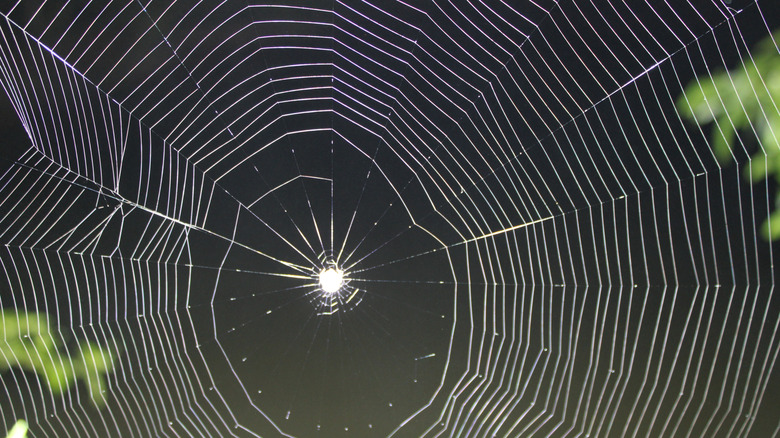
When most people think of a spider web, they think of the classic circular design built by orb-weaver spiders. This family of more than 3,000 species of arachnids build circular webs with a central hub, strands that radiate out like spokes in a wheel, and a sticky spiral to catch prey. In 2011, scientists launched two orb-weaver spiders to the microgravity environment of the International Space Station (ISS) to see how spiders spin webs in space. A 2021 study of those data found that spiders can spin similarly shaped webs in microgravity, but only if the lights were on.
The spiders spent two months living in separate, cube-shaped enclosures on the ISS, building webs while being photographed every five minutes. Both enclosures were lit by white LEDs from one side of the cube, which scientists referred to as the box's top. The spiders had 12 hours of light and 12 hours of darkness each day, with one of the boxes having infrared LEDs to allow photography in the dark. At the same time, scientists observed two other spiders in identical enclosures on Earth as a control.
How spiders weave their webs
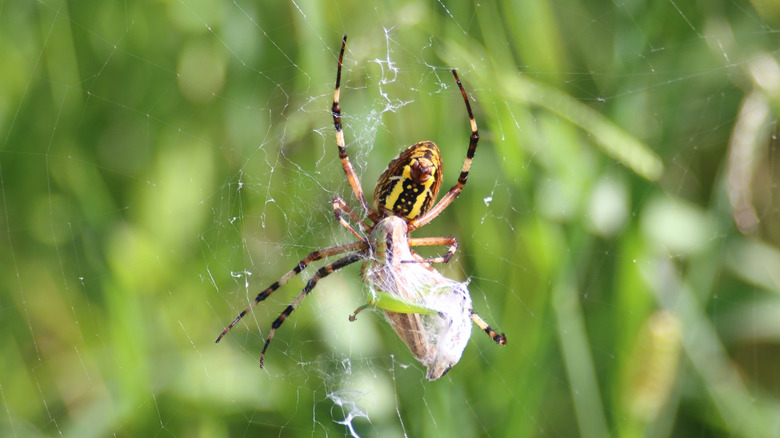
Orb-weaver spiders rebuild webs each day, consuming old silk as a way to recycle proteins. They build the webs with non-sticky silk to support the structure and then spin a spiral pattern around the hub using silk coated with a natural glue to catch prey. However, orb-weaver webs are typically asymmetric, with a larger capture area below the hub than above it. A spider will rest in the web's hub facing downward, waiting for vibrations that signal prey being captured.
The consensus has long been that web asymmetry and downward-facing behavior is the result of the force of gravity. Researchers have tried to assess this by adding weight to spiders and changing the orientation of webs from vertical to horizontal, but the results of those studies have been mixed.
Sending spiders to space is a logical choice for measuring the effects of gravity, and scientists have launched spiders into orbit before. However, previous experiments were unable to gather enough reliable data on web building. The 2011 experiment was designed to improve on prior studies by taking more regular photographs. The scientists also kept the spiders separated to keep them from interfering with each other's web building and fed them a regular diet of fruit flies.
In darkness and in light
The scientists expected that webs made in space would be less asymmetric and more irregular than those built on Earth. However, while the webs spun on the ISS were more irregular than those built on the ground, there were some notable differences in asymmetry. Webs that the spiders built in darkness had random designs. But if the lights were on when the spiders started spinning, the resulting webs turned out asymmetric. At the same time, the spiders themselves faced downward when resting like they would on Earth, but only as long as the lights were on.
These findings suggest that in the absence of gravity the spiders were using the lights as a cue for orienting their webs. This hints that while gravity is important, spiders can use visual stimuli as a sort of backup orientation system for building webs and waiting for prey. So it turns out that spiders can spin webs without gravity, just as long as someone leaves a light on for them.