

What It Physically Feels Like After Eating Fire
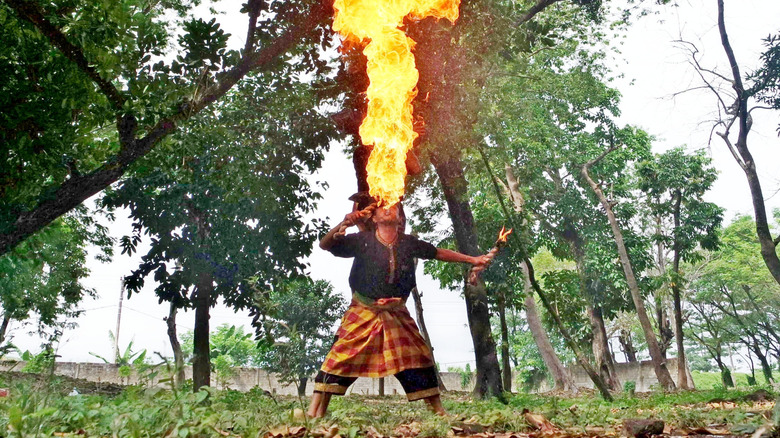
Fire is produced from the combustion of gas, meaning it can't technically be "eaten." The fire-breathers and fire-eaters that you might see at a circus don't actually ingest the fire itself, since combustion occurs outside their bodies. To produce the illusion, firebreathers hold a flame in their outreached arm and spit fuel over it. This spray technique is required for combustion to take place, since it disperses the fuel into tiny airborne droplets that mix with the air and combust, just like the injectors in your car. Fire-eaters finish their act by extinguishing the flame in their mouths, though the flame stops burning once they close their mouths and cut off oxygen. Nonetheless, mistakes do happen, and many fire performers have done serious damage to their windpipes.
According to a Boca Magazine interview with professional fire-dancer Lauren Çek, there are several ways the performance can go wrong. For one, heat rises, which is why firebreathers always aim their fire to the sky. Attempting to "breathe" the fire in any other direction can easily burn your lips, mouth, and face as the flames rush upwards. And should you breathe in through your nose at that critical moment of combustion, the combustion can travel into your nose and mouth. Says Çek, "It's not a big deal; you just burn off some nose hairs."
But what happens if the flame does travel into your windpipe? Fire-eaters complete their act by extinguishing the torch in their mouths. Done correctly, the fire simply can't burn in a closed mouth with no air. Still, the stunt may burn the performer's mouth, since the torch continues burning right until they close their lips. Fire-eaters don't swallow the flames, but the act can wreak havoc on the mouth, esophagus, lungs, and stomach.
Short-term mouth burns, long-term cancer risks

Fire-breathing (spitting combustible fuel over an open flame) and fire-eating (extinguishing a flame in your mouth) both come with risks. Should a firebreather accidentally inhale the burning fuel, or should a gust of wind sweep the flames back into their face, the byproducts of the fire can reach their lungs. The short-term effect is a painful thermal burn to the mouth and throat, while the long-term effect is an increased risk of cancer. In a Vice interview, a street performer claims he lost two colleagues to stomach cancer for using diesel in their acts.
Firebreathers who have accidentally breathed in fuel describe the experience as a gasping shock throughout their diaphragm. When the heated toxic byproducts of the fuel combustion enter the lungs, they immediately damage cell and tissue membranes. The fuel doesn't even need to be on fire to do damage — street performers may use gasoline, diesel, and alcohol, while professionals use paraffin lamp oil. In either case, breathing in these volatile chemicals can cause internal chemical burns.
The sensation is akin to when water goes down the wrong pipe, though far more painful. Ironically, the fiery sensation isn't just from the heat, it's also from the chemical burns. This is then followed by a swelling immune response from the affected tissues. This swelling chokes the airways, increasing the risk of asphyxiation. Those who die typically do so from asphyxiation — though there are few first-hand accounts about the experience of dying. For those who do survive, they report a crushing sensation in their chest for hours and days afterwards. In severe cases, pneumonia may develop. So what does fire taste like? Survivors describe the taste as oily, metallic, bitter, and similar to burnt flesh. Surprise, surprise.