

In 1952, A Chemist Accidentally Overheated A Piece Of Glass. He Didn't Expect What Happened Next
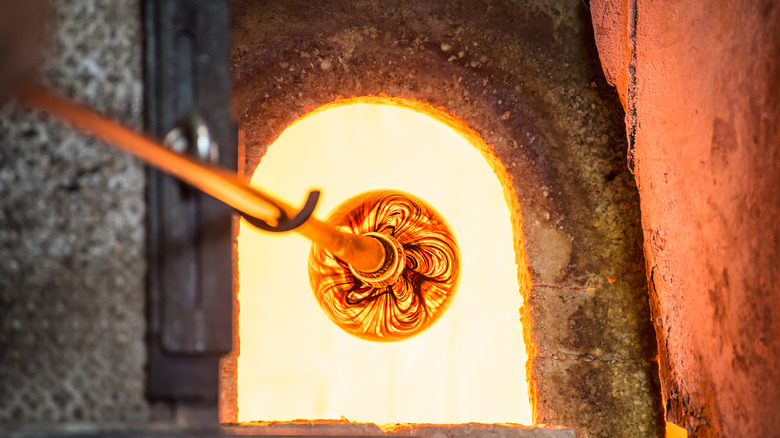
While many of the advancements we rely on in modern life came from years of careful planning and refinement, some can have their origins traced back to what famed painter Bob Ross would call happy accidents. In 1952, Don Stookey, a chemist working for Corning Glass Works, had one of these happy accidents while working on a new type of glass. He noticed that the oven he was using to heat-treat a glass sample had overheated and quickly went to retrieve what he expected to be a molten mass of glass. Instead, he found a solid material with unusual properties.
Immediately after pulling the glass out of the oven it fell to the floor. But instead of deforming or shattering, it landed on the floor unscathed with a metallic sound. The heating process had turned the glass he was working on into a crystalline material, known as glass ceramic, that is harder and stronger than glass and retains its shape and size at a wide range of temperatures. This accidental discovery spurred the creation of materials that have since been used in a wide variety of products.
Tweaking glass properties with chemistry
In the late 1940s, Stookey was working on types of glass that would take on different colors when heated or exposed to ultraviolet light. This was accomplished by adding elements like tin, barium, silver, and antimony in varying amounts. Then in 1947, the research director at Corning challenged the company's scientists to develop a new material that could be used in color televisions. What they needed was a way to make a glass mask with many tiny holes to guide electron beams used to make images on a television screen. After some work, Stookey devised a way to treat glass with lithium in a way that allowed it to be etched with hydrofluoric acid in specific areas to create intricate patterns.
This glass, known as Fotoform, is what led to the discovery of glass ceramic. Stookey attempted to heat a sample to 1,100 degrees Fahrenheit, but the laboratory oven malfunctioned and reached more than 1,600 degrees. This is higher than the roughly 1,300 degrees to which glassmakers will heat glass in order to make it soft enough to shape and bend. However, instead of softening, the chemicals in the sample of Fotoform crystallized, making a dense, white material that was far stronger than glass and could withstand rapid heating and cooling without breaking.
The many applications of glass ceramic
Corning patented this material under the name Pyroceram and within a few years the company was producing a new line of cookware known as CorningWare that could go straight from the oven to the refrigerator and back without shattering. Further refinement of glass ceramics allowed manufacturers to make hard, strong, and heat-resistant materials that were transparent like conventional glass.
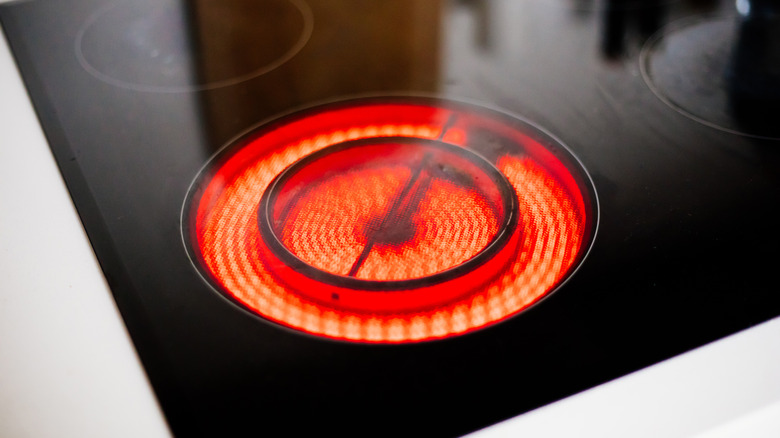
In the years since their discovery, glass ceramics have found their way into all sorts of products. In addition to dishes, glass ceramic is widely used to make cooking surfaces for stoves that are heat- and scratch-resistant. Transparent and heat-resistant glass ceramics are also used for windows in ovens, grills, and fireplaces. And the high strength of glass ceramic makes it well-suited for mobile device screens and bodies where scratch and shatter resistance are vital. At the same time, glass ceramics expand and contract less with temperature changes than conventional glass, and can even be engineered to have a coefficient of thermal expansion of nearly zero. This property is especially useful for mirrors used in reflecting telescopes.
Over the past several decades glass ceramics have made many modern conveniences possible. The different types of glass ceramic we carry in our pockets and keep in the kitchen are the result of careful testing and design. But the original material that proved it was possible came from a happy accident.