

The 'Useless' Organ That Kicks In When You Hold Your Breath

Although the spleen isn't the most well-known organ, calling it "useless" is a bit of a stretch since its function is well-studied by medical researchers. A simple way to think of how the spleen functions in the human body is like a military reserve. It's filled with soldiers (blood cells) that aren't on active duty until they're needed, and then they're called into action. Holding your breath seems to be one of the ways that you can call these cells into action since research consistently shows that breath-holding leads to a temporary decrease in spleen volume.
In a study published in PLoS One, researchers showed about a 10% reduction in spleen size after short breath-holding in 12 healthy adult volunteers. Spleen volume remained significantly depressed for 2 minutes before returning to its baseline size. The researchers found similar levels of reduction in three tasks: breath holding, deep-inspiration breath holding, and the Valsalva maneuver. The Valsalva maneuver is when you forcefully exhale with your mouth closed to increase pressure in your chest and abdomen.
This is one of many studies that have shown short-term reductions in spleen volume during tasks involving breath-holding. Much of the current research comes from divers. Previous research suggests that divers who hold their breath may see up to a 50% reduction in spleen volume within two minutes.
Why does breath holding shrink the spleen?
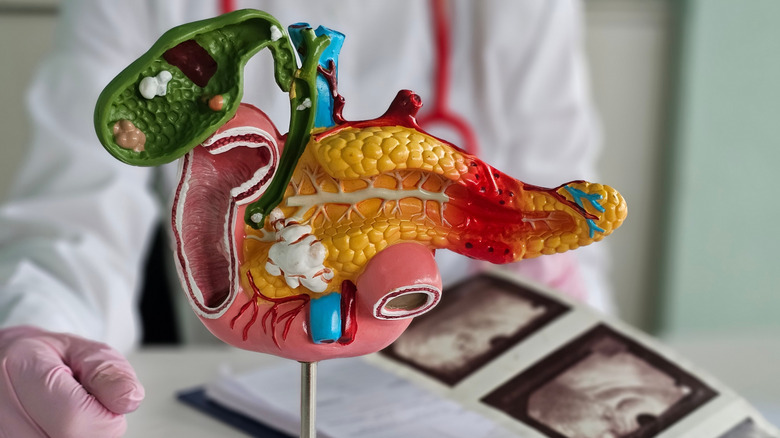
Your spleen is an organ on the left side of your body and acts as a reserve for platelets, red blood cells, and white blood cells that aren't actively circulating through your bloodstream. The reason holding your breath may shrink your spleen comes down to red blood cells. These cells contain hemoglobin, an iron-containing protein that carries oxygen. The spleen contains up to 30% of the red blood cells in your body at any given time.
The spleen releases red blood cells in response to physiological stress on your body that may require more oxygen to handle. Holding your breath can potentially trigger this response as part of your body's defense mechanism since breathing is how your body adds oxygen to your blood. The release of red blood cells from the spleen temporarily gives your body more oxygen availability before you can oxygenate your blood by taking a breath (especially if you're underwater and can't breathe).
In the study published in PLoS One, the researchers speculated that the volume reduction may be attributable to sympathetic nervous system activation and compression of the spleen. Sympathetic nervous system activity can stimulate contractions of smooth muscles (muscles under subconscious control) inside your spleen. This contraction causes pressure inside the spleen that pushes stored blood into circulation.
Advantages of having a larger spleen

Taking a deep breath and holding it seems to be one of the ways to cause a temporary reduction in spleen volume. For many people, knowing that holding your breath shrinks your spleen has little application other than as a trivia fact. However, understanding the function of the spleen is very important for divers who have to hold their breath for minutes at a time.
Research suggests that repeated diving exposures can lead to training adaptation such as increased spleen volume. This adaption may allow the spleen to release more blood when oxygen isn't available and help increase the amount of time a person can hold their breath. With training, the body may also produce other training adaptions like shifting the way the mitochondria use energy and increasing heart and lung efficiency in low-oxygen conditions.
Increased spleen volume may also have a genetic component that allows certain people to perform better at breath-holding tasks like diving. For instance, Indonesia's Bajau people have a thousand year history of diving being integral to their way of life. These people seem to have gene adaptions such as in the PDE10A gene that gives them an enlarged spleen and aids them with diving.