

Scientists Confirmed The Planet In Our Solar System That Ironically Smells Like Farts
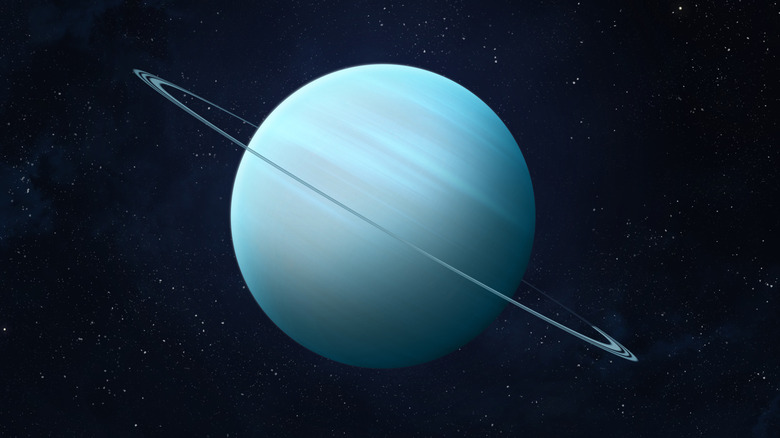
We have known what other planets in our solar system look like since Galileo Galilei saw Mercury, Venus, Mars, and Jupiter through his telescope beginning in 1610 (and accidentally created a crisis of faith in the process). And since 1955, we have known that other planets produce noise at radio frequencies, giving us insight into what the sound like. But until relatively recently, we have never known for sure what other planets smell like, and it turns out that ironically, Uranus smells like farts.
To be fair to Uranus, the actual scent is produced by hydrogen sulfide, the compound common in human farts that makes the gas smell like rotten eggs. We have known for a long time that Uranus's atmosphere would be unpleasant because it is made of hydrogen-rich compounds like ammonia, methane, and hydrogen sulfide. So why is hydrogen sulfide so common in the atmospheres of other planets in our solar system?
Hydrogen sulfide's abundance in space
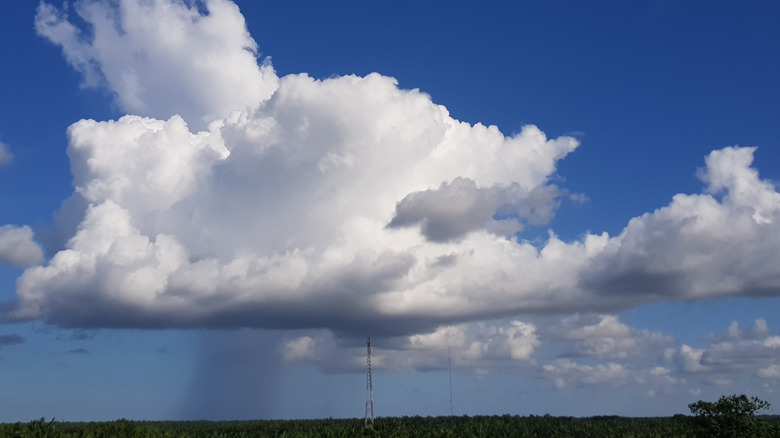
Take a moment to appreciate Earth's uniqueness. Its atmosphere of nitrogen, oxygen, argon, and carbon dioxide (with water vapor, other trace gases, and suspended particles) is capable of supporting life as we know it. The smell of the ground after rain is something that can't be recreated on any other planet we have yet discovered.
Hydrogen sulfide is a much more common atmospheric component on other planets in our solar system and beyond, for several reasons. First, sulfur is an abundant element (the tenth most common in the solar system) that is accreted as a solid during early planetary formation and then vaporized by the heat in protoplanetary cores. Because hydrogen is the most abundant element in the solar system, sulfur often reacts with it to produce hydrogen sulfide (H2S). This gas then accumulates in hydrogen- and helium-rich atmospheres, which are the most common class of atmospheres for the many other planets we have so far discovered.
How smell can help us learn about planets and their formation
Because the only firsthand accounts of how another celestial body smells have come from Earth's moon (which the astronauts thought smelled like spent gunpowder) we have to use other means to identify odor-causing compounds. Most commonly, that is done through spectroscopy. Spectroscopy helps us identify elements by measuring their light, and each element and molecule leaves a unique fingerprint on the light it interacts with.
Astronomers on Earth have used spectroscopy to observe the universe since 1863, when astronomer William Huggins and chemist William Allen Miller attached a prism spectroscope to the telescope at Huggins' private observatory in London. However, Earth's atmosphere limits us to observing the radiation signatures that can penetrate it. These include visible light (observable everywhere) radio waves (which require quiet zones or very large receivers), and near- and mid-infrared signals (only detectable at high, arid locations on Earth). The presence of hydrogen sulfide in Uranus's atmosphere was confirmed by ground-based spectroscopy at a high-altitude observatory in Hawaii in 2018.
The James Webb Space Telescope uses infrared spectroscopy to examine exoplanet atmospheres, identify early galaxies, and observe the birth of new star systems. We may soon know of other planets that smell like farts — but none will smell quite like Uranus.