

Scientists Still Debate This Bizarre Magnetic Cow Phenomenon
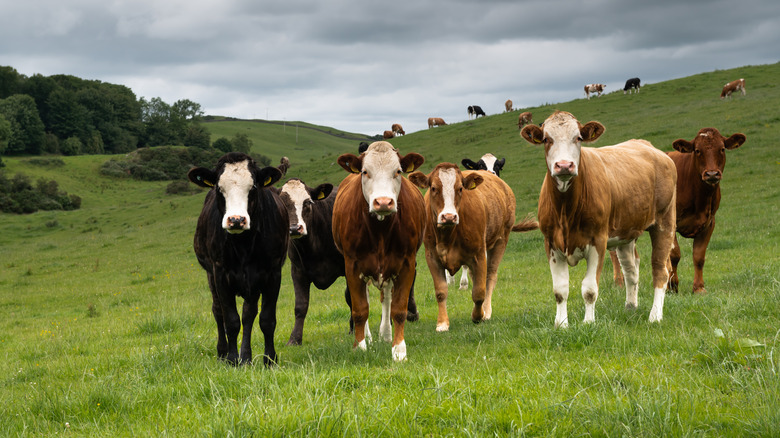
Whether its a sprawling Texas cattle ranch or a picturesque Pennsylvania dairy farm, if you ask someone to describe a rural scene, there's a good chance their mental picture will include a herd of cows. In many cases these cows will all face the same direction while they graze. Traditional wisdom states that cows face into the wind while grazing, while animals may face toward the sun, or away from it, to warm up, cool off, or simply get the sun out of their eyes. However, scientists continue to debate what role Earth's magnetic field plays in the direction herds of cattle face.
Many animals have the ability to detect magnetic fields. Observations and experiments have found that some animals rely on magnetic fields to find their way home. For example, migrating birds use magnetic fields to know where to go. However, observations of this ability in large mammals have been limited. Some studies have observed alignment with magnetic fields in herds of cattle and deer; although other researchers have called these findings into question, finding no correlation between the directions cattle face and Earth's magnetic fields.
A possible internal compass for cows
A 2008 study investigated how magnetic alignment might play a role in grazing and resting cattle and deer. The researchers used Google Earth satellite images of more than 300 herds of cows around the world. Cows are known to align with the wind and sun when the weather is cold and windy, so the study used imagery taken during warmer seasons and when the sun was higher in the sky, as evidenced by shorter shadows. They also observed the alignment of deer when grazing and resting as well as the layout of areas where deer had rested.
Analysis of these images showed that cows and deer largely aligned themselves in a north-south direction. The researchers ruled out wind as a factor controlling alignment because prevailing wind directions in the areas studied tend to run to the east or west and because deer typically seek areas sheltered from the wind. Based on that, the study concluded that the animals were likely influenced by Earth's magnetic field. A later follow-up noted that electromagnetic fields from nearby powerlines seemed to disrupt the north-south alignment, possibly supporting their conclusion.
Sunlight rather than magnetic fields
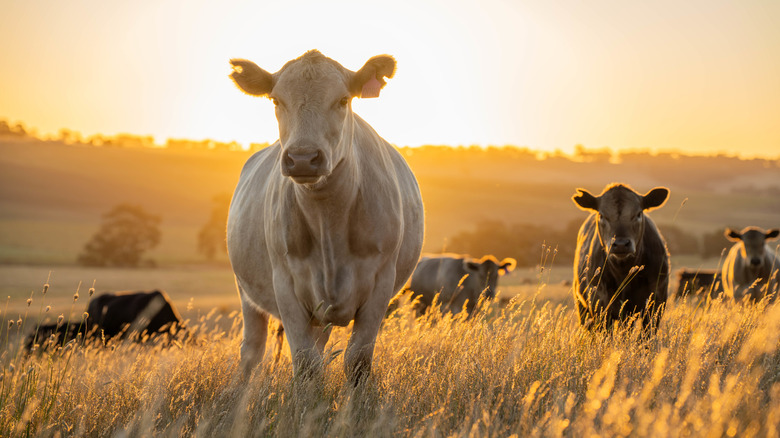
Some scientists have questioned the findings of the 2008 study, which were based on observations using satellite images, not an experiment with treatment and control groups. Similarly, while prior research observed body alignment, there was no indication whether the animals' heads or tails were facing north or south.
A 2018 study carried out an experiment on 34 cattle, with some of the cattle wearing a powerful magnet on a collar and others without a magnet. The researchers also conducted more than 2,400 observations of 659 cattle to re-evaluate the hypothesis that cows use Earth's magnetic field to align themselves. They found that the orientation of the cows was essentially random rather than north-south whether the cows had a magnet on or not. They also found that wind direction appeared to have no effect on which way cows faced, though the researchers didn't have data on wind speed.
The researchers concluded that the cows observed in satellite photos might have been trying to minimize their exposure to the sun as the images were from sunny, cloudless days. This aligns with other studies showing similar behaviors in other large mammals. While these findings contradict those of the 2008 study, the exact reasons behind why cows face the way they do when grazing remains unsettled and thus worthy of further study and debate.