

5 Animals That Are Smarter Than You Think

Many animals are well-known for their intelligence. Animal cognitive science has shown how octopuses are skilled problem-solvers and how chimps evolved to use tools. But give either animal a standard IQ test, and they'll probably score a 0. Their illiteracy doesn't help.
It's easy to see why the intelligence of non-human creatures can't be measured using human metrics. After all, an octopus has no need for a calculator, but it does tackle challenges in its marine environment with incredible creativity and reasoning. For instance, a 2011 study observed an octopus skillfully navigate a maze with a tentacle to find food, much like it would have to probe through crevices in a reef while hunting. And while chimpanzees might use tools like rocks in battle against enemy chimp troops, their powerful canine teeth serve them to win a fight, as well. Humans don't have dexterous tentacles nor a mouth full of deadly dentition, so we've filled a specific niche that can distort our perception of what being "smart" really means.
Thus, when we remove our anthropocentric bias from the definition of intelligence, a vast variety of animal species emerge as smarter than we originally thought. Even the classically-cited animals, like chimps and orcas, may surprise you with their adeptness at problem-solving and awareness. Other species display skills in using tools and teaching, such as the orangutan and the raven.
Here, we explore the diverse ways that non-human animals prove to possess surprising intellect.
Bottlenose dolphins — The standout Cetaceans
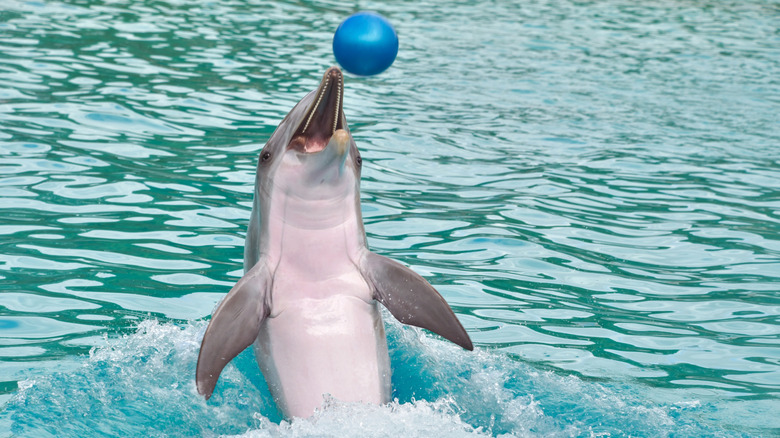
The infraorder Cetacea comprises 89 species of porpoises, whales, and true dolphins. That includes some of the most iconic marine mammals, like the humpback whale, the bottlenose dolphin, and the orca. It also includes the blue whale — the largest animal to have ever existed.
Interestingly, Cetacea has given rise to several of the smartest animals ever studied. For a long time, the intelligence of these aquatic creatures was believed to be related to their large brains. However, contemporary research has called into question the importance of brain size in determining intelligence.
Nonetheless, the cetacean brain certainly gives clues for the reasons why they're so smart. For example, the long-finned pilot whale has the most neocortical neurons out of any mammal. Such neurons make up the neocortex, the part of the brain responsible for cognition, spatial reasoning, motor control, and language. Cetaceans have been observed forming complex social relationships, vocalized communication, and even collective decision-making.
The cetacean that truly stands out as the brainiest, however, is the bottlenose dolphin, which has been observed using tools. For example, they'll wrap sponges around their snouts to protect themselves from getting injured when digging for food in the sea floor. They'll also sometimes carry conch shells while foraging, possibly to use as a shovel.
Reports of bottlenose dolphins engaging in "complex play" also indicate their intelligence. Some blow rings of bubbles, seemingly just for the fun of it, and they may even smile while doing so. Other studies have explored the immense capacity for communication among bottlenose dolphins, with the species demonstrating communicative abilities with both human beings and with other bottlenose dolphins via song-like whistling. Such behavior is eerily similar to that of humans, and high intelligence is the feasible explanation.
Chimps — The great ape second only to humans
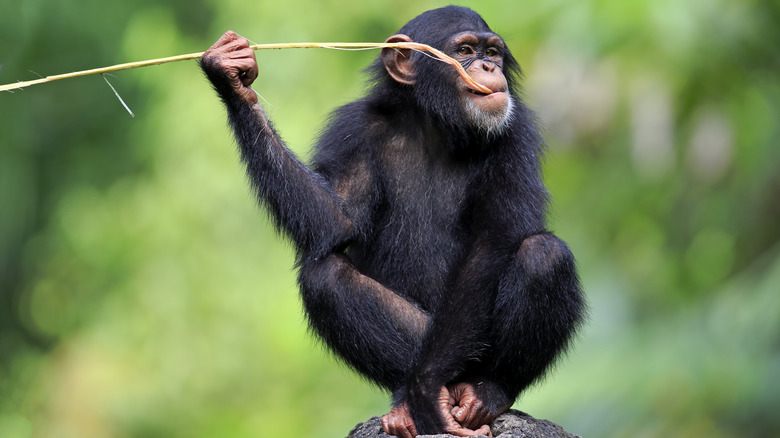
It's hard to argue against the claim that human beings are the smartest animals on Earth. After all, we created the concept of intelligence, so it's fair to take the crown. Yet the species with perhaps the best shot of usurping the throne are our closest relatives.
Humans are one of eight extant species within the great ape (Hominidae) family. We share this branch of the evolutionary tree with three species of orangutan, two species of gorilla, and two species of Pan (the chimpanzee and bonobo). That last one has proved to possess a high intelligence for decades.
In fact, we share 98% of our DNA with chimps and bonobos, and the cognitive parallels are clear.
For instance, chimpanzees have evolved to use tools. Examples include creating toothpicks to fish termites from holes and using rocks to crack open nuts. They've even been observed wielding stones as weapons. Other intelligent behaviors include teaching, complex social coordination, vocal and signed communication, and a working memory rivaling that of humans.
Other non-human great apes are intelligent too, but none has surpassed chimps. For example, orangutans have been observed both using tools and manufacturing them, honing leaves to make umbrellas and branches to make back scratchers. One captive orangutan was even taught to create a stone axe. However, chimps discovered stone tools on their own, without the need to be taught by humans.
Another trait that chimps share with humans is inquisitiveness. We humans like to explore, even without the promise of a reward. Chimps seem to do this as well. When presented with a puzzle, chimps prove to be far more persistent than other animals. Does that suggest an intrinsic desire to solve a task just for the satisfaction of completing it? It's certainly possible.
Crows — The kings of the corvids
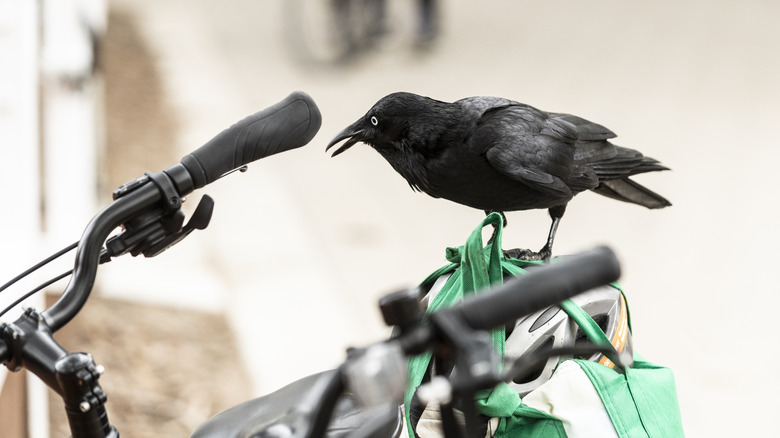
Crows and ravens have flown their way into our cultural consciousness through songs, symbolism, and stories. Their intelligence is also well-recognized, as accounts of crows being able to count birthed the alliterative phrase "counting crows." But although the ability of crows to count is debated, the animal's intellect is not.
Birds in the genus Corvus are commonly known as ravens, crows, and rooks, with no distinct taxonomic difference between their names. Thus, the word crow is often used as a blanket term to refer to any Corvus species, of which there are 50.
The Corvus genus is part of the Corvidae family of birds, which includes other intelligent species like Jays and Magpies. The Corvidae family's only rival on the intelligence scale is the Psittaciformes order, where parrots come from.
But within the Corvus genus, one species has stood out as the cleverest of the bunch: crows. For a stark example, New Caledonian crows regularly use sticks as tools to probe holes for food. Captive individuals have even been observed bending metal wires into careful hook shapes to poke into curved insect tunnels.
Another remarkable example of crow intelligence can be seen in a film segment hosted by the legendary David Attenborough. The clip shows a carrion crow placing hard nuts in the path of traffic to crack them. The urbanite crows even appear to prefer pedestrian crossings, waiting for the stoplight to change before collecting their meal.
Examples of crow intelligence like these abound, and each one is as fascinating as the last. In fact, crows out-perform dogs and cats in certain spatial problem-solving tasks, such as the challenge of determining which container shapes can fit food in them.
If crows prove anything, it's that "bird-brained" doesn't mean stupid.
Domesticated dogs — Man's smartest friend
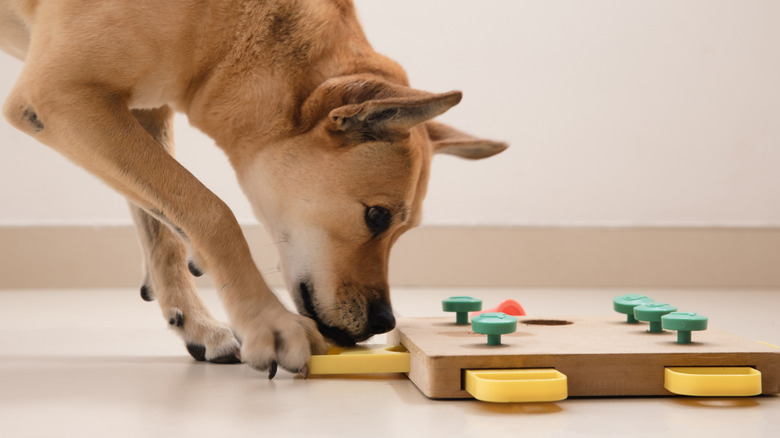
Man's best friend may be smarter than you think. While Canis familiaris might not score as highly as chimps and dolphins in cognitive tests, the species still shows remarkable cognitive skills in the domains of memory, learning, problem-solving, and even object permanence.
The archeological record suggests that dogs were the first organism domesticated by humans, with the earliest evidence going as far back as 15,000 years ago. The symbiotic relationship between these early canines and Homo sapiens shaped the Canis familiaris brain over time to synchronize with our means of survival. And because Homo sapiens (literally "wise man") are so clever, so too did dogs adapt to our complex social structures and language. Dogs' ability to learn spoken words is obvious. Many dog owners teach their pets simple commands like "sit," "stay," "heel," and "lay down." But professional dog trainers take vocalized commands to another level, teaching their dogs dozens of different auditory cues. And dogs are surprisingly quick to learn.
One study from 2003 revealed how dogs can associate objects with words in a brief period of time. The researchers passed objects around while stating the object's name, leaving the test dogs to watch. Once they instructed the dog to retrieve the newly-named object, the dogs consistently retrieved it. Even though canine cognition has been studied extensively, dogs continue to surprise us. Stray dogs in Moscow have been observed navigating the city's complicated subway system, and a Seattle dog figured out the bus schedule to get to the local dog park. There's even evidence that dogs possess a "theory of mind," assessing what humans are able to see from their different vantage points.
Maybe the old adage that you can't teach an old dog new tricks isn't true.
Octopuses — The cephalopods with nine brains
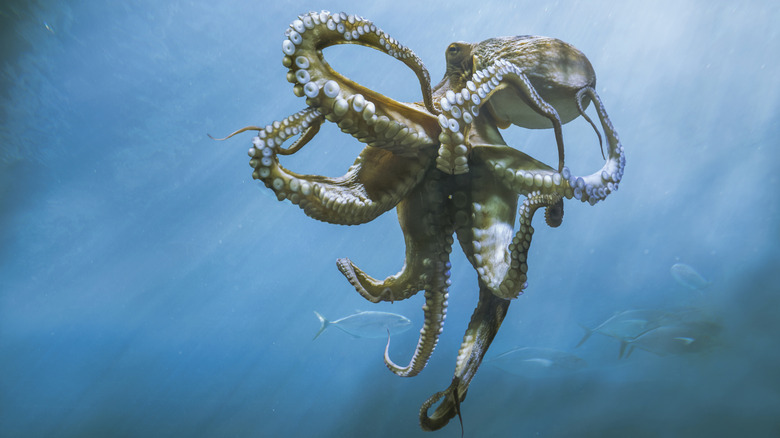
The intelligence of octopuses is especially exciting, since these mollusks are so distinct from the vertebrates that dominate most lists of intelligent animals. Indeed, an octopuses' nervous system is alien compared to our own, containing nine different brains alongside three different hearts.
In basic terms, octopuses have decentralized brains, or ganglia, located at the base of each one of their eight tentacles. Their ninth brain is equally foreign to us mammals, wrapping around the esophagus in a doughnut shape. One might expect such a bizarre nervous system would fail to achieve anything remotely intelligent, but such is not the case.
In fact, the octopuses' class Cephalopoda contains some of the most intelligent animals on Earth. It includes squids, cuttlefish, and octopuses, and it boasts the most complex and largest brain-to-body mass ratio among invertebrates.
But the octopus stands out among the cephalopods as the brainiest of the bunch.
It's been observed using tools, such as crafting coconut shells into shelters and manipulating the tentacles of the Portuguese man o' war to use as a venomous shield and weapon. Octopuses have also shown remarkable puzzle-solving skills, with various studies recording octopuses unscrewing jars and remembering the solutions to puzzles.
Octopuses and other cephalopods are living proof that our human mammalian brains aren't the end-all-be-all for intelligence. The fact that such distantly related species can display such incredibly advanced cognitive abilities means perhaps our reign as the smartest animals isn't as guaranteed as we might like to believe.