

A New Island Just Emerged In Alaska. What Caused It?
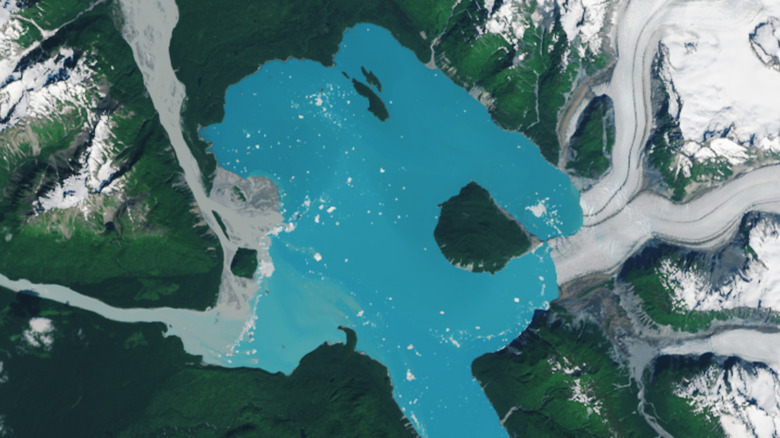
As the summer of 2025 drew to a close, a pair of NASA satellites captured images of an island in Alaska that hadn't been there before. The images, released in August by NASA Earth Observatory, come from Glacier Bay National Park, located on the Gulf of Alaska, one of the bodies of water that surround Alaska on its southeast arm. They show a small island rising from the eastern side of Alsek Lake, and while it is only two square miles in area, its significance to the scientific community is tremendous.
New islands regularly pop up around the world, though the vast majority are too small to warrant notice and are often consumed by water before long. These new islands are often created by underwater volcanic eruptions, but the island that just appeared in Glacier Bay National Park has a completely different origin. Instead of being formed by land emerging from a body of water, the new island formed through the opposite force: Water covering existing land until a small landmass is fully surrounded.
A century ago, Alsek Lake, where the island now resides, barely even existed. Instead, the massive Alsek Glacier filled the area. However, that glacier has been retreating for decades, and the more it melts, the larger Alsek Lake grows. As the glacier retreated, a small mountain known as Prow Knob emerged into view. In the summer of 2025, the glacier fully disconnected from the land, and Prow Knob became surrounded by the growing lake, creating this infant island.
Changes are happening throughout Glacier Bay
Unfortunately, the story of Alaska's newest island is really a story about the impacts of global warming, and the long-term consequences it will have for the planet. NASA Earth Observatory has observed continuous glacial retreat in the Pacific Northwest and elsewhere since the 1990s. The phenomenon has grown exponentially worse over the past decade, so researchers weren't at all surprised when Prow Knob became detached from the Alsek Glacier and converted into an island. In fact, the change had long been foreseen, and some researchers predicted it was going to happen as early as 2020. Still, the confirmation of these grim expectations is highly concerning.
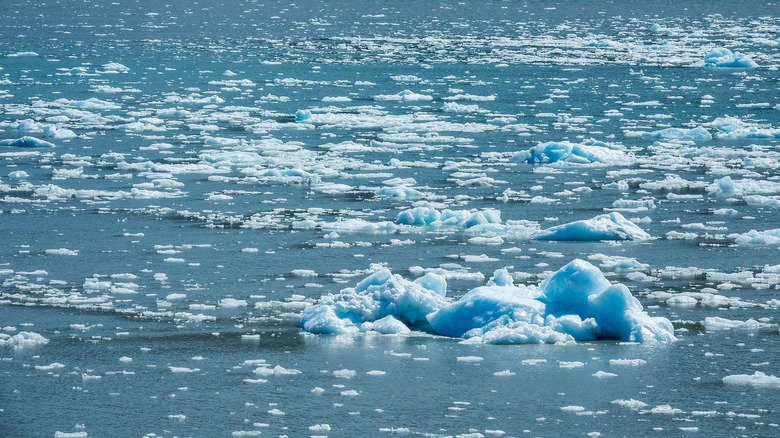
Satellite data shows that over the past 41 years, Alsek Lake has nearly doubled in size, going from 17 square miles to 29 square miles. All of this added water comes from glacial melt, which speaks to how rapidly ice is retreating, especially in Alaska, where temperatures are climbing at twice the average global rate. Tragically, the emergence of Alaska's new island will only hasten this decline, as the separation from Prow Knob has made what remains of the Alsek Glacier less stable. It is now expected that large chunks of ice will break away from the glacier in the near future, greeting icebergs in the lake that eventually melt and raise the water level even higher.