

The Invasive Plant That's Destroying Indiana's Ecosystems
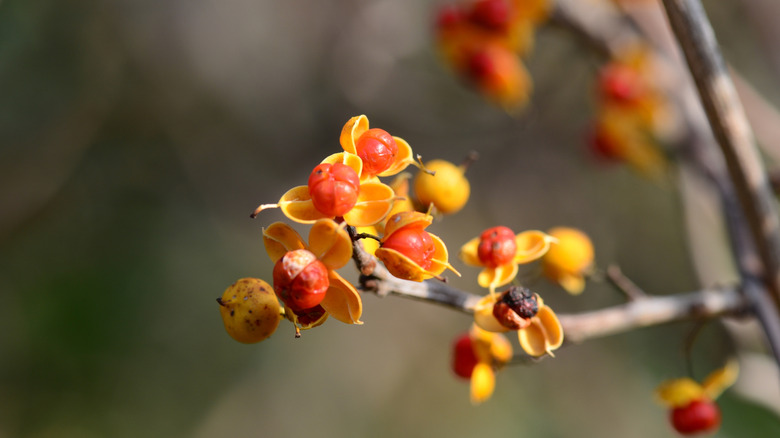
Sometimes the most destructive species are also the most beautiful. Invasive species in Illinois include the spotted lanternfly with its vibrant red body, while the massive Burmese python has had a devastating impact on Florida's Everglades. Now, there's a non-native plant in Indiana that's been long appreciated for its beauty, but its spread is growing out of control. It's called the oriental bittersweet, a vine that grows eye-catching orange-and-red berries, and its once-beloved reputation is quickly degrading in the face of the takeover.
The oriental bittersweet is known by many names. It's also been called the round-leaved bittersweet, the oriental staff vine, and the climbing spindle berry. First brought to the northeastern United States from eastern Asia in the 1860s, the plant was often bought, sold, and shared among homeowners in the Great Lakes region. Gardeners loved the thick vines, clustered orange berries, and plump round leaves, and it was a common ingredient in wreath-making. Few could have suspected that after 100 years, the curious vine would start wreaking havoc in national park forests.
Oriental bittersweet is destructive in several ways. The most devastating is how quickly it hogs sunlight. The leaves blanket forest canopies, while the vines spread from tree to tree, preventing native plants on the forest floor from getting adequate sunlight. Sometimes, its curtains grow so densely that it's difficult to even identify the plant species underneath them. The oriental bittersweet hogs nutrients, as well. Vines can grow as thick as six inches across as they wind up tree trunks, sapping nutrients and water from the soil at the base of the tree and disrupting capillary action.
Why Indiana's parks are suffering from an oriental bittersweet takeover
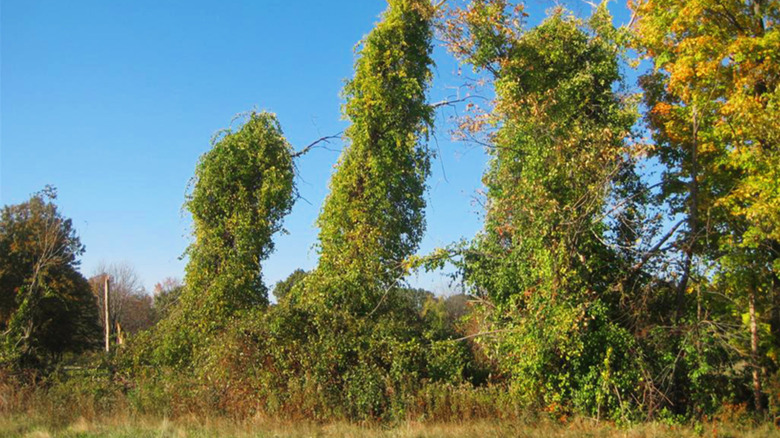
According to a 2016 report from the United States Department of Agriculture, the oriental bittersweet is prevalent in 11 U.S. states: Connecticut, Delaware, Indiana, Maryland, Massachusetts, New Hampshire, New Jersey, Ohio, Pennsylvania, Rhode Island, and West Virginia. While infestations are growing concerns in all 11 states, the plant's widespread proliferation in Indiana's state parks in particular, has bloomed in recent years. Hoosier park authorities have lately reported "massive" infestations, especially mentioning Brown County and Clifty Falls State Park.
The oriental bittersweet's devastation of Indiana forests is multifaceted. Besides the plant's knack for stealing sunlight and resources from native plants, its proliferation is also causing Indiana trees to topple over. Its matted mass of vines and leaves can act as a sail in the wind, causing its supporting trees to lose stability in high winds and topple over, sometimes dragging multiple trees down with it.
Indiana's notoriously severe weather conditions can also fell trees infected by oriental bittersweet. Normally, native deciduous trees lose their leaves in the winter, which helps prevent the top branches from accumulating ice and snow. The oriental bittersweet is deciduous as well, but its dense networks of vines are thick enough to trap heavy icy precipitation in treetops. This causes the trees to become top heavy, sometimes snapping off healthy branches, and sometimes bringing the whole tree down.
The future of Indiana forests under siege

Before European colonization and subsequent deforestation, 90% of Indiana's land base was covered in forest. Now, about 20% of Indiana is forestland, while another 20% is timberland. The vast majority of that land is privately owned, as only about 4% of Indiana is government protected. Thus, the responsibility for controlling the spread of invasive species like oriental bittersweet falls on the shoulders of Indiana residents.
Currently, the main approach from state and federal park officials is to simply remove the plants by the root. The Indiana Department of Natural Resources also suggests considering using systemic herbicides like glyphosate, but such chemical intervention can negatively impact the rest of the ecosystem. Preventative measures, such as only planting native plants in private gardens, destroying the berries after uprooting oriental bittersweets, and taking care not to carry soils from infected areas, are also recommended in the agency's guide to the oriental bittersweet.
While the oriental bittersweet may seem to only pose an immediate threat to trees, the entire ecosystem beneath its canopies suffers. In the words of The United States Geological Survey, invasive species like the oriental bittersweet "change the natural nutrient cycling processes that take place in ecosystems." Ecosystems are adaptive to slow change, but invasive species are fast. Now that humans introduced the destructive oriental bittersweet to Indiana's forests, it's on us to control it.