

Why Physicists Have A Big Problem With Star Trek's Phasers

It's common knowledge today that phase-based weapons systems have been in use since before the establishment of the United Federation of Planets in the mid-22nd century. Modern phasers are capable of stunning, heating, cutting, concussing, vaporizing, and even disintegrating. They are a true marvel of technology. But many physicists and chrononauts (from the 21st century in particular) don't understand how a phaser can vaporize a body without leaving a mark on the nearby environment. Of course, the answer is pretty straightforward: It's fiction.
Even if we acknowledge that the phaser is a fictional weapon, the 21st-centry killjoys kind of have a point (even the movies are lying to you about space lasers). The energy it would take to vaporize a human body, according to a 2017 study from the Journal of Interdisciplinary Science Topics, is about 3 gigajoules. That much energy output in one second is about comparable to the power output of a nuclear power plant. It would probably leave a mark.
Compounding this issue is that we have a pretty good idea of how much power a phaser can output. In "The Mind's Eye" (Season 4, Episode 24 of "Star Trek: The Next Generation"), Lieutenant Commander Data explicitly states that a Type III phaser he and Lieutenant Commander Geordi La Forge are testing has a constant energy usage of 1.05 megajoules per second. At that rate of output it would take 3,000 seconds (50 minutes) of continuous fire to fully vaporize a body. Of course, there's a bit more to it than that.
What is a phaser anyway?
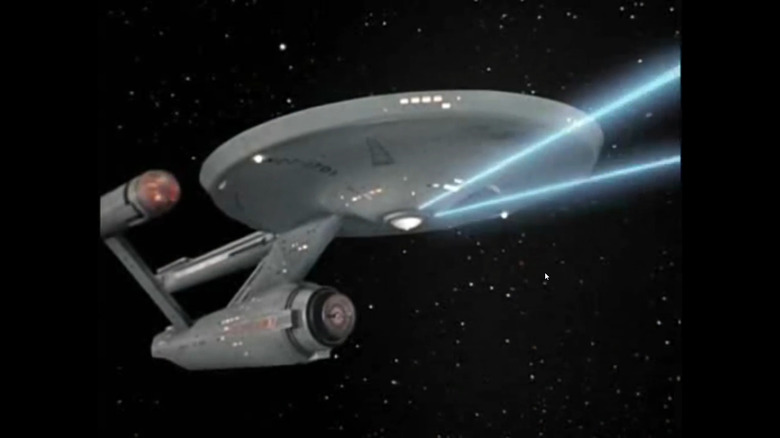
To really dig into this issue, we need to establish what a phaser is within the context of the "Star Trek" universe. The original "Star Trek" series didn't have any in-universe explanations for how phasers worked, but the 1968 "The Making of Star Trek" book explained that they were lasers with a pulsating frequency that can "interfere or interact with the wave pattern of any molecular form." By 1979's "Star Trek: Spaceflight Chronology," the lore had changed a bit to phasers being a hybrid weapon that combined a laser and a particle beam weapon.
By the time of "Star Trek: The Next Generation," the showrunners had once again changed what a phaser was. As laid out in the 1991 "Star Trek: The Next Generation Technical Manual," phasers work by emitting "nadions," subatomic particles that can "liberate and transfer strong nuclear forces." For those of you who skipped that day of chemistry class, the strong force is the force that holds together not just the protons and neutrons in the atomic nucleus, but the very quarks of which protons and neutrons are composed.
The idea behind these fictional nadions, is that a tiny jolt — a whole-body atomic nudge, if you will — is enough to disrupt your nervous system, causing you to be rendered unconscious. But at higher intensity settings, it can cause complete disintegration at an atomic level, rendering you to less than dust.
Do phasers already exist?
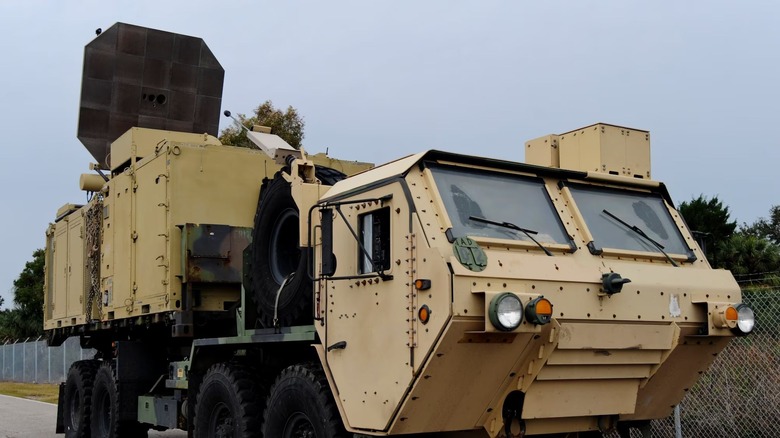
Although the phasers from "Star Trek" don't exist (yet), there are a number of directed energy weapons that have some of the same properties a phaser would. U.S. defense contractor Raytheon has had a weapons system called Phaser in development since 2016, but rather than nadions, it projects a wide beam of high-energy microwaves to overload and disable the electronics in drone swarms.
For the past two decades, the U.S. military has been developing millimeter wave directed energy weapons. These weapons systems generate electromagnetic waves that work on the same principle as a microwave, only on human targets instead of your leftovers. The high-energy millimeter waves penetrate the skin by less than a millimeter and heat up the top-most layer of subcutaneous water and fat to 130 degrees Fahrenheit, effectively burning whatever skin it comes in contact with. There's not a lot of concrete data on these weapons systems because they're so highly classified, but they do seem to work on similar principles to the original 1968 conception of the phaser.
Interestingly, millimeter-wave technology is being combined with deep learning to create semi-autonomous hidden weapons scanners. Essentially, millimeter wave radar (like those body scanners used by the TSA) is used to scan someone, then that information is analyzed by AI to search for hidden weapons. Honestly, that totally sounds like the kind of technology that would be in "Star Trek."