

The Unsettling Reason You Should Never Plant A 'Tree Of Heaven' In Your Backyard
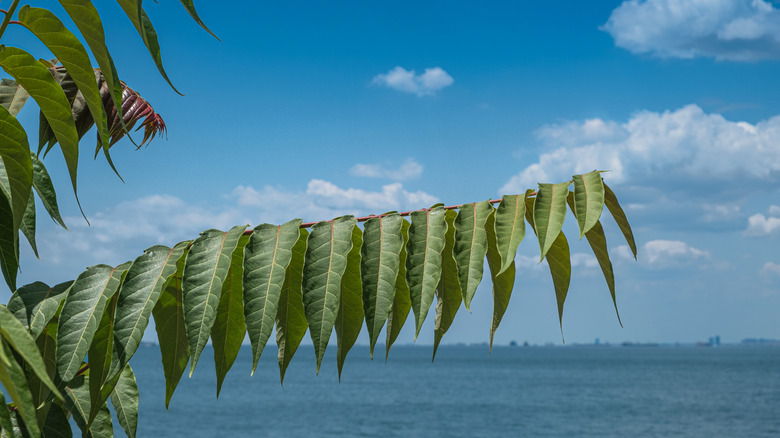
The tree of heaven is aptly named. Its beautiful green leaflets grow in rows along its thin stems, giving its branches an appearance not unlike that of ferns. But unlike ferns, the tree of heaven can grow over 15 feet in height per year, with adults growing up to 75 feet high and 50 feet wide. Its native range is in northeast China, but seeds were brought to North America in 1784 for sale in nurseries. At the time, few people guessed that the curious "Chinese sumac" would become a powerfully harmful invasive plant.
First grown intentionally as an ornamental plant, the tree of heaven has spread out of control across North America. It's now considered an invasive species in 30 U.S. states, including Hawaii. The plant employs aggressive tactics to outcompete native plants. For one, its roots release chemicals that are toxic to other plants, which removes competition from the surrounding topsoil. Then, it grows clusters of seed pods that are released by the hundreds of thousands per season. With ample room to grow, the seeds propagate quickly, forming monocultural thickets. Thus, one single tree of heaven can multiply into dozens in a relatively short amount of time.
But besides its rapid propagation, the tree of heaven has recently introduced a new problem: it's a spotted lanternfly magnet. The invasive spotted lanternfly has spread like wildfire across North America over the past decade, and its insatiable appetite for tree sap has devastated ecosystems in states like Illinois. To make matters worse, the lanternfly highly favors the tree of heaven above all other trees. Plant a tree of heaven in your backyard, and you'll create a breeding ground for another aggressive invader.
Two invasive species combine for a cascade of destruction
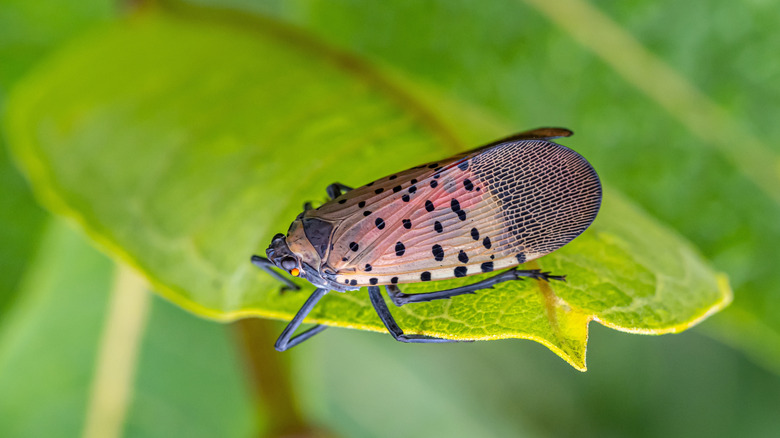
The spotted lanternfly's speed of spread is unprecedented. Native to southeastern Asia, the colorful insect began invading the Korean peninsula and Japan in the early 2000s. In 2014, it made its way to the United States. Now, the spotted lanternfly has a chokehold in 19 states. It feeds by piercing tree trunks and eating the sap, which can outright kill young saplings and create fungal infections in adult trees.
Compare the range of the spotted lanternfly with that of the tree of heaven, and the overlap is obvious: forest ecosystems in the northeastern United States and the west coast are contending with assaults by both invasive species simultaneously. And the parallel isn't a coincidence. The tree of heaven accelerates spotted lanternfly breeding due to its plentiful and easy-to-access sap. According to the Cornell College of Agriculture and Life Sciences, when spotted lanternflies encounter a tree of heaven, they lay their eggs in greater numbers and earlier in their life cycle than they do with native trees.
With its population boosted by the tree of heaven, swarms of spotted lanternfly then turn to native trees. Over 70 different species of North American trees are under attack by the invasive insect, exacerbating the on-going threat to native flora due to invasive species. Still, reducing the number of trees of heaven may help slow the speed of the spotted lanternfly's spread.
How to stop the spread of tree of heaven in its tracks
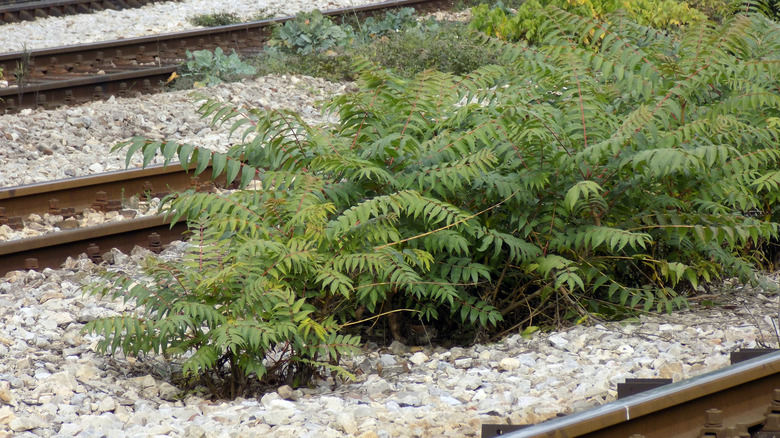
It's extremely difficult to completely eradicate a tree of heaven. Cutting one down at the base does little to stop it from reproducing, since the roots send out new shoots. Unfortunately, its long-reaching root system often weaves its way into sewers, drainage pipes, and cracks in concrete, making it nearly impossible to manually remove every potential new sprout.
Even small root fragments left behind in the soil are enough to regrow the removed tree. Herbicide is the only effective method for killing a tree of heaven, and repeated applications are often necessary. Because the tree of heaven already releases toxic chemicals into the soil, applying additional herbicides may leave the ground sterile and contaminated. Thus, attempting to kill an established tree of heaven is an uphill battle.
Prevention is the best medicine. Environmental agencies like the California Department of Fish and Wildlife have prioritized preventative measures to stop its spread. That means ending the practice of planting it in backyards and gardens, so homeowners can make informed decisions before the aggressive tree of heaven gets a foothold. If you want to do your part in the fight against invasive species like the spotted lanternfly and the tree of heaven, stick to planting native species.