

The Rock That Could Change What We Know Of Planet Mars Forever
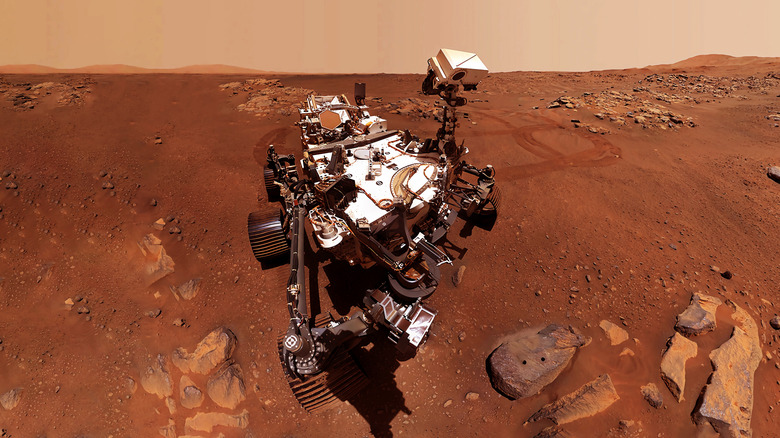
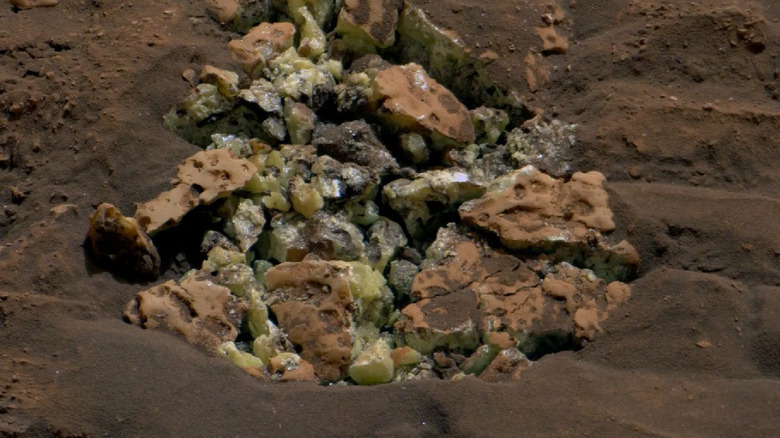
Sometimes, the greatest scientific discoveries happen by complete accident, and an inadvertent move by NASA's Curiosity Mars rover last year may have uncovered one of the red planet's most important secrets. On May 30, 2024, Curiosity rolled over a rock, which cracked under the rover's 1,982-pound weight. When the rock crumbled apart, it revealed a secret inside: a jumble of yellowish-green crystals. They were made of pure sulfur, not exactly what you'd want to find in a souvenir geode, but for Mars researchers, the find couldn't be more exciting.
This discovery marks the first time that pure elemental sulfur has ever been found on Mars. Prior to this, traces of sulfur on Mars had only been found in the form of sulfates, compounds that form when sulfur mixes with other minerals in water and then dries out. Discovering sulfates was an exciting breakthrough, as it gave us even more evidence that Mars once had water, but the recent discovery of pure sulfur tells us that Mars may have even more in common with Earth than we ever thought.
On Earth, like on Mars, sulfur typically appears in the form of sulfates. However, pure sulfur crystals are known to form on Earth through volcanic and hydrothermal activity. These crystals could help us better understand the geological history of Mars and why volcanic activity has seemingly ceased on the red planet. NASA scientists are currently analyzing the data collected by Curiosity in hopes of determining the origin of these sulfur crystals.
The special region of Mars where Curiosity found sulfur
The Curiosity rover stumbled over the sulfur-filled rock while exploring a region of Mars called the Gediz Vallis channel, a long gash carved into the rocky slope of Mount Sharp. The 3.4-mile-tall mountain lies at the center of Mars' Gale Crater, where Curiosity first touched down more than a decade ago. Mount Sharp was a big factor in NASA choosing the crater as a landing point because it has unique geological features that could be key to understanding the planet's history. The mountain shows clear stratification, just like sedimentary rocks here on Earth, and each layer holds remnants from a different period in Martian history.
The Curiosity rover isn't able to reach the top layers of Mount Sharp because the peak is simply too high and steep, but this is where the Gediz Valdez channel becomes crucial. The channel is full of rocks that came tumbling down from the ridge above, and because the channel is easily accessible to Curiosity, the rover is able to analyze rocks from Mount Sharp's upper levels without having to climb there. It was amongst this littering of stones that Curiosity stumbled across the pack of pure sulfur crystals. Because the rock had tumbled down from above, scientists aren't sure which period of Martian history it came from, but it could have significant implications for the biggest question in the astronomical world.
What this discovery means for the potential of life on Mars
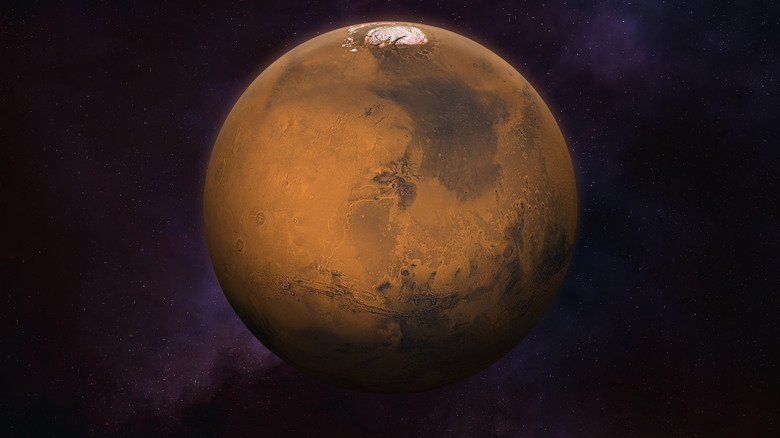
Every discovery made on Mars leads back to the question of whether the planet once hosted life, or may even host it still. Curiosity was deployed to answer that question, and this latest discovery adds to a growing list of evidence that the red planet once had the right conditions for life. The very existence of the Gediz Vallis channel, which scientists believe was carved by erosion from an ancient canal on Mars, is evidence of water. The discovery of sulfates and now pure sulfur within the channel are equally significant, as sulfur is just as vital to life as water.
Sulfur molecules play a far bigger role in life than many realize, being an essential building block of proteins. Sulfur is also involved in vital bodily functions like signaling between cells and protecting against free radicals. Every lifeform ever analyzed by scientists has contained sulfur, down to unicellular spores, and it is one of the most abundant elements in the human body. In the search for extraterrestrial life, sulfur is one of the key clues that NASA has its eye on, which is why Curiosity's latest discovery is so exciting. But in order to really understand the significance of this find, NASA needs more evidence on how these sulfur crystals formed. Fortunately, the Gediz Vallis channel is littered with many other rocks that look strikingly like the one Curiosity ran over, and it's clear the rover's investigation is just getting started.