

The Average Lifespan Of A Bowhead Whale Might Surprise You
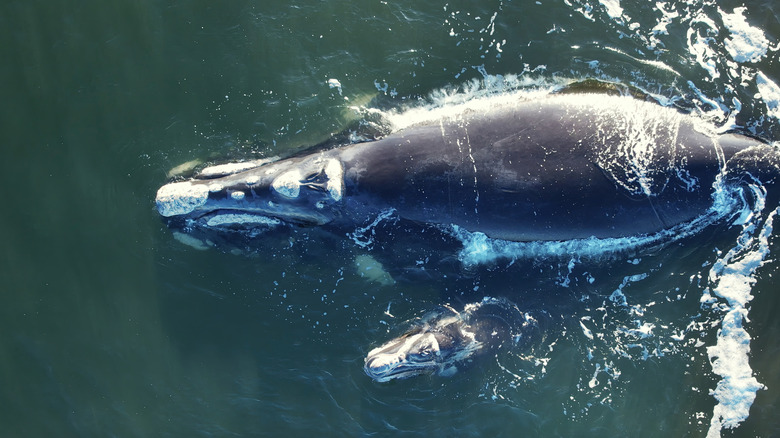
The bowhead whale is a treasure trove of fun facts. It can grow up to 65 feet in length and weigh 200,000 pounds, and while that's not quite the largest whale species, it's still among the biggest animals on Earth. Bowheads also have the thickest fat of any animal, with blubber up to a foot and a half thick. The outermost layer of their skin is an inch thick, which is about 25 times thicker than the human epidermis. This insulation allows the bowhead to be the only baleen whale that lives full-time in the Arctic. They also have the largest mouths of any animal and the widest vocal range of any whale. These facts alone paint the picture of one of Earth's most awesome species, and yet, we haven't even gotten to the coolest part. What excites biologists most of all, is the bowhead whale's lifespan, which can eclipse two centuries.
Bowhead whales live longer than any other mammals, and are among the longest-living animals on Earth. How do we know this? Fortunately for marine biologists, whales have proteins in the lenses of their eyes that gradually decay over time. The oldest bowhead whale to have its eye analyzed was an unfortunate victim of 20th-century whaling that biologists estimated to be 211 years old. It's quite possible that, as you are reading this, there are bowhead whales in the ocean whose lives overlapped with Thomas Jefferson's. Naturally, the question on everyone's minds is how these whales live so long.
What bowheads can teach us about aging
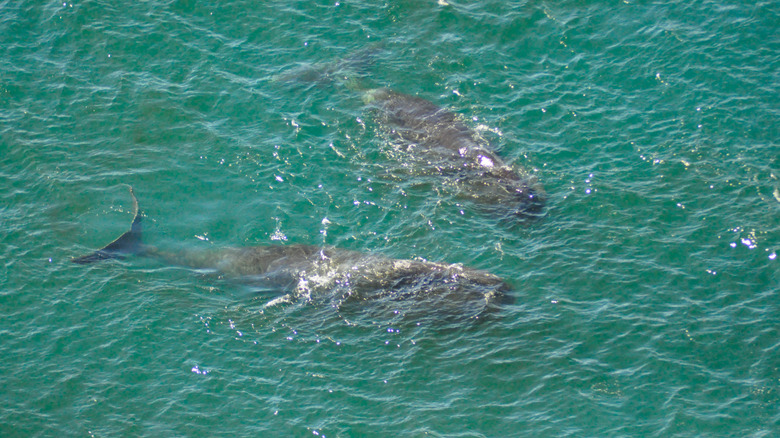
Many biologists believe that studying the bowhead whale could help us develop anti-aging treatments. The reason that animals die of old age is that DNA undergoes mutations over the course of a life. These mutations can come from specific forces such as diet, disease, and radiation exposure, but they can also occur randomly. Over time, accumulated mutations weaken the genes', causing the body to decay. This decline doesn't happen until after sexual maturity, to ensure animals have a chance to pass on healthy genes to their offspring. Bowheads take a full 25 years to reach sexual maturity, so that decline doesn't even begin for a quarter of a century. Their advantage doesn't stop there, though.
A study published last month in Nature, revealed an incredible new side to bowheads' longevity. These whales have long been noted for having extremely low rates of cancer, which seems to go against logic. A larger body means more cells, so shouldn't they have higher rates of cancer? The study authors set out to answer that question by analyzing cell samples from bowhead whales. They discovered that bowheads have extraordinarily high levels of a protein called CIRBP, which works to repair broken strands of DNA. The secret to their power is that CIRPB production is triggered by low temperatures, and with a life spent in water that's no higher than 2 degrees Celsius, bowhead whales produce 100 times more CIRPB than we humans do.