

What Are Dishwasher Pods Actually Made Of?
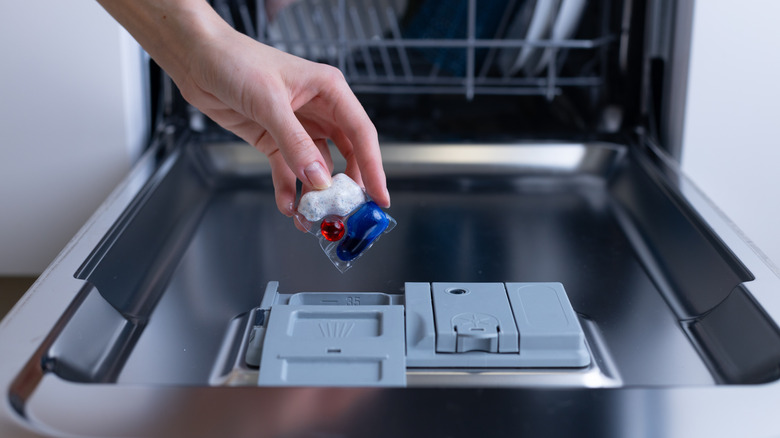
Dishwasher pods add a much-appreciated bit of convenience to a tiresome chore, and they offer some notable benefits beyond just that. Using pods ensures a consistent dose of detergent for each wash, and they help you avoid using too much detergent, which can actually clog your dishwasher and break it. Pods are also helpful for people with dexterity issues. It sounds like a great deal all around, but there's one facet of dishwasher pods that has a lot of people worried: the clear film that surrounds them. There's no two ways about it, dishwasher pods are made of plastic, specifically polyvinyl alcohol, or PVA (alternatively, PVOH). Like other types of plastic, PVA is made from petroleum, which has raised concerns about pollution and potential harmful health effects. There is some validity within these claims, but there's also a lot of misinformation being spread, and it's necessary to clear that up.
PVA is different from the vast majority of plastics because it can be made water-soluble, yet has great tensile strength and flexibility. That makes it the ideal material for packaging dishwasher and laundry detergent pods, but as anyone who's used these pods can probably attest to, sometimes the plastic doesn't dissolve completely, leaving a weird melted goop in its place. This has done nothing to soothe worried washers, most of whom share the same concern. In recent years, the proliferation of petroleum-based microplastics in water, which can pollute our own bodies, has caused well-warranted panic. But dishwasher pods are a different matter.
PVA doesn't dissolve into microplastics

More than 99% of plastics are made from petroleum, but not all of these are created equal, and not all of them break down into microplastics. The term "microplastics" specifically refers to solid particles of plastic under 5 millimeters in diameter, which are not water-soluble or biodegradable. The grade of PVA used in detergent pods does not create microplastics because it dissolves into liquid form. There also appears to be some confusion between PVA and the similarly-named PFAs, which are also known as "forever chemicals" due to their non-degradable nature. Again, this isn't the case for dishwasher pods, but that doesn't mean there is zero cause for concern either.
Not all grades of PVA dissolve in water, and even though the kind used in dishwasher pods does, many still have concerns about the liquid plastic residue they leave behind. This is where wastewater treatment plants come into play. Wastewater is treated with microbes that can actually eat PVA, further breaking it down into a form that can't accumulate in the body. This system isn't nearly as effective for other types of plastic, but a 2021 research study done in Belgium demonstrated that PVA-based films like the kind used in dishwasher pods fully biodegrade in 60 days, and some samples in as little as 28 days. Dishwasher pods are even listed on the EPA's Safer Choice guide, but the controversy with PVAs goes even deeper than the products themselves.
PVAs are steeped in misinformation

Fears about the safety of dishwasher pods have risen lately online, particularly in communities and social media pages targeted at mothers. These warnings have been pushed in large part by companies that offer an alternative product to dishwasher pods, the most notable being Blueland. The company, which offers film-free dishwasher tablets amongst their products, has rolled out a series of advertisements featuring alarming graphics, such as dishwasher pods floating in a breast milk pump.
Blueland has built its brand around the idea that PVAs are bad, and to this end, they repeatedly cite a 2021 study by environmental researcher Charles Rolsky, which claimed that more than 75% of PVAs remain in water after treatment. However, there were some serious flaws with that study, beginning with the fact that it was based on a computation model rather than actual experiments with detergent pods, and much of the data it cited was taken from non-soluble grades of PVA, not the grade used in dishwasher pods. The study was ultimately rejected by the EPA and removed by the journal that originally published it.
Dishwasher pods aren't going to poison you with microplastics, but there remains a very valid concern with their use. Regardless of the way it breaks down, PVA is still made from petroleum, and thus, its use adds to fossil fuel consumption. Plus, detergents can pollute waterways, regardless of what they are or aren't wrapped in, and that should be an even bigger concern.