

What Scientists Say About The Trump MRI Rumors
In mid-October, reports of a mysterious MRI scan performed on U.S. president Donald Trump circulated news sources, but there was little information regarding the purpose of the test. The 79-year-old president attempted to downplay the seriousness of the MRI, stating, "It wasn't the brain, because I took a cognitive test and I aced it" (via CNN). This statement helped to dissuade some supporters' fears surrounding the president's cognitive health, but it didn't exactly answer why such a medical test was necessary in the first place. Finally, on December 1, some of the details of the MRI were made public.
According to the released report, Trump received an MRI scan of his abdomen and cardiovascular system. The report was summarized using classic public-relations language; White House press secretary Karoline Leavitt said that the results of the imaging were "normal," stating there was, "no evidence of arterial narrowing impairing blood flow or abnormalities in the heart or major vessels" (via Fox News). But many experts aren't so dismissive of the gravity of such a test's purposes, pointing out that the need for an MRI is a cause for concern on its own.
For starters, an MRI is not part of "routine" health screens or "preventative care." MRIs are targeted tests that screen specific parts of the body when doctors suspect possible underlying diseases. Still, if the test really was just part of a general health screening, it wouldn't be the first time that wealthy citizens have paid for unnecessary medical care. Some concierge-style physicians have fallen under fire recently for providing MRI or CT scans to the wealthy without official medical indications. Certainly, Trump's wealth and position will provide access to anti-aging treatments and the best medical care that money can buy, though the same can't be said for average Americans.
MRIs aren't part of standard health screens
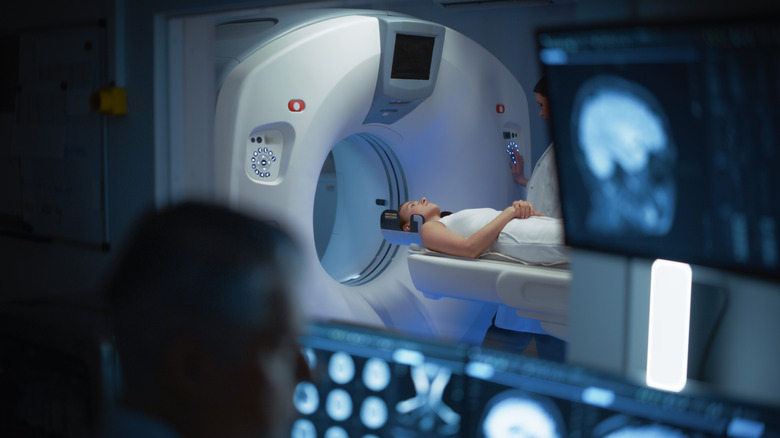
Experts largely agree that the procedure is likely the result of a suspected disease from the president's physicians. Although president Trump feigns ignorance as to the purpose of the scan, patients are always informed of the purpose of an MRI; when prescribing an MRI, doctors are required by law to explain its purpose to the patient. (This is partly due to the use of Gadolinium-based contrast injections, which have a small risk of allergic reactions.) In any case, it's part of informed consent when conducting an MRI, and Trump and his handlers would have certainly been informed of the purpose of the MRI. Therefore, the Trump administration is likely underplaying the importance of the MRI.
It's been confirmed that the president suffers from a condition called "chronic venous insufficiency" (CVI), which explains his bruised hands, from the intravenous needles involved in treatment, and his swollen ankles. However, CVI is a fairly innocuous condition, and it typically requires an ultrasound — not an MRI — to test. Thus, experts have speculated if the president has suffered from mini strokes that were covered up, pointing to his dragging leg, drooping left side of his face, and increasingly unfocused speech patterns.
Of course, such suggestions are just speculation. Donald Trump was 78 years and seven months old at his second inauguration, making him the oldest person to assume the office of the presidency. Such an age comes with expected medical monitoring, since the body's organs start aging faster the older you get; those nearing 80 years old are expected to require professional surveillance. As much as the administration's public relations might like to keep medical care of the president under wraps, it's clear that the octogenarian commander-in-chief needs the appropriate elder care of someone of his age.