

Scientists Can't Quite Believe This Abandoned Cow Phenomenon
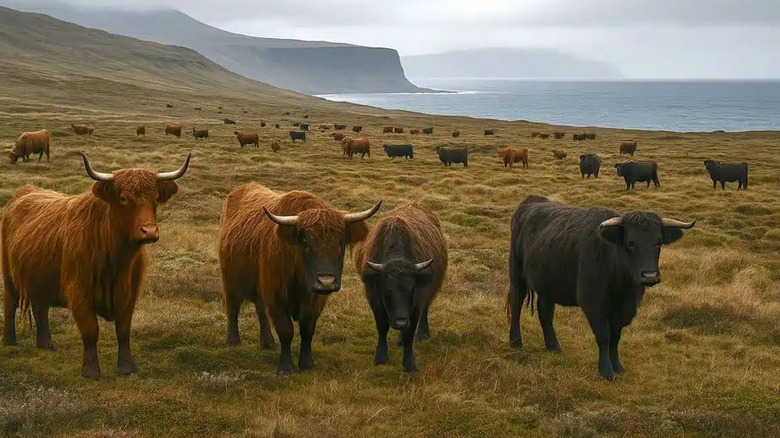
Around 1871, a farmer from the French island of Réunion off the coast of Madagascar took his family and his cows to far-flung Amsterdam Island — which is roughly equidistant between Africa, Australia, and Antarctica — to try and eke out a living. Less than a year later, the party returned to Réunion and left the cows behind. Although history has mostly forgotten that failed expedition, science is still studying the cows it left behind.
Amsterdam Island is little more than a volcanic rock jutting out of the southern Indian Ocean, so it's no surprise the French settlers left so quickly. What is surprising is that the cows they left behind ended up flourishing and establishing one of the few feral populations of domestic cows anywhere in the world. At their peak, the Amsterdam Island cows numbered around 2,000, with seasonal researchers culling around 50 per year for food.
Despite the scientific value of the cows (particularly to geneticists), they were an invasive species, destroying the ecosystem and becoming a menace to endemic plant life. In order to curb the effects of the environmental destruction the cows were wreaking, the French government erected an electrified barbed wire fence to confine the animals to the north side, culling the herd south of the fence. Following the success of these efforts, the decision was made to cull the remaining population in 2010. Despite this, these cows are still helping us learn about how evolution and natural pressures shape life.
Why are the Amsterdam Island cows so interesting
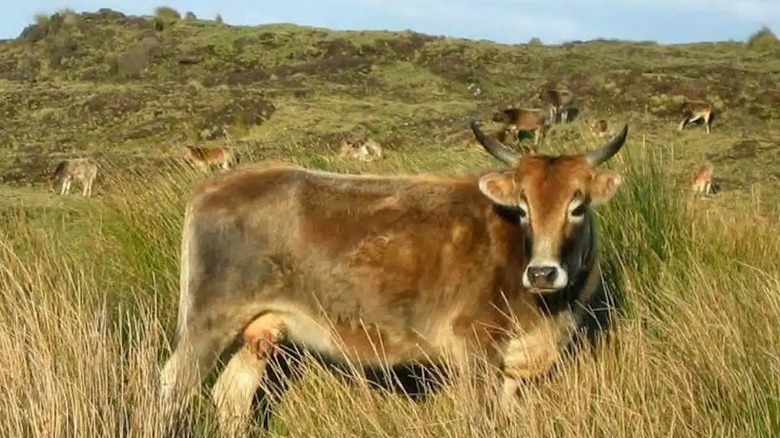
There aren't many feral cow populations in the world, so there haven't been too many opportunities to study the feralization process among cattle. One thing that surprised researchers was the genetic diversity of the Amsterdam Island cows. Reporting in Molecular Biology and Evolution, scientists found that the feral cows of Amsterdam Island exhibited more genetic diversity than their domestic European counterparts, despite a founding population of only 5 individuals a little over 100 years ago.
The scientists speculate that part of the success of the Amsterdam Island cows comes from their pre-feral heritage. The abandoned cows' ancestors were predominantly European, closely related to the Jersey cattle breed from Great Britain. Their relatively small stature and pre-adaptation to cold, wet climates, gave them an advantage in the subpolar environs of Amsterdam Island.
The feral cows of Amsterdam Island have been eradicated, but they weren't the last population of feral cows. In the Chernobyl Exclusion Zone, feral cows — and their effect on the environment — are being studied as an analog to aurochs, the extinct wild forbear to cows. And in Alaska, the feral cows of Chirikof Island are being protected as a genetic failsafe against a potential disease outbreak. It's too late for the Amsterdam Island cows, but we can still protect the feral cows that remain.