

Why People Are Putting Cardboard In Their Gardens

Interest in something called the "cardboard method" has skyrocketed recently as gardeners in the northern hemisphere prepare for the winter months. The technique is simple in practice, but it can provide a powerful boost to the health of your garden. All it takes is some cardboard, a hose, and some extra topsoil.
To employ the "cardboard method," lay bare cardboard on the garden bed you want to prep for the winter, covering the soil completely. Make sure to use only raw cardboard, and remove any plastic labels or prints. Then, drench it in water until the cardboard is nice and soggy. Finally, throw another layer of topsoil or woodchips over the entire surface until no cardboard peeks through.
The result is a garden "lasagna," whose layers help maintain a warm, healthy microbiome under the cardboard while also preventing weeds from breaking through its surface at the first hint of spring. Without this layered protection, freezing temperatures can penetrate deeper into the soil, killing off and slowing down many of the microorganisms that plants need to grow. But the method goes beyond the latest "life-hack" trends of home-gardening blogs; it's actually a tried-and-true gardening practice called "sheet mulching," and its underlying concept is based on real agricultural science.
The science of making a garden soil 'lasagna'
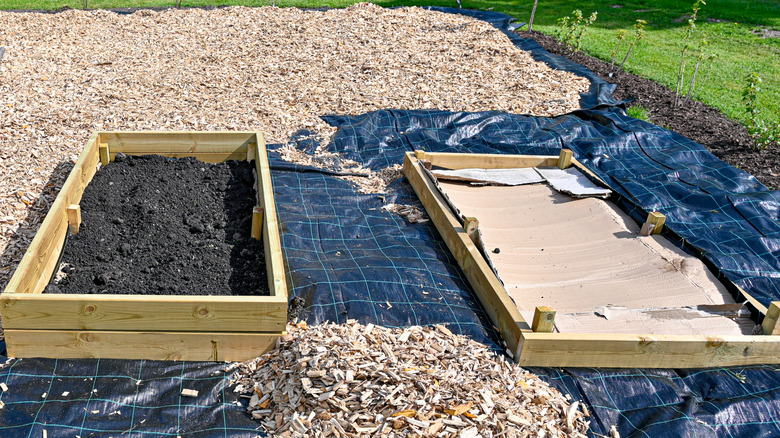
You can use other materials for sheet mulching besides cardboard. Newspapers and thick paper work, too, since they're also primarily made from cellulose, which is the key ingredient. The cellulose fibers in cardboard and newspapers hold together well over the course of a winter, forming a semi-permeable seal over the soil below. This, as the name of the practice implies, creates a natural mulching layer.
The microbes beneath the surface of the cardboard (or paper) will continue to break down the organic materials in the soil as the temperature above ground drops. Their biological processes generate heat and organic gases that remain trapped beneath the sheet of cardboard, allowing the microbes to continue working throughout the winter. Then, after a few months pass, the cardboard (or paper) will also break down, further enriching the soil with its cellulose content. Once it does, the soil below and the added mulch layer above connect, and the invigorated microbes can start decomposing the top mulch layer just in time for the start of the gardening season.
Using cardboard for your garden instead of recycling or tossing it in the garbage is an excellent way to reduce waste. In fact, cardboard often goes to waste processing plants, where microbes are used to break it down anyway. Thus, sheet mulching skips the middle man, while also enriching your garden beds.