

The Surprising Object That Will Soon Become The World's Largest Artificial Reef
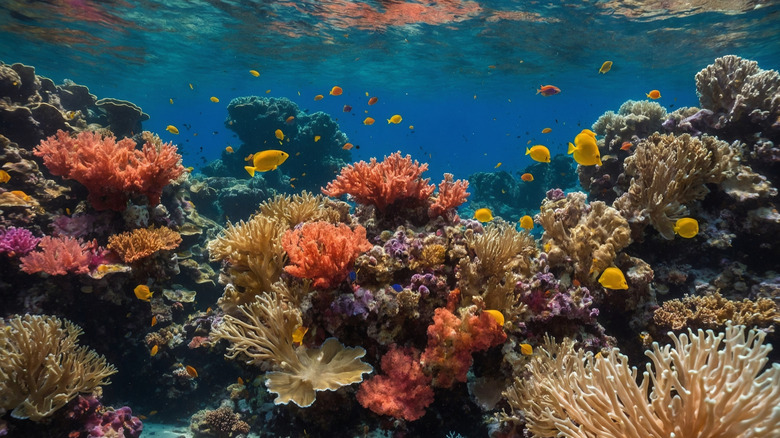
The rapid decimation of coral reefs around the world has served as one of the most tragic and terrifying testaments to the horrors of climate change. Human interactions with coral reefs, including pollution, overfishing, and ocean acidification, have destroyed as much as two-thirds of our planet's historical reef coverage, putting countless species at risk of extinction. However, human activities also have the potential to do the opposite — create brand new reef coverage. Growing global efforts towards coral gardening and the construction of artificial reef ecosystems offer hope for the future. That's more true now than ever, as plans to turn the SS United States into the largest artificial reef in history are currently underway on the U.S. Gulf Coast.
Humans have actually been creating artificial reefs for a long time, just not on purpose. Throughout history, shipwrecks landing on the ocean floor have become frameworks around which new coral reefs can form. After the fragile state of natural reefs came to light, people began doing the same on purpose, intentionally sinking retired ships in areas where they can be taken over by marine life.
The SS United States will be the biggest ship to meet this fate when it's sunk in 2026.The colossal vessel measures 990 feet in length and 101 feet at her widest, with 12 decks, making her even bigger than the RMS Titanic. She will provide a massive framework for future coral growth, which seems like a fitting end for a ship whose life was defined by record-breaking feats.
The SS United States was a technical marvel
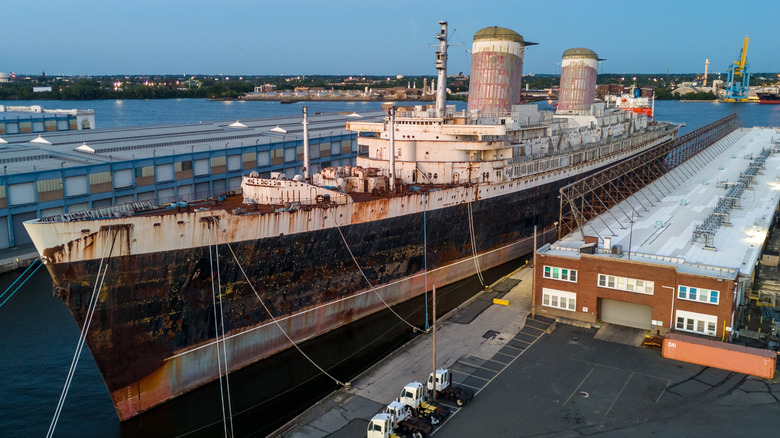
The SS United States is one of the greatest maritime engineering feats in history. She was built between 1950 and 1952, and remains to this day the biggest passenger ship ever made in the U.S. You might expect the SS United States' massive body to slow her down, but that couldn't have been further from the truth. She could reach 44 miles per hour, which is absolute lighting for an ocean liner. On her maiden voyage in 1952, the ship set a record for the fastest trans-Atlantic crossing in history, at just three and a half days. That record still stands in 2025.
The SS United States was able to defy speed expectations for her size because the ship's frame was designed from lightweight and flexible aluminum. This also allowed her to be built without expansion joints, meaning that if the ship were to collide with an iceberg like the Titanic, her hull would still hold together. The SS United States was also built to be fireproof. The only pieces of wood on the entire ship were the kitchen cutting boards and a piano made of fireproofed mahogany.
The SS United States was faster and stronger than any other passenger ship ever built, and that's because the ship had a secret side purpose. Built amidst the Cold War, the ship was covertly subsidized by the U.S. government, but never saw wartime action. In fact, she operated for barely more than a decade.
A second life beneath the waves
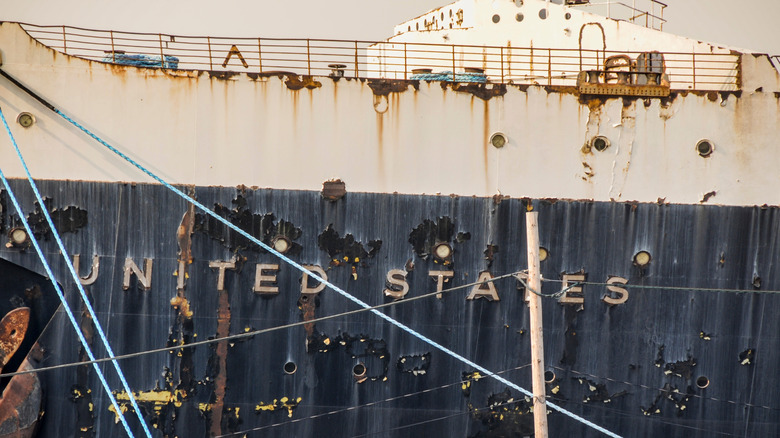
The SS United States was abruptly taken out of service in 1969. More and more passengers were turning to air travel, and the ship was hugely expensive to operate. However, the government didn't have a retirement plan ready, so the SS United States bounced through a few owners before landing in a Philadelphia dock. She sat there from 1996 until 2024, when the ship was purchased by Okaloosa County, Florida, which will oversee her sinking. The waters off the Gulf Coast provide the right climate for coral reefs, and there are already several other artificial reefs in the area.
Before the SS United States can begin her second life as an artificial reef, a lot of prep work must be done to ensure the safety of the environment. Earlier this year, the ship was relocated to Mobile, Alabama to undergo a deep clean, removing any trace of dangerous pollutants like plastic, glass, and chemicals.
The SS United States is expected to be ready in early 2026, at which point it will be towed from Mobile to a point 32 nautical miles southeast of Pensacola and sunk. It will ultimately descend to a depth of 180 feet, but the top decks will only be around 60 feet below the surface. Tourism officials have expressed an interest in turning the artificial reef into a diving destination, but doing so could bring more of the environmental damage these projects are supposed to be saving us from.