

Scientists Still Debate The Function Of This 'Useless' Organ In Humans
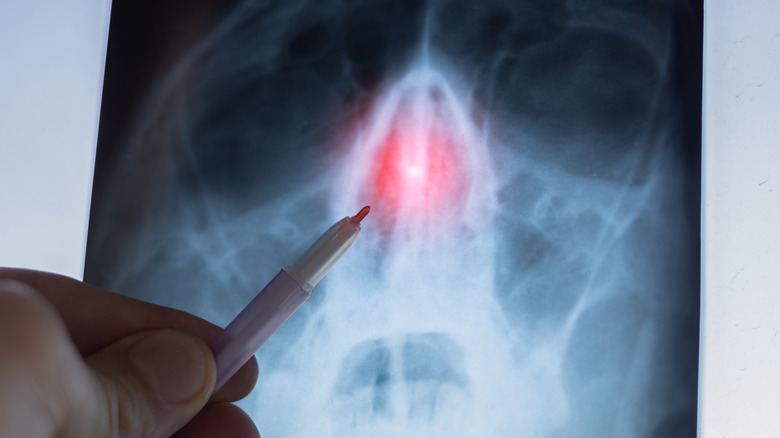
For skeptics of evolution, vestigial organs are pretty difficult to explain. The human body has inherited numerous adaptations from our ancient ancestors that no longer serve a purpose in our modern world. Wisdom teeth, for example, were once necessary when our diets were mostly composed of tough, uncooked foods like nuts and raw tubers. Now, those extra molars can actually cause more harm than good. However, there's one organ for which scientists continue to debate its value: the vomeronasal organ, or "Jacobson's organ."
The puzzling part about the Jacobson's organ is that it very clearly has a purpose in other animals. Most species of reptiles, mammals, and amphibians possess one, typically found within their nasal cavities, and it's used for detecting pheromones and specific chemicals from other animals. Essentially, Jacobson's organ is like a specially-tuned smelling instrument, providing animals the ability to detect the specific chemical signatures of prey, predators, or potential mates.
But if you can't recall ever being able to tell the difference between two people based on the smell of their pheromones, don't worry. A recent analysis of the human vomeronasal organ (VNO) declared that it is most likely a vestigial, non-functioning organ. A 2023 paper, published in Surgical & Radiologic Anatomy, goes on to suggest, "It is not necessary to take particular care not to damage the VNO during septal surgery." Such a stance mirrors that which had once been held by the medical establishment in regards to the appendix. But the consensus on the appendix has changed, and biologists now recognize that the appendix is more important than previously thought. And, like the appendix, it's possible that the Jacobson's organ isn't completely useless after all.
An organ of secrets and sexual behavior
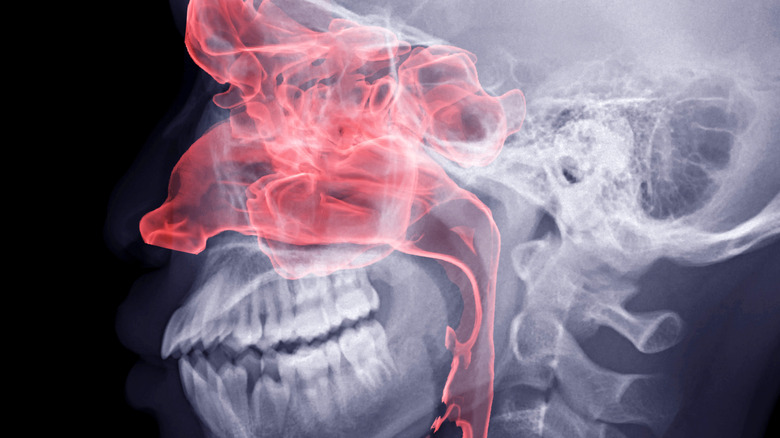
The debate on whether or not humans possess a VNO is settled. Dissections, MRIs, CAT scans, endoscopies, and even electron microscopy have all confirmed its existence in humans. It sits inside our noses near the nasal bridge, where cartilage meets bone. Anatomists describe it as a "blind sac," which means its sensory cells work the same way as the rest of our olfactory system; as air breathed in through the nose passes over the VNO, specialized sensory cells take "samples" to detect airborne chemicals and alert the brain to their characteristics. Whether or not those specialized sensory cells in the VNO can distinguish specific pheromones, however, is still up for debate.
For one, not every human possesses a vomeronasal organ. Based on various studies, it appears that only around one-third to two-thirds of people have one, and it's more commonly found in infants and young people. This fact alone suggests the VNO is vestigial, since it's apparently not necessary for survival into sexual maturity. Not having one does not affect life expectancy. That being said, a 2018 review of the literature in The Cureus Journal of Medical Science highlights several potential benefits to keeping your VNO intact.
One study demonstrated that the VNO does hold "receptor function," though this was contradicted by other studies that claim that VNO receptors' genes are inactive in humans. There are also claims from clinicians that the removal or damage of the VNO can affect sexual behavior. This makes sense, since the organ is so closely tied to mating behavior in other animals. Indeed, the VNO is connected to "cranial nerve N," which may have an important role in hormonal activity. But for humans, the data is lacking, and the debate continues.