

The Fascinating Death Ritual Of Elephants Explained

Many animals are smarter than you might think. Elephants, besides being the largest land animals to walk the earth, are exceptionally intelligent. Beyond their amazing pattern recognition skills and use of tools, elephants practice a unique ritual that most people assume is reserved only for Homo sapiens. Elephants practice burial rituals for their dead, which could mean that they both recognize the gravity of death and retain long-term memories of their loved ones.
In a devastating 2024 report published in the Journal of Threatened Taxa, elephant zoologists in India described the great extent to which Asian elephants mourn and bury their deceased relatives. It's one of the first times Asian elephants have been officially recorded practicing burial procedures for their dead. Previously, only African elephants have been observed conducting similar death rituals.
The report describes five separate instances of Asian elephants burying dead calves in the eastern floodplains of northern Bengal. Each of the five cases followed a similar pattern; when a calf died prematurely, its mother and relatives carried the corpse to a ditch, where they placed the carcass with its legs upright. The mourning elephants then moved earth and foliage over the dead body to cover it. Most tellingly, other members of the herd participated in the burial ritual — soil was compacted by multiple members to help cover the carcass. It would appear elephants not only bury their dead, but they work together to ensure their fallen herd members rest in peace.
Distinguishing intentional burial rituals from accidental treading
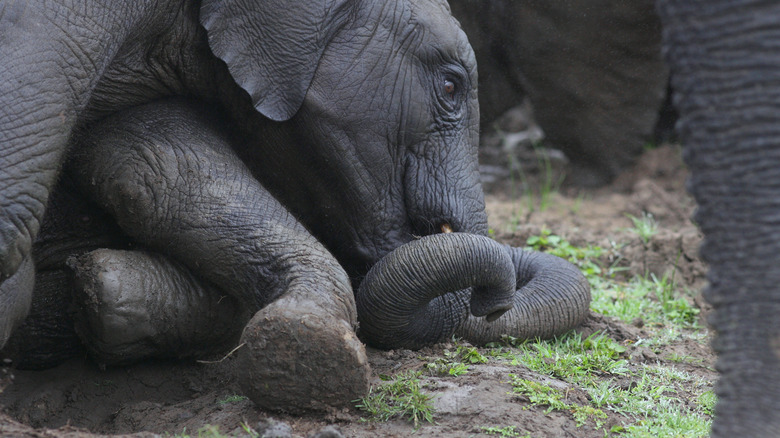
We humans are always on the hunt for signs of intelligence among other species. But such a characteristic is hard to quantify — even goldfish may be brainier than we thought. Yet, all metrics indicate that elephants are smart, especially when compared with our own cognitive skills. Elephants have displayed extraordinary memories (thus birthing the idiom "a memory like an elephant"). They've also shown the ability to understand body language, distinguish between different languages, and even pick up paintbrushes to render self-portraits. It would be futile to argue against the intelligence of elephants.
Thus, the burial rituals of elephants are unlikely to be pure coincidence. Based on observations of elephant intelligence, it's probable that elephants do indeed seek to bury their relatives according to the same motivations as human beings. Nonetheless, we must be careful to avoid anthropomorphizing the behaviors of other species. As pointed out by critics of the report, the burials recorded in the Journal of Threatened Taxa lacked direct observation.
It's easy to jump to conclusions. We humans are apt to latch onto signs that other organisms share our knack for empathy, and it's possible that our conclusions about the social behaviors of elephants are hasty. Still, elephants have been observed carrying their dead offspring for miles, so it's not far-fetched to conclude that the massive herbivores might seek to intern their dead with ritualistic honors. After all, our own origins are questionable, and other animal species might hold a similar reverence for the circle of life as we.