

Here's What Could Happen To Our Solar System After The Sun's Fiery Death
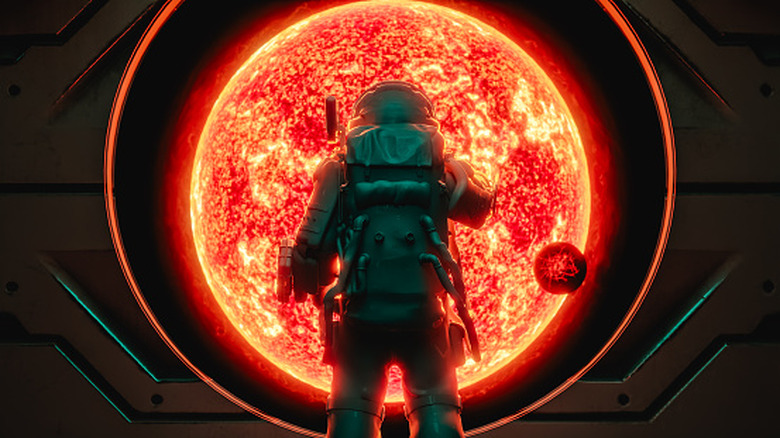
Despite what human history suggests, the sun was not always as it is, nor will it remain as it is now forever. In fact, in a few billion years, the sun as we know it today will cease to exist, and in its place will be a husk of a star, bereft of most of its mass, slowly cooling over billions of years. But what about the planets it leaves behind — what happens to them? Well, some will be lost, and others will slowly drift away, but there's a lot of uncertainty.
To explain the ultimate fate of our solar system, it helps to have a broad idea of the life cycle of a star. Stars form when a cloud of gas (mostly hydrogen) is pulled together by gravity. Eventually, the hydrogen in the core is compressed to the point where the atoms begin to fuse together into helium, releasing massive amounts of energy, pushing out against the crush of gravity and bathing us in light and warmth.
Eventually — typically after billions of years — a star runs out of hydrogen in its core, which signals the beginning of the end of its life. With the outward pressure of fusion gone, the helium core contracts, raising the temperature and internal pressure of the star, causing it expand. The extra heat also causes any remaining hydrogen around the core to begin fusing, increasing the outward pressure even more. This is the beginning of the sun's red giant phase, and when things get interesting for the solar system.
What happens when the sun turns into a red giant?
It's called a red giant for a reason. The added outward pressure inside the star causes it to expand to up to over 1,000 times its previous size, and as it expands, the surface of the growing star cools, changing its color to red. Our sun won't reach that 1,000-fold threshold, but it will certainly consume Mercury and Venus, and probably Earth. This period of stellar inflation will take about a billion years, so it's not something that will sneak up on you.
Meanwhile, in the heart of the dying sun, the pressure and heat continue to rise until the now-helium core fuses into carbon in the space of few minutes. The energy released by this helium flash vaporizes the core, causing it to expand, leading to a precipitous loss in temperature, shrinking the sun back down to within the bounds of Mercury's orbit. But as the core once again coalesces, the temperature and pressure force the surface of the sun out into a second red giant phase and it glows with 3,000 times the luminosity of today.
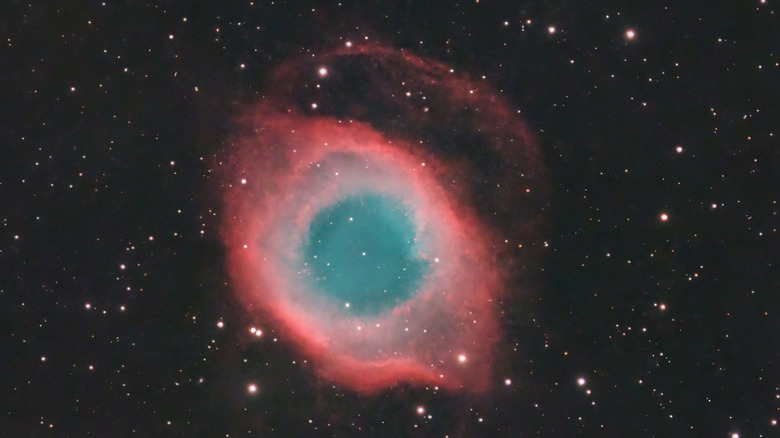
Eventually, over the course of half a million years, the sun will shed its outer layers — nearly half of its mass — into a huge cloud of stellar dust called a planetary nebula which will glow for a few thousand years before the remnant of the solar core runs out of fuel, transitioning to a white dwarf.
What happens to the solar system when the sun dies?
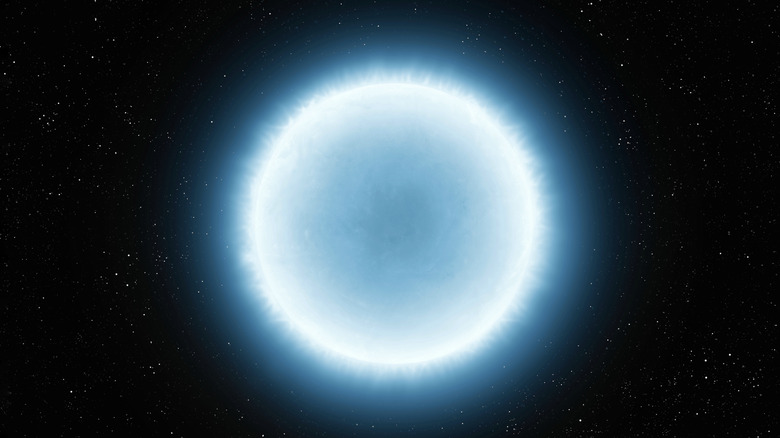
When the sun is just a white-hot remnant of its former glory, the solar system will be a very different place. Mercury, Venus, and Earth will be long gone, vaporized by the implacable expansion of the sun. Mars will likely be spared, but it and the outer planets will orbit the sun at about twice the distance they do now thanks to the mass lost in the transition to white dwarf.
As for the sun itself, it will spend the rest of its life slowly losing heat. All that will be left of it is an ultra-dense core of carbon and oxygen, the elemental ash of the sun's last helium burning fling. This leftover material is so dense that one cubic inch of it would weigh around 15 tons.
Eventually, the sun will die, cooling to the point where it no longer gives off life, transitioning to the hypothetical black dwarf phase of its life. The reason it's hypothetical is because no black dwarfs have been observed. In fact, it's estimated that there hasn't been enough time for a black dwarf to form anywhere. If you want to see one, you'll just have to wait for a few trillion more years.