

Scientists Didn't Expect This Part Of The Body To Stay Active After Death
Throughout human history, science has tried to answer whether an afterlife or reincarnation exists, but it seems doubtful that the limits of mortality will ever allow us to do so. However, a growing body of research has revealed a different type of life after death. As with all multicellular organisms, a human being is not a singular living thing, but rather a collective of living things housed within a common shell. There are roughly 30 trillion cells in the average human body, and they don't all die at the same moment. Certain body parts can survive for hours, or even days after your last breath, and some research suggests that your skin in particular could show signs of life well after you're in the grave..
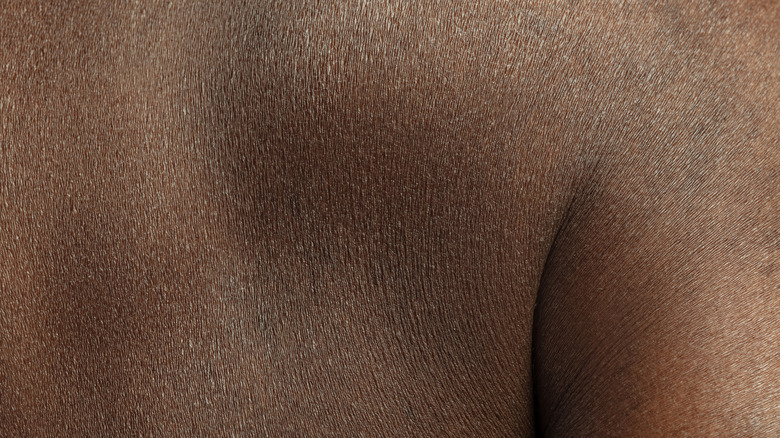
A study published in 2020 in the journal Scientific Reports revealed that at cold temperatures, some of the cells in human skin can remain active for as long as 32 days after their host has died. Researchers studied cadavers preserved between 4–6 degrees Celsius (approximately 39–43 degrees Fahrenheit) and found that the state of the skin continues to change long after the vital internal organs have ceased functioning. In fact, although the body turns cold within hours of death, the cells of the epidermis and hair follicles don't actually show any change until three and a half days after death. It takes about 20 days for most skin cells to die out, and the sweat glands can remain active for as long as 32 days.
The body parts that outlive us
Different organs in the body die at different rates depending on their function and resilience. The brain, heart, and nerve cells die within minutes of the last breath, as they require a constant stream of oxygenated blood to function. The liver, kidneys, and pancreas also go rapidly, failing within an hour of death. Other parts hang on much longer. The last of the internal organs to die are in the reproductive system — the prostate or uterus depending on the individual — but other tissues in the body live beyond that.
The skin takes a particularly long time to decay because its cells demand very little energy supply. Also at play here are fibroblasts, the primary cells in connective tissue, which play a major role in repairing damaged skin cells. Fibroblasts can maintain cell-to-cell communication even after their host has died, as if they are completely oblivious to the change.
Some parts of the body even increase their activity after death, albeit, for a limited time only. Certain types of gene transcription escalate in the hours and days following death, including genes linked to inflammation and stress. The same goes for genes typically associated with embryonic development, which means that after death, some cells in our bodies return to their prenatal states. It is only a temporary spike in activity, however, as are all postmortem cellular activities. Death cuts the whole body's power supply off, and eventually, even the least energy-consuming parts of it go out.