

Scientists Say 'Cloud-9' Discovery Could Unlock Secrets About The Dark Universe
Space is vast and filled with mysteries we have yet to unravel. One of the biggest mysteries we still can't explain is dark matter, the unseen glue holding galaxies together that makes up around 80% of all the matter in the universe, the other 20% being the stuff you're used to (stars, planets, bicycles). The problem with dark matter (which could have blasted a hole in the Milky Way) is that it's really hard to study because, for all intents and purposes, it's invisible, but we can infer its existence based on the behavior of the matter we can see. And thanks to a cloud of hydrogen gas we found 14 million light-years away, we might begin to be able to unlock some of dark matter's secrets.
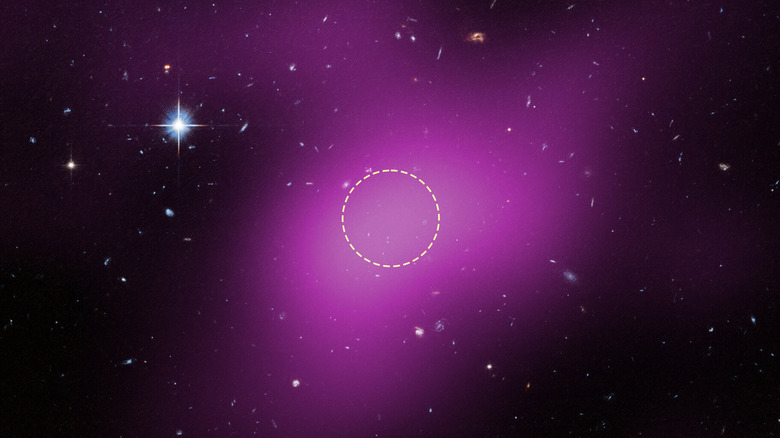
The intriguing space object has been dubbed Cloud-9 — so named because it was the ninth cloud listed in a survey of the nearby M94 galaxy — and astronomers think it could be a rare class of celestial object known as a RELHIC, or reionization-limited H Ⅰ cloud. In plain English, it's basically a cloud of electrically neutral hydrogen (H Ⅰ) left over from the early days of the universe (a relic) that was never fully ionized by stellar radiation.
Cloud-9 is essentially a galaxy that never formed. It was first described in a 2023 paper in The Astrophysical Journal, and researchers speculated that it could be a dwarf galaxy or a then-theoretical RELHIC. To solve the mystery, an international team of scientists pointed Hubble at the cloud to take a closer look and didn't see anything. That lack of light (no stars) established that Cloud-9 was likely a RELHIC and not a small galaxy.
How do we know Cloud-9 has dark matter?
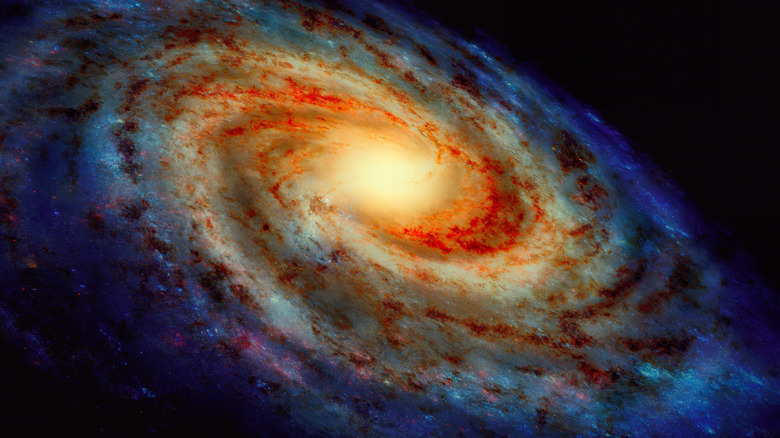
Dark matter was famously confirmed by Vera Rubin back in the 1970s. She looked at the rotation speed of the outer reaches of galaxies compared to the visible matter present, and showed that there was a lot of mass missing to account for how fast the outer regions were moving. But we can barely see Cloud-9, so how do we know what's there?
Based on the H Ⅰ observations, scientists know that the mass of the hydrogen is around a million times more than the sun. And given the distribution of the gas and its proximity to M94, there has to be something holding that cloud together, preventing it from dissipating into intergalactic space or being absorbed into M94. In order to account for these variables, that something has to be around 5 billion times the mass of the sun. Assuming the latest model of the universe is correct, that invisible something is dark matter.
So what does this new information about Cloud-9 actually tell us about the universe? First of all, it confirms some of the predictions of cosmologists, letting them know they're on the right theoretical track with their models of the universe. It also gives scientists insight into the mass required to kick off galaxy formation. With Cloud-9 essentially being a failed galaxy, we can infer that successful galaxies must have more mass than Cloud-9. Finally, much like a newly discovered class of black hole, Cloud-9 is unlike anything ever discovered, and that's remarkable all by itself.