

Why Scientists Say This Humanoid Robot Is 'Super Human'

Many science fiction fans envision a future with flying cars and robot maids. But now, China is close to releasing flying cars, and the robotics industry has already birthed humanoid robots. A "humanoid robot" is generally defined as one which resembles human beings physically, possessing a similar body shape and the ability to interact with our human-built world. But now it appears that Boston Dynamics has surpassed that definition altogether with its new Atlas robot design. With capabilities greater than humans, the Atlas robot is a "superhuman" humanoid.
Dr. Robert Playter, the CEO of the robotics engineering company Boston Dynamics, described the "superhuman" skills of the company's upgraded Atlas design in a January interview with 60 Minutes. Says Playter, "All of its joints can rotate a full 360 degrees ... That's beyond what you and I can do, and we think that's the way you should build robots: Don't limit yourself to what people can do, but actually go beyond." The video shows Atlas smoothly performing tasks at an auto factory line.
While the upgraded Atlas robot is certainly humanoid by definition — possessing autonomy, a head, torso, two arms, hands with fingers, and legs with bipedal locomotion — it's hard to see many human qualities in the machine. Videos of Atlas have shown it standing up from a laid down position by drawing its feet up to its midsection and pushing off the ground. Other times, it's shown rotating its torso or head a full 360 degrees with its feet planted in place. Clearly these skills have powerful applications for factory work and other manual tasks that humans do now, which is supposedly the main goal behind Boston Dynamics' creations. But whether a super-human robot like Atlas will eventually be adorned with human-like skin and soulful eyes is still an open question.
How a super human robot may surpass humans physically and intellectually
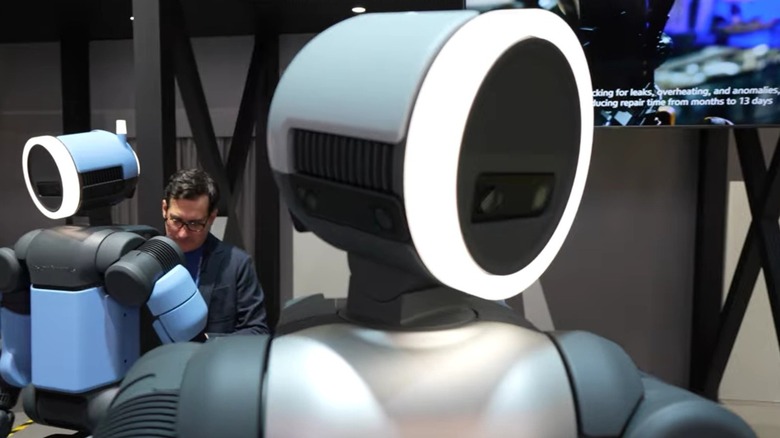
Atlas's super-human skillset is, for the moment, mostly physical. The engineers at Boston Dynamics made its extremely "dynamic" movement possible by eliminating the need for wires to run between joints. Its ability to rotate those joints a full 360 degrees and beyond gives it a physical leg up on human capabilities. But what separates Atlas from a highly advanced piece of factory equipment is its ability to learn.
Atlas indeed has a brain, or at least a brain analog. Composed of cutting-edge microchips and software, Atlas' neurology allows it to find the most efficient ways to perform repeated tasks in what can only be described as machine learning. For example, when an operator controls Atlas' movements remotely to perform a task, the robot soon figures out the goal of the task and, with experience, learns to perform it independently of human controllers — sometimes even more efficiently. Atlas even has tactile sensors in its 3-digit, dexterous hands that allow it to adapt to the materials that it handles, optimizing its grip strength and finger orientation for the optimal movement. The focus on practical applications is apparent, and so far, (thankfully) the Atlas robots haven't been installed with AI chat bots.
Yet, while Atlas is clearly capable of "learning," CEO Dr. Robert Playter admits that advancements in AI have outpaced advancements in robotics. Playter says, "While AI, while software, can sort of move ahead at super speeds, these are machines, and building reliable machines takes time." For the optimists, this may be disappointing. On the other hand, for those who fear the future fallout of "superhuman" robots with superhuman intelligence, such as Stephen Hawking did, perhaps delays in the robotic revolution are a good thing.