

Scientists Are Releasing Wasps Into US Forests — Here's Why
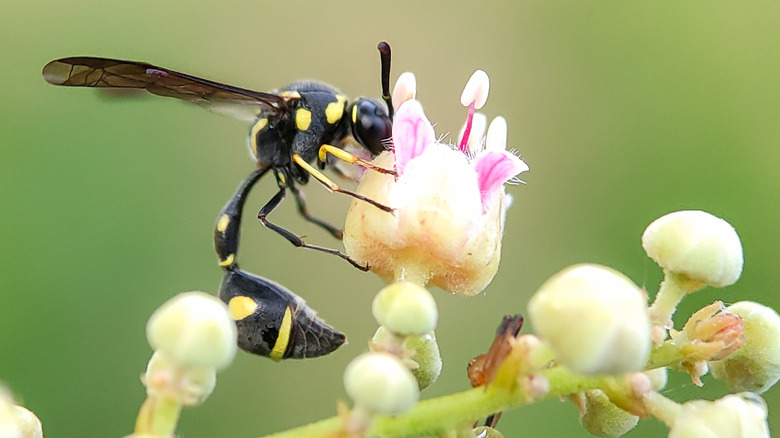
In 2025, conservationists in Oregon released more than 22,000 wasps into woodlands surrounding the Portland metro area. Unleashing an insect swarm upon your land may sound like a baffling move, but this same scene played out in New York, Minnesota, Vermont, and more than 30 other states. In some parts of the country, this has been happening for a decade, and yet, this is probably the first time you're hearing about it. That's because the types of wasps being released are so small you can hardly see them, and they don't have the power to sting anybody. What they can do, remarkably well in fact, is fight one of the world's most destructive invasive species.
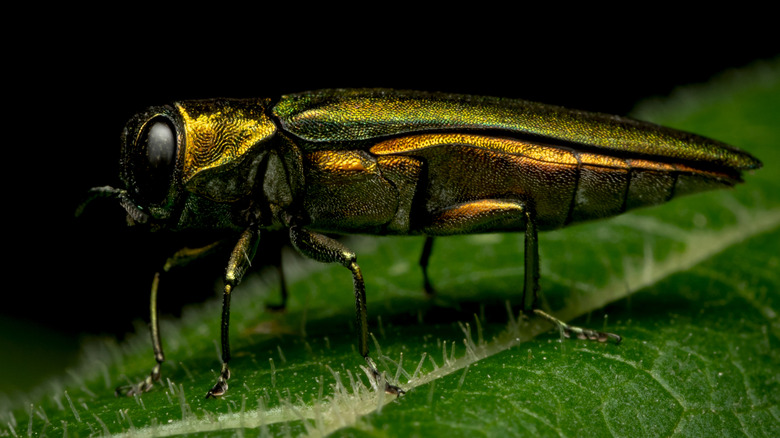
The emerald ash borer (Agrilus planipennis) is a glittering green beetle roughly half an inch long. It is native to northeast Asia, where it can be found in north China, east Russia, Japan, and the Korean Peninsula. However, in 2002, emerald ash borers were discovered near Detroit, Michigan, assumed to have accidentally escaped Asia in wood packing materials. In the two decades since, emerald ash borers have spread to 37 states and counting. They lay their eggs on the bark of ash trees, and when the larvae emerge, they proceed to devour their way through the wood. This has led to the deaths of hundreds of millions of ash trees in both the U.S. and Canada, and efforts to quarantine the species have failed. Now, conservationists want wasps to hunt the ash borers down.
Who can defeat the emerald ash borer?
In their northeast Asian homeland, emerald ash borer populations are kept in check by several species of parasitoid wasps. Parasitoidism is an especially gruesome form of parasitism in which an insect lays its eggs on or near a host species. When the larvae hatch, they infest the host and devour it from within. The wasp species that naturally prey on emerald ash borers aren't native to North America, so conservationists have begun importing them and releasing them into the wild.
Fighting an invasive species by introducing more invasive species sounds risky at first, but parasitoids are by nature extremely picky, only capable of feeding on specific host species. The wasps being released into U.S. forests now only attack emerald ash borers, which makes them very effective pest control agents.
Four wasp species have been approved for release in America. They are Oobius agrili, Spathius agrili, Tetrastichus planipennisi, and Spathius galinae. The first three are native to China, but S. galinae is native to Russia, making it particularly useful for deployment in colder regions such as the Great Lakes and Canada. In their native homes, these wasps are extremely effective at keeping emerald ash borer populations under control, especially S. agrili, which kills as many as 90% of emerald ash borer larvae around the Beijing area. The USDA has set up facilities for breeding these parasitoid wasps, producing more than half a million of them during 2020 alone.
Saving America's ash trees takes a creative approach

The deployment of parasitoid wasps in the fight against emerald ash borers has yielded some promising results. Three years after first being introduced to Massachusetts, Connecticut, and New York, S. galinae had parasitized up to 78% of local emerald ash borer populations. Unfortunately, the emerald ash borer has continued to expand its range across the U.S., so scientists have had to find other creative ways to preserve the nation's ash trees.
Although the emerald ash borer is an invasive species and thus has no natural predators in the Americas, one local animal has developed a taste for them: the woodpecker. There are an estimated 17 woodpecker species spread across the U.S., which feed on insects and insect larvae that live beneath tree bark. Woodpeckers are highly adept at digging emerald ash borer larvae out of infested trees, and have developed into a helpful predator. The presence of woodpecker marks on ash trees is also a useful marker for scientists to identify trees under attack.
Meanwhile, other scientists are hoping to defeat the emerald ash borer by breeding extra-resilient trees. Only around 1% of ash trees have been found to resist the invasive larvae, but selectively breeding from these trees could pave the way for restoring the ash forests that are being destroyed. Several groups, including the Nature Conservancy, have announced tree-breeding programs, but they will take years to yield results. Meanwhile, be thankful for the thousands of little wasps fighting for our forests.