

Here's What A Fireball Looks Like Tearing Through The Sky (And The Science Behind It)
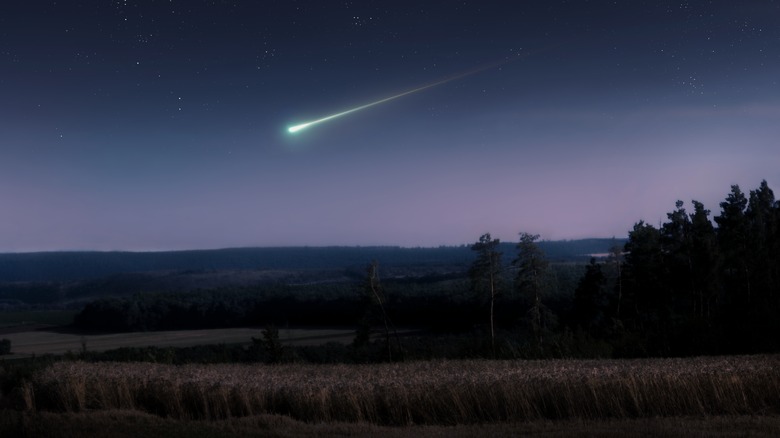
2026 is off to one heck of a start. The news is enough to give any person heart palpitations, and now there's fire raining from the sky? That's what a video captured near Los Angeles on January 10 appears to show. Local news station ABC7 posted footage of the phenomenon, showing a flickering white clump of flames streaking across the night sky. At first, there were some doubts that it might be a rocket launch or yet another Starlink satellite falling out of orbit, but the American Meteor Society soon confirmed that it was indeed a fireball.
A fireball is a special type of meteor that shines brighter than any star in the night sky. The brightness of an astronomical object can be measured in stellar magnitude, a scale on which lower numbers mean brighter objects. The sun, the brightest object in the sky, has a stellar magnitude of -26.7, while the faintest stars visible with the naked eye have a stellar magnitude around +7. Fireballs are difficult to measure because they last mere seconds, but they generally fall into the stellar magnitude range of -5 to -10. This makes them brighter than Venus at its maximum (a magnitude of -4.6) and considerably brighter than the brightest star in the night sky, which is Sirius (a magnitude of -1.46). Some fireballs can even exceed the brightness of the full moon (magnitude -13), though these are the rarest of the rare.
How fireballs are created
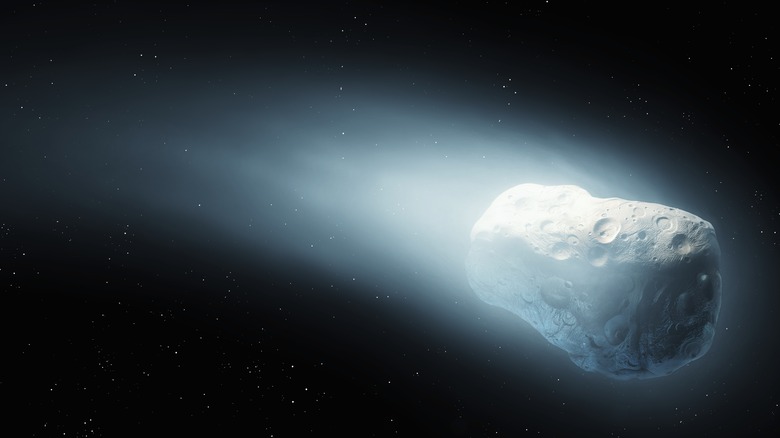
There's a lot of debris floating around in space — bits and pieces of rock and metal chipped off of comets and asteroids — and when a piece of it enters Earth's atmosphere, it becomes a meteor. What we perceive as "shooting stars" are really meteors burning up as they fall. Incinerating meteors is one of the main ways in which Earth's atmosphere protects life below; otherwise, we'd all be killed by tons of metal raining down on us at supersonic speeds. Most meteors are actually very small objects, the size of grains of sand or pebbles, but it takes something bigger to make a fireball.
For a meteor to burn bright enough to count as a fireball, it needs to be roughly the size of a baseball at the very least. The largest fireballs, those whose luminosity can rival the full moon's, come from meteors the size of cars. Sometimes, fireballs even explode in mid-flight, in which case they are technically known as bolides.
If a meteor crashes to the ground, it becomes a meteorite, but most meteors are so small that they incinerate completely in the atmosphere. Fireballs, however, are large enough that in many cases, some fragments will survive the journey down to the ground (though rarely the object as a whole). When fireballs are sighted, it often prompts a nearby hunt for meteorites, which can reveal important information about stellar objects. Such finds are considered rare, even though fireballs actually occur quite frequently.
Fireballs are more common than you think
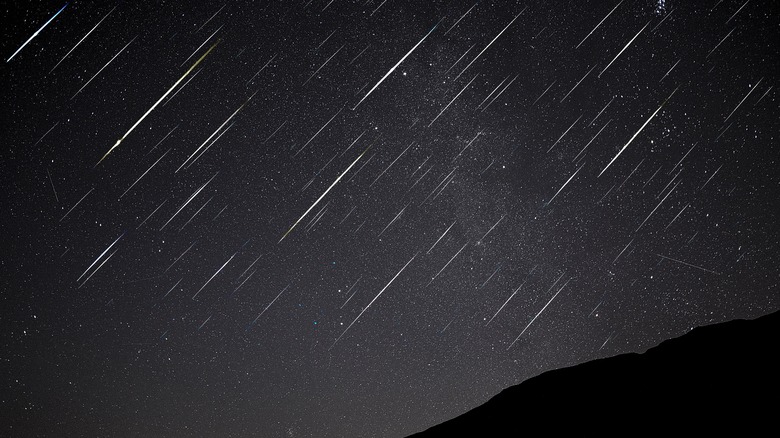
Fireballs and meteor showers stir up a lot of excitement in the news, but they actually occur every single day. You'd be shocked by the amount of space debris that enters Earth's atmosphere every day. It's raining cats and dogs up there, or rather, satellites and meteors. Fireballs are uncommon amongst meteors as a whole, and yet still, thousands of them rain down on Earth every single day. However, just because fireballs are falling doesn't mean we can see them. During the day, they are obscured by the sun, and most fall over the ocean, which accounts for nearly three-quarters of the planet's surface area. Even when a fireball does fall in your area, you have to be looking at just the right spot in the sky and at just the right time, because they rarely last more than five seconds. So, even though fireballs are an exceedingly common occurrence, actually witnessing one can be a once-in-a-lifetime experience.
Even when you can't set eyes on a fireball, you might be able to hear it. Fireballs aren't just big, they're also really, really fast. Meteors can reach speeds exceeding 100,000 miles per hour when they enter the atmosphere, and even though the descent slows them down considerably, fireballs can still exceed the 760 miles per hour as they near the ground. This triggers a sonic boom, although it usually won't reach your ears until a few minutes after the fireball has passed.