

What Science Says About The Largest Solar Radiation Storm In 20 Years
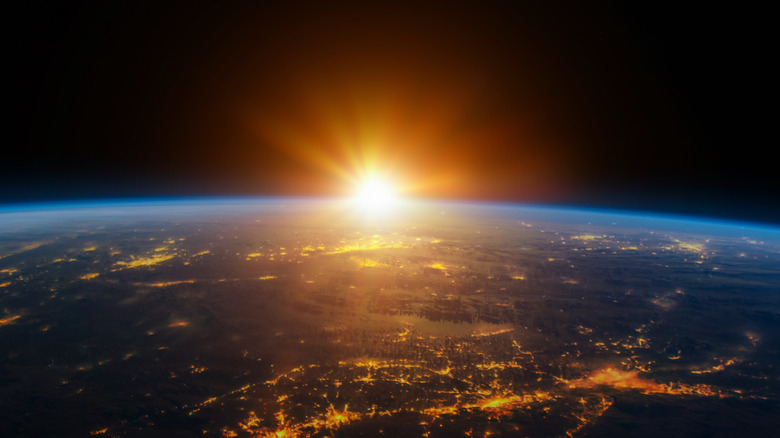
The year 2026 kicked off with a celestial bang. In mid-January, the sun blasted the Earth with the fallout of an intense solar storm. The resulting geomagnetic blast wave sent colorful auroras dancing across the world as far south as Colorado and in 23 other U.S. states. But while the geomagnetic storm resulted in colorful dancing bands of light for sky watchers, another invisible storm was simultaneously raging over the planet. The solar storm also delivered a wave of super-charged particles, which washed over the planet in what experts have described as the most powerful solar radiation storm of the past 20 years.
In October of 2003, a similar solar storm spread fears across the world (just in time for Halloween). NASA ranks solar storms in order of energy intensity, denoted by the classes A, B, C, M, and X — the most powerful. That "Halloween storm" reached X45, which was strong enough to send astronauts on the International Space Station into shielded shelters, completely disable a newly-launched Japanese satellite, blow out detectors, and disrupt GPS communications in various places across the globe.
The current solar radiation storm has also reached "X-Class" status, making it "the largest solar radiation storm" since the 2003 Halloween storm, according to the NOAA Space Weather Prediction Center (SWPC). Rated at X1.9, it's not quite strong enough to knock out Japanese satellites. However, the SWPC also has a ranking system to predict the amount of damage a solar storm will do. Based on its S1-to-S5 scale, the SWPC places the current storm at an S4, which comes with the following risks: astronauts and people in high-flying aircraft may have heightened radiation exposure; satellites may experience imaging and memory system disruptions; and solar panels may have reduced efficiency. All told, the risks aren't apocalyptic.
Why we're safe on the ground in the face of a severe S4 solar storm
The S4 ranking of the current radiation storm isn't cause for alarm among us terrestrial inhabitants. Although an S4 rating is considered "severe," with the aforementioned risks to astronauts and high-flying aircraft, the majority of earthlings are safe. Both geomagnetic and radiation storms are deflected by Earth's magnetic field, which block most solar winds from reaching the surface of the Earth. At the worst, such solar activity leads to disruptions in GPS and satellite-based communications.
The sun's weather follows an 11-year cycle, in which activity on its surface waxes and wanes. About every 11 years, the sun's magnetic field reverses direction, which results in predictable changes in its activity. For instance, in August and September of 2025, the current cycle hit its peak. As the sun's magnetic poles shift direction, more frequent flares and coronal mass ejections can be expected, which blast satellites, such as Starlink satellites, out of orbit. This explains the recent intensity of solar storms, though it's difficult to accurately predict just how powerful each of the sun's outbursts directed toward our planet will be.
Of course, forecasts are based on guesswork. Each time the sun's shifting magnetic field triggers violent changes on its surface, it increases the risk of producing devastating solar winds strong enough to disrupt navigation, radio communications, and other space-based technology. For instance, the hypothetical S5 ranking of solar storms brings with it the following risks: "Satellites may be rendered useless, memory impacts can cause loss of control, may cause serious noise in image data, star-trackers may be unable to locate sources; permanent damage to solar panels possible." Thus, notable disruptions to our terrestrial lives are certainly possible — though only time will tell.