

The 'Useless' Body Part That Can Explain Why Humans Get Leg Pain

Studies in anatomy prioritize focus on the vital organs, including those than can regenerate — obviously a sensible move — but arguably the most fascinating body parts are the nonvital ones. Vestigial body parts are features inherited from our distant evolutionary ancestors that no longer play a significant function in modern humans. These structures are often dismissed as insignificant, but just because a body part is no longer essential doesn't mean it can't have a noticeable impact on your life. Vestigial features explain why we get goosebumps and why some people can wiggle their ears. Their impacts are usually unserious, but one vestigial feature can cause serious pain. The plantaris muscle, located in the calf, isn't very big, but its low profile has made it an overlooked culprit in sports injuries.
The plantaris is perhaps the least well-known among the parts that make up the human leg because it is hidden within a much larger muscle mass. The plantaris begins at the back of the knee, just below the bottom of the femur, and connects to the heel via the long plantaris tendon. It is surrounded by the two main muscles of the calf, known as the gastrocnemius and the soleus. Due to this positioning, injury to the plantaris is often misinterpreted as coming from the larger calf muscles, or from the Achilles tendon. Fortunately, the plantaris presents far less of a medical problem than those other muscles, and you don't even need it to retain perfect function in your legs. That begs the question: Why do we have it?
The mysterious origins of the human plantaris
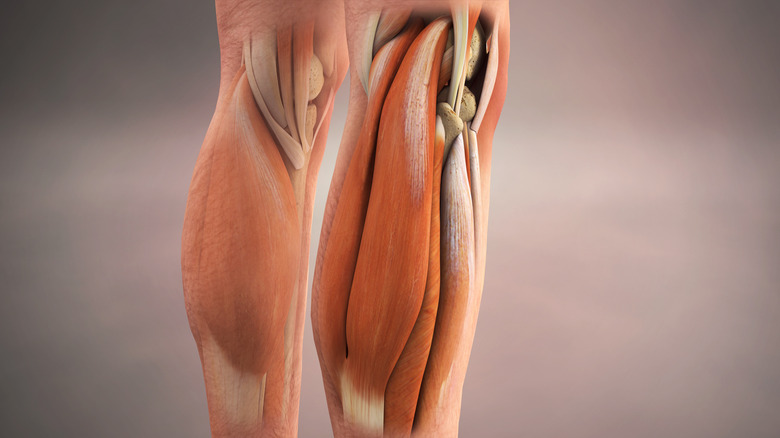
Considering that the plantaris performs no notable function, and its only impact seems to be causing us leg pain when it gets stretched the wrong way, many doctors and patients alike have wondered why this muscle even exists in the first place. As with other vestigial body parts, the answer lies somewhere in human evolutionary history. Not all mammals have a plantaris muscle — it is notably absent in most hoofed animals — but primates almost universally have the feature. The prevailing theory is that the plantaris muscles help tree-dwelling primates like spider monkeys, lemurs, and lorises get their footing on high branches. Although the plantaris doesn't play a role in modern human movements, it may be important for smaller ankle motions that tree-climbers need.
Millions of years ago, the evolutionary ancestors of humans lived in the trees, at which point the plantaris muscle was likely very important to us. Since descending from the world's canopies onto its ground, we've ceased to need it, but it lingers in the body as a remnant of our past. At least, it does for the time being, but evolution might gradually eliminate it from our physiology altogether. Roughly 10% of people today are born without a plantaris muscle, and it doesn't present any obstacle in their lives. However, some researchers have questioned whether the plantaris is really vestigial because, despite our ability to get by without it, it does have a lot of value from a medical perspective.
The plantaris has a surprising medical significance

The plantaris doesn't gain the wide recognition of eye-popping muscles like the biceps and pectorals, but it is well-known in the field of medicine – particularly sports medicine. Sudden ankle movements, such as landing a jump or pivoting the foot, can tear either the plantaris muscle or its tendon. A torn plantaris can feel a lot like a torn Achilles tendon, a pain athletes often liken to a hard kick to the back of the leg. Many plantaris tears are initially assumed to be Achilles tears, one of the worst injuries an athlete can suffer. However, a plantaris tear is not nearly as bad because the muscle isn't essential. It doesn't even require surgery, although it will likely be quite painful temporarily.
The plantaris tendon is notable for being the longest tendon in the human body. However, it is so thin that new medical students in training often mistake it for a nerve, earning it the playful moniker of "freshman's nerve." Though historically dismissed as useless, the plantaris tendon has gained new purpose in modern medicine due to its usefulness in tendon repairs and transplants. The plantaris tendon is always proportional to a person's height and leg length regardless of gender or age, making it a suitable graft candidate for any patient. The fact that the plantaris is "useless" is actually its biggest advantage from a medical standpoint because the tendon can be removed without causing any problems.