

How A Scientist Accidentally Killed A 5,000-Year-Old Tree
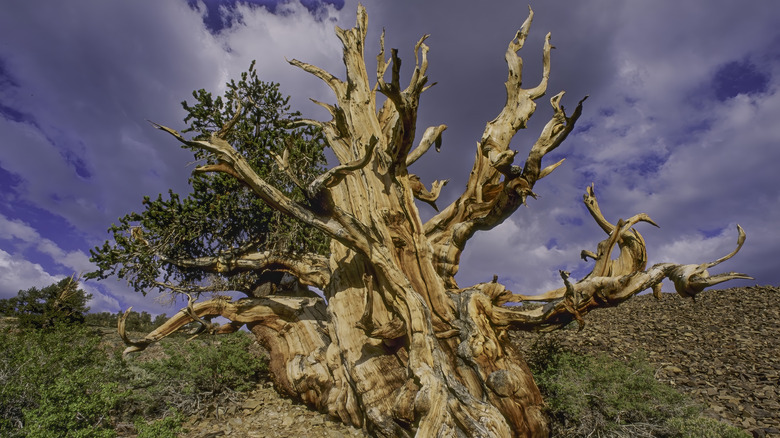
If you think you've ever messed up badly at your job, consider the case of Donald Rusk Currey. In 1964, the young graduate student of the University of North Carolina at Chapel Hill was studying the past climate by sampling the inner rings of trees. His research took him to Nevada's Wheeler Peak mountain, where he searched for trees that were old enough to have lived during the Little Ice Age period, which occurred around 700 to 150 years ago. Finding one particularly gnarled and old-looking pine tree, Currey chopped it down. But when it came to determining how ancient the tree was, Currey wouldn't learn until he counted the rings.
Returning to his hotel room, Currey pored over a cross section of the tree with a magnifying glass, counting its rings to determine its age. As the number mounted from 100 to 1,000 to 3,000 and beyond, his heart may have sunk. All told, Currey counted 4,862 rings, making it the oldest (non-clonal) organism ever recorded at the time. Certainly, he had found a tree worthy of his research, plus several extra millennia in age.
The story is sad for several reasons. For one, Currey had full permission from the local Forest Service to chop down the tree, so the gravity of his mistake fell entirely on his shoulders. Plus, it's not clear if Currey had intended to chop the tree down to begin with. Some sources claim that his methodology was to collect core samples, not entire cross-sections, and that Currey only chopped down the tree when his drill bit got stuck inside the trunk. But sadder still is how the event reveals a paradox in scientific inquiry; in the words of J.R.R. Tolkien, "He that breaks a thing to find out what it is, has left the path of wisdom."
Prometheus: The ancient tree left behind
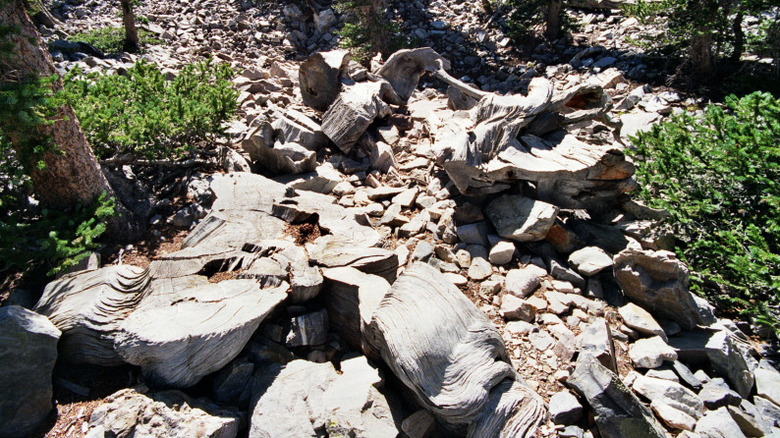
The tree Donald Currey had chopped down, later nicknamed "Prometheus," was a Bristlecone pine tree from the Great Basin National Park in Nevada. Bristlecone pines are uniquely slow growers, an adaptation to the harsh climate of the region. Consequently, they can live for thousands of years, without ever gaining much height. Most grow to somewhere over 50 feet in height, with wide girths and twisted, sparsely-needled branches. Thus, some people may be apt to forgive Currey — Prometheus was big, but not so big as to hint at its ancient age.
At the time, Prometheus was the oldest non-clonal organism ever identified, but the oldest organism on Earth is actually a forest of cloned quaking Aspen trees in Utah. The colony is called Pando, and its root system is estimated to be approximately 14,000 years old. However, determining the age of a root system is difficult, since the actual stems, or individual Aspen trees, in Pando only live to about 130 years. With no rings to count, it's hard to even define an age for a clonal colony like Pando.
Currey has since passed on, but he may have been relieved to learn that in 2012, another Bristlecone pine was awarded the crown of the oldest non-clonal tree, at 5,065 years old. And in the East China Sea, researchers have discovered a glass sponge, one of the most indestructible organisms, that appears to be far older. By comparing the layers of the sponge's body with the climatic history of the region, scientists can determine how many ages the creature lived through. Combining this technique with radiocarbon dating, the researchers estimate the East China Sea glass sponge to have an age of approximately 11,000 years. That makes Prometheus seem like a young sapling.