

Scientists Don't Quite Believe What Happened To California's Joshua Trees
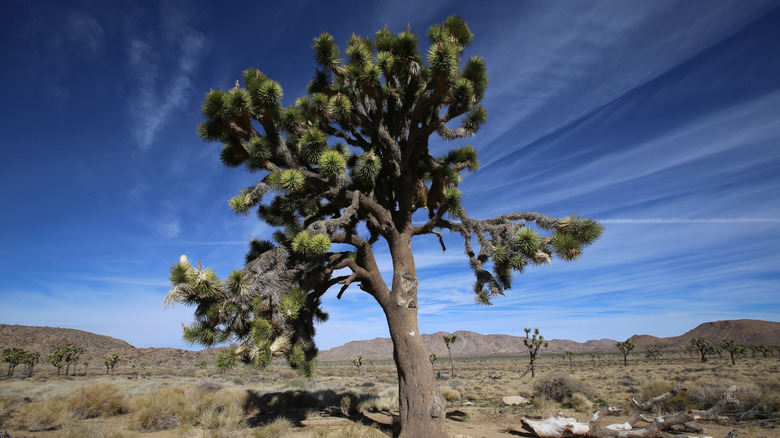
One of nature's most beautiful displays is when a tree or a flower goes into bloom. It's a vibrant reminder that life not only persists, but it does so in style. But the blossoming of flowers often depends on pollinators for a plant to successfully reproduce, so when plants and the insects that pollinate them are out of sync, the plants may miss out on their chance to reproduce for that season. That's what's currently happening to Joshua trees in California which bloomed three months early.
To make sense of why an early bloom is bad for the Joshua tree, you first have to understand its life cycle. Joshua trees, one of America's most famous desert plants, are capable of asexual reproduction, but their sexual reproductive life cycle begins when they flower, usually between February and May. The flowers of the Joshua tree can only be pollinated by two species of yucca moths, which emerge from their cocoons when the flowers usually blossom and only lay their eggs in the seed pods of the trees' flowers. When the eggs hatch, they feed on the fertilized seeds before dropping to the ground, building a cocoon, and waiting to emerge the next season.
You can see why the out-of-season blossoming is a problem — the timing for this symbiotic relationship can't really work. Making matters worse, no one is really sure what triggers the Joshua trees to flower, nor what triggers the yucca moths to emerge from their cocoons, leaving scientists and observers helpless in the face of this bout of bad luck.
Harnessing citizen science to help the Joshua trees
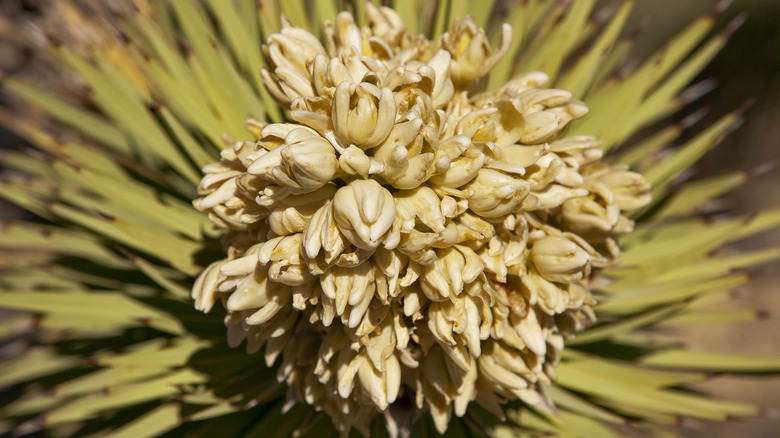
Even though we don't know what triggered this early bloom from the Joshua trees, some researchers have attributed it to a cool, dry year with intense rainfalls that hit the region in November 2025. It's not settled science, but there's research that indicates this was the cause of the previous anomalous bloom in 2018.
To get to the bottom of this mystery, a team of scientists at California State University Northridge is asking the public for help. Specifically, they would like anyone living in or planning to visit the Mojave Desert to take pictures of any Joshua tree flowers or fruit they come across and upload the photos to the iNaturalist app on their smartphone.
The team from CSUN plans to take all these data points, compare them to known weather events, and feed it all into their machine-learning models to help them predict when the flowers will emerge in the future. Considering that the Joshua tree is already struggling to survive in the midst of climate change, and the fact that it doesn't flower every year, knowing when they will could be vital to protecting this iconic species.